

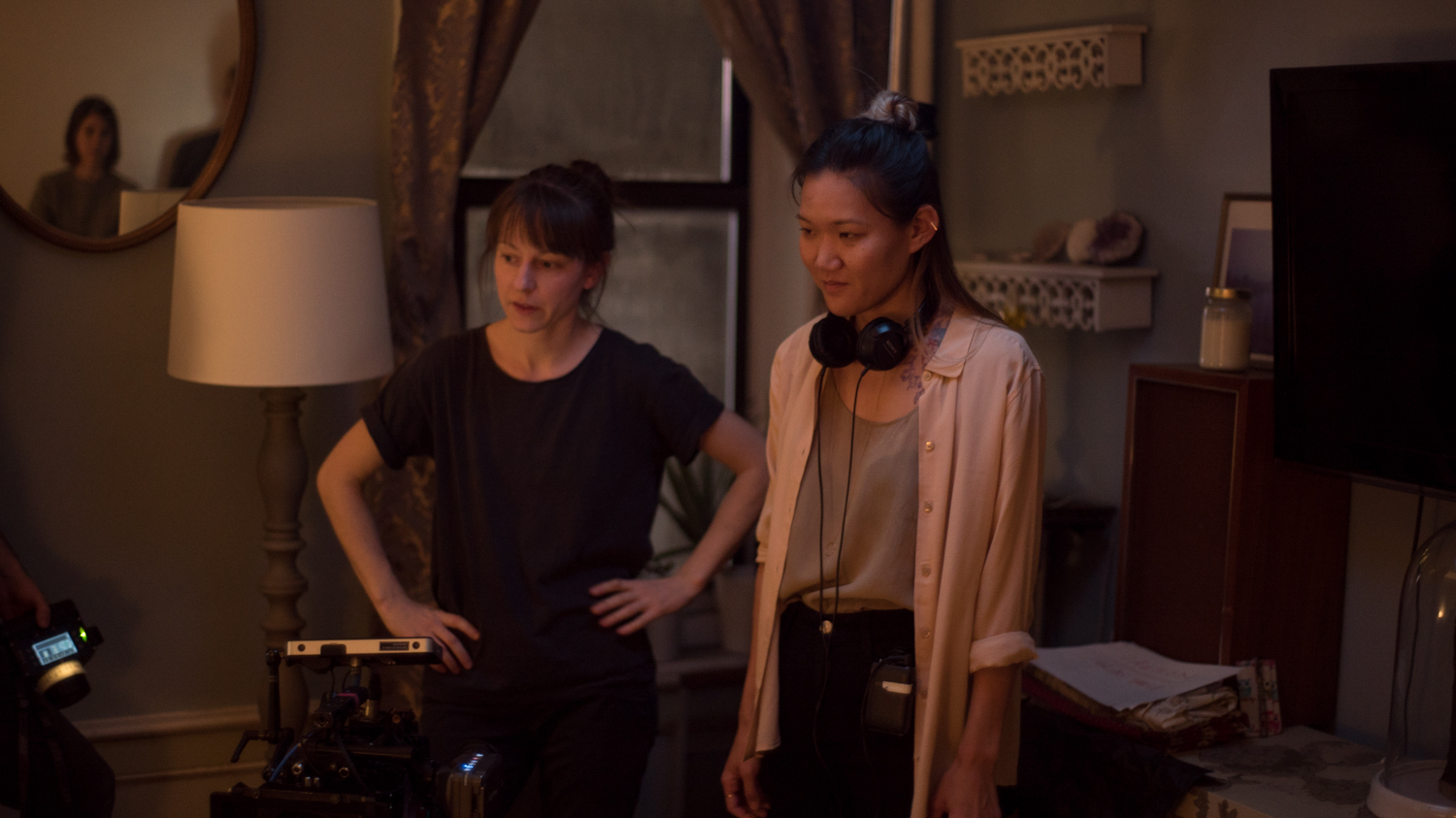
Director Tiffany Frances and DP Fletcher Wolfe. Photo credit by Ian Kammer.
From 2007 - 2017, women directed just 4% of Hollywood’s top-grossing 1,100 films. For every 22 male directors hired to helm a studio production, one female director was hired. This statistic reveals a troubling fact about our industry: female directors are finding far fewer career opportunities than their male counterparts.
Dr. Stacy L. Smith, a professor and researcher at the USC Annenberg School for Communication and Journalism, has spent her career studying gender and racial bias in media. Her 2017 report “Inclusion in the Director’s Chair?: Gender, Race, and Age of Directors across 1,100 Films from 2007-2017” sheds light on these issues through data and by examining the underlying causes and barriers perpetuating these stagnant numbers.
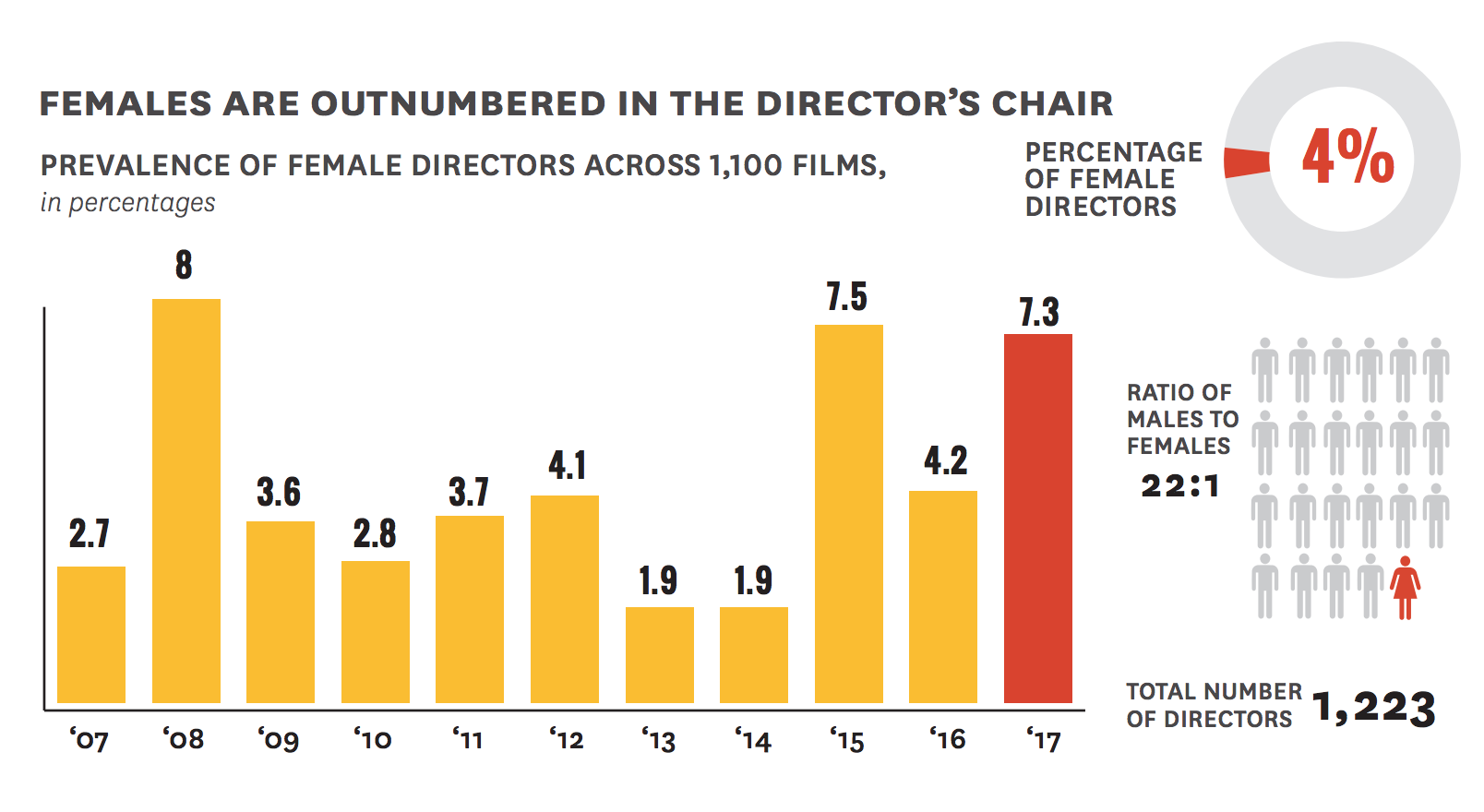
Figure 1. Prevalence of Female Directors Across 1,100 Films. Graph from Dr. Stacy L. Smith, et al., Inclusion in the Director’s Chair: Gender, Race, and Age of Directors Across 1,100 Films from 2007-2017, (2018), 1. Digital.
Despite increasing awareness and support for gender parity in Hollywood, the needle has barely moved in over a decade. The percentage of female directors working on studio films actually dropped between 2015 and 2017. The situation has grown so dire, in fact, that the ACLU and the U.S. Equal Employment Opportunity Commission opened an investigation into hiring practices across the studio system. More and more, people from around the industry have been using their individual platforms to raise awareness about these issues. Frances McDormand ignited a conversation around inclusion riders during her Oscars’ acceptance speech this year. And as the #MeToo movement continues to build momentum, our conversations at Tongal have turned increasingly self-reflective: How can we as a creative platform create a more equitable environment for female directors, producers, writers, animators to thrive? How can we play a larger role in launching the careers of underrepresented filmmakers?
For the purpose of this article, we’ll focus primarily on gender parity. While leveling the playing field to allow more creators to get in the game is an intrinsic part of the Tongal mission, we believe gender is a good starting point as we explore how Tongal can empower creators from all underrepresented backgrounds.
Like Smith, we started by analyzing the percent of female directors who have helmed open projects on our platform. Of the 1,483 open projects launched since 2012, female directors helmed 25%. For every 3.2 male directors selected for a project on Tongal, at least one female director was selected - a much higher batting average compared to the industry at large.
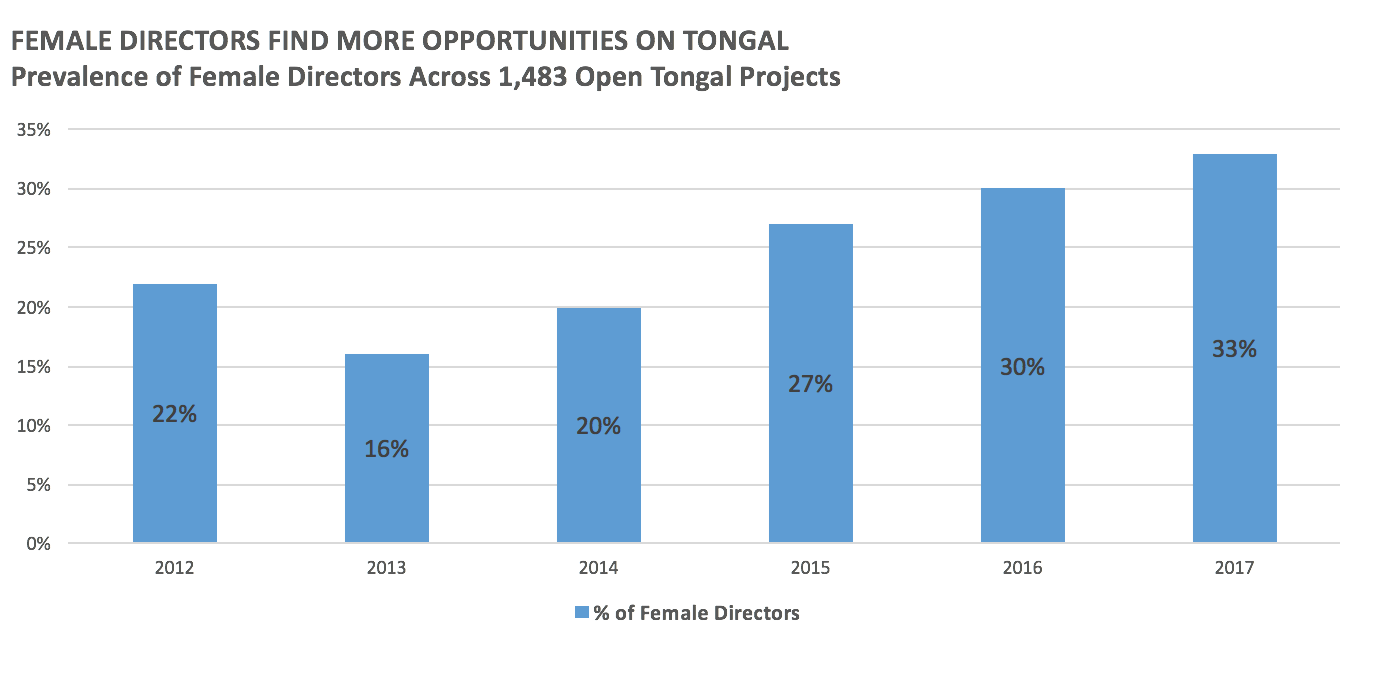
Figure 2.
The percent of female-directed projects has trended upwards in our community since 2013. If you add female producers to the mix, 41% of our productions have had at least one female creative lead.
Of course, directing a studio film marks a high point in a filmmaker’s career. What about those modest successes along the way - those smaller opportunities that pave the way to a filmmaker’s “big break”?
In order to understand the full scope of gender bias across our industry, we must examine the entire career pipeline, from independent features to episodic TV to big-budget studio productions. As women ascend the proverbial ladder in Hollywood, there are fewer opportunities for them at each level. Smith calls this the “fiscal cliff”, citing there's a 23% drop in employment for female directors from independent narrative films to studio films. The opposite is true for male directors; opportunities increase for men directing independent features (72.5%) to episodic television (83%) to motion pictures (95.7%).
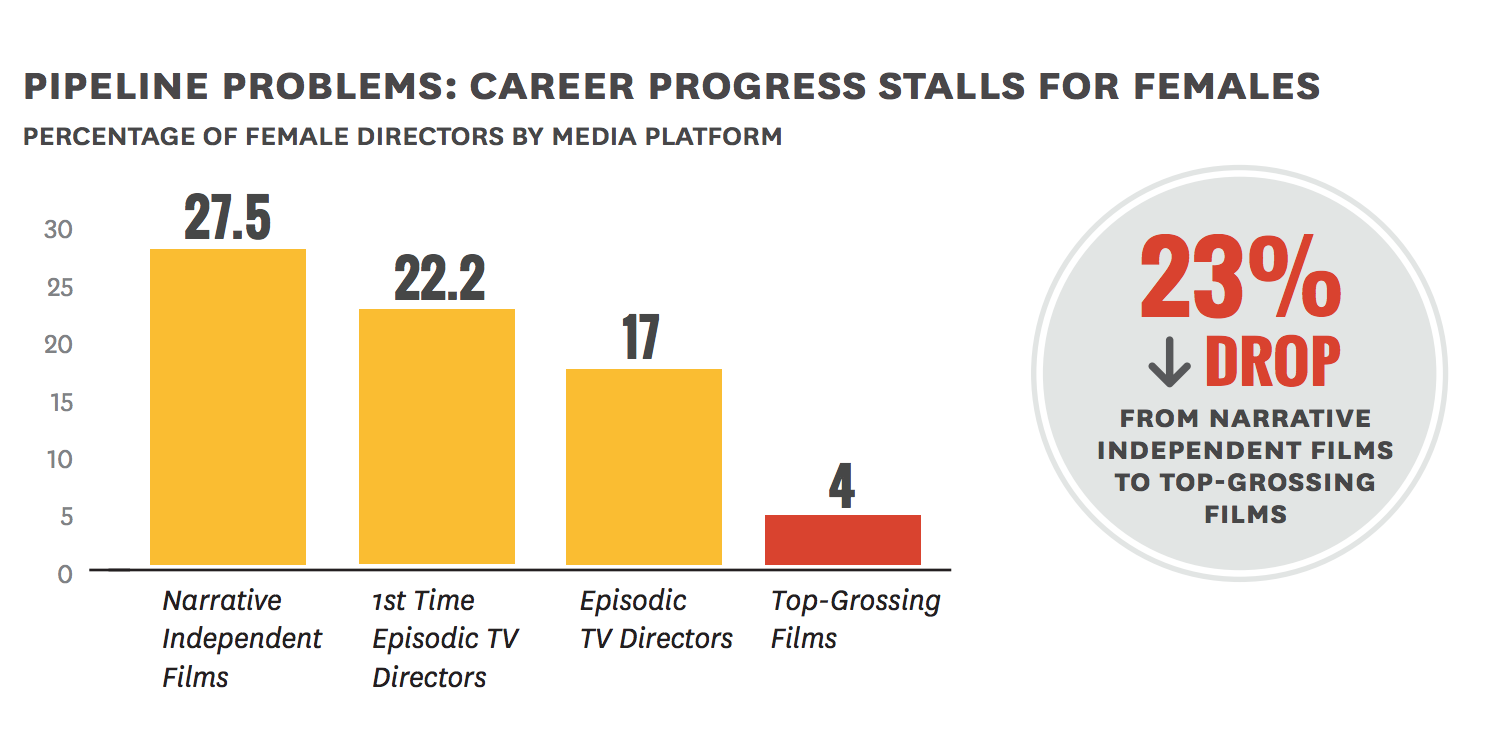
Figure 3. Percentage of Female Director by Media Platform. Graph from Dr. Stacy L. Smith, et al., Inclusion in the Director’s Chair: Gender, Race, and Age of Directors Across 1,100 Films from 2007-2017, (2018), 2. Digital.
Women in film have a much harder time getting their careers off the ground as well. The chart below shows that men are often granted significant opportunities much earlier in their careers, starting in their 20s, while female directors tend to build momentum later on in their careers - around their 30s and 40s - and have shorter career spans overall.
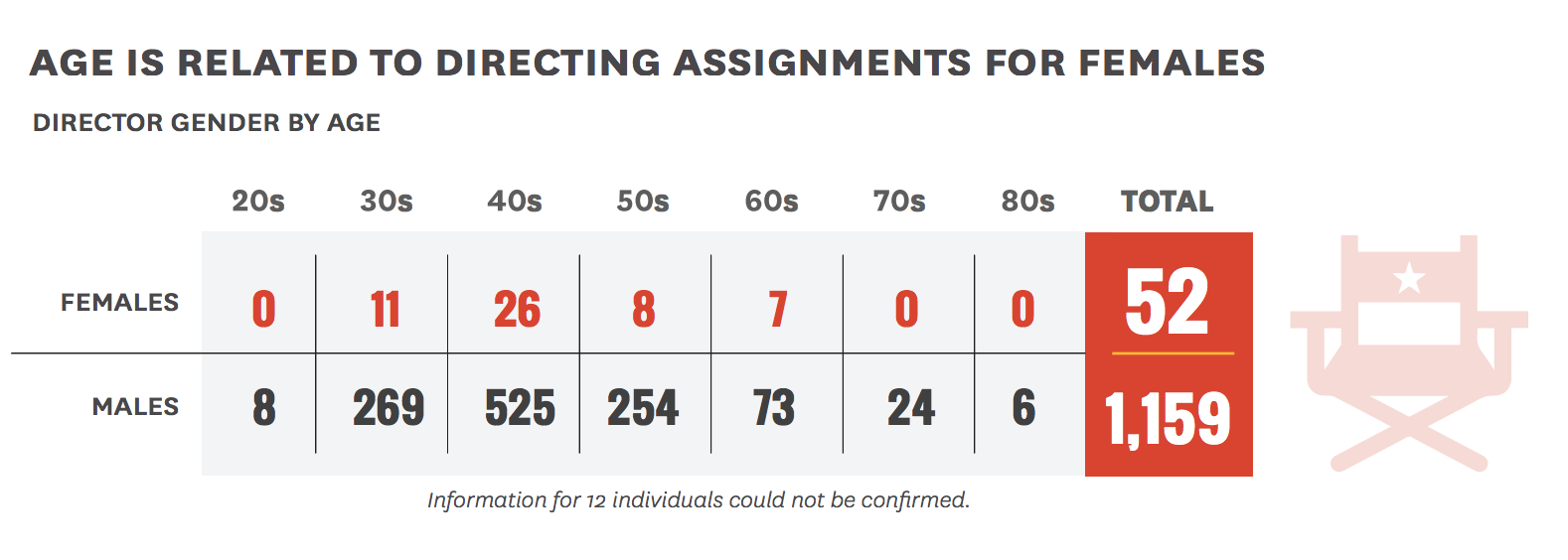
Figure 4. Director Gender by Age. Graph from Dr. Stacy L. Smith, et al., Inclusion in the Director’s Chair: Gender, Race, and Age of Directors Across 1,100 Films from 2007-2017, (2018), 2. Digital.
We wanted to see if this same phenomenon affected our own community by looking at the age of directors when they landed their first Video project on Tongal. We found that female directors achieved early career success on Tongal at the same rate as male directors do. They are also translating their success on Tongal into other industry opportunities.
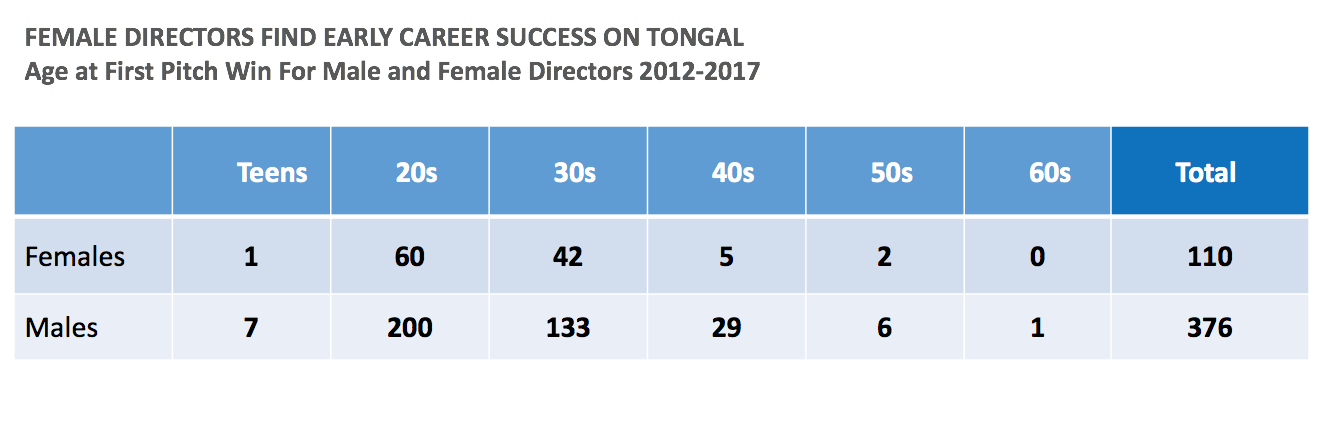
Figure 5.
We believe women achieve early success on Tongal because our model eliminates the barriers and usual gatekeepers women face throughout the process.
Another issue women face is trouble achieving career sustainability - the ability to find continual work in their chosen field. After directing a major studio film, female filmmakers often have trouble getting re-hired for other studio projects. Though the “one-and-done” phenomenon affects both genders, it disproportionately affects female directors. Between 2007 - 2017, men directed a range of 1 and 15 movies each, while women directed a range of 1 and 4 movies. Women were much more likely to direct just one film in this 10-year span.
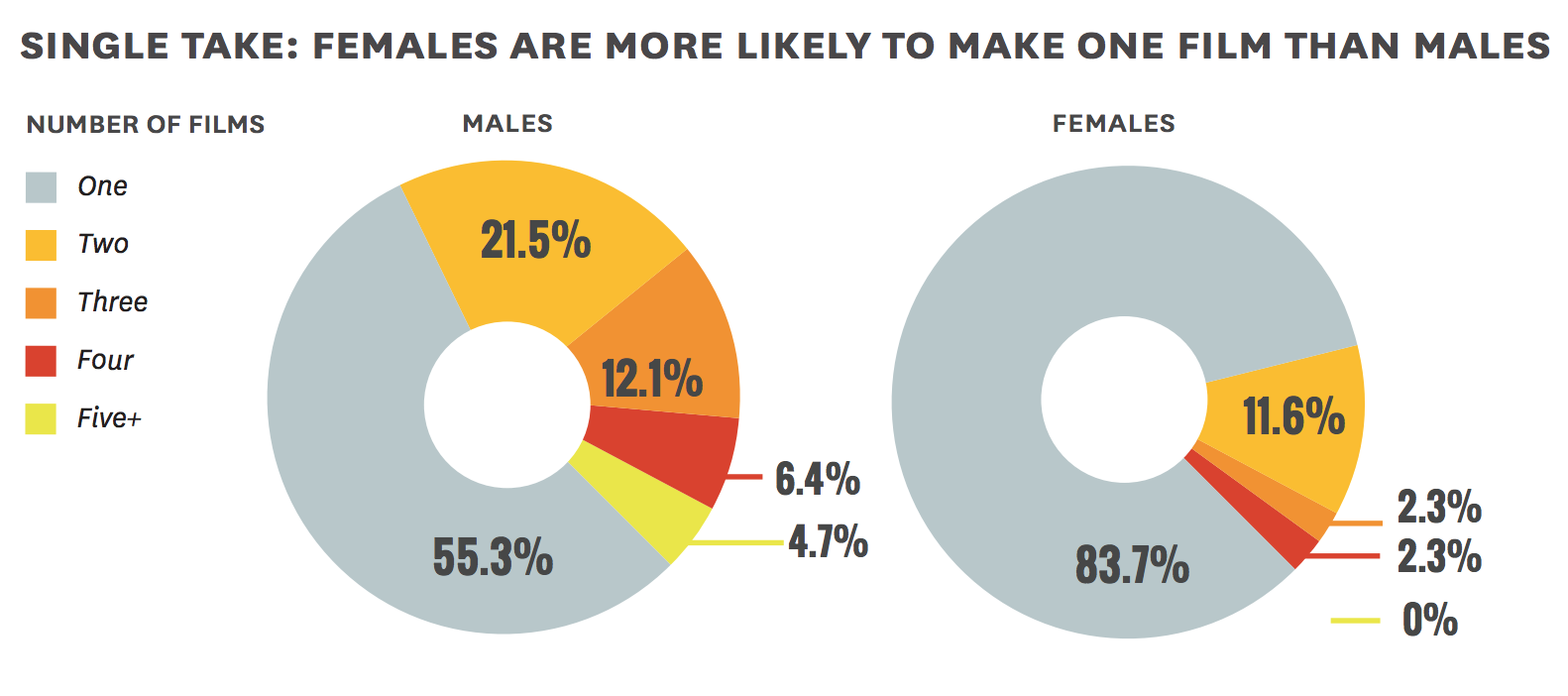
Figure 6. Prevalence of Females and Males Directing More Than One Studio Film. Graph from Dr. Stacy L. Smith, et al., Inclusion in the Director’s Chair: Gender, Race, and Age of Directors Across 1,100 Films from 2007-2017, (2018), 2. Digital.
Men are also about twice as likely to direct two films (21.5% vs. 11.6% ) and over five times as likely to direct three films (12.1% vs. 2.3%).
We looked at a similar stat across our own projects to see if women had a harder time landing multiple Video opportunities. Since 2012, male directors were selected for a range of 1 and 36 projects on Tongal, while female directors were selected for a range of 1 and 28 projects. The "success rate" increased quite a bit for both parties, but there's still a gap. However, the chart below does reveal that Tongal has a more even playing field when it comes to the chances each filmmaker has of being selected for one or more projects. Female directors are just as likely to win a second project, more likely to win a third project, and almost as likely to be selected for five or more projects.
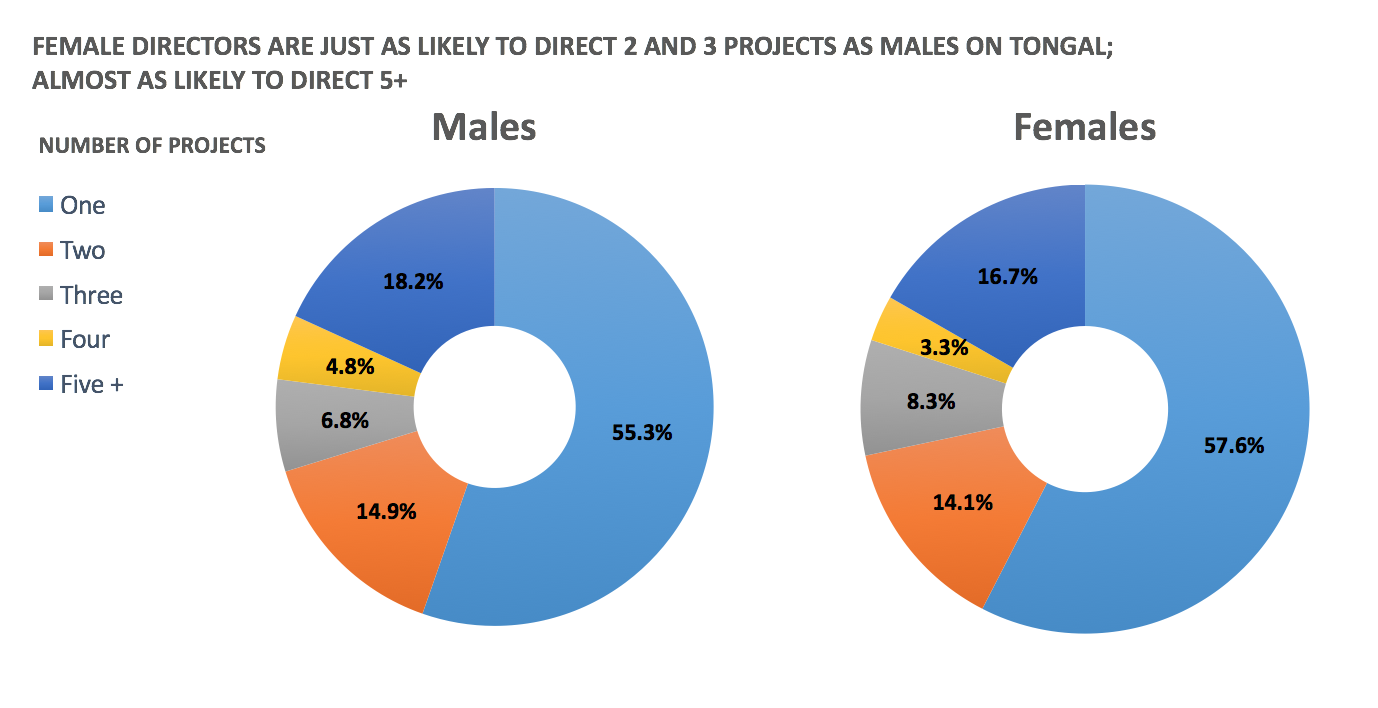
Figure 7.
WHAT ABOUT ADVERTISING?
Let’s take a quick detour over to the advertising industry. Alma Har’el, the founder of Free the Bid and one of only four women who’s directed a Super Bowl commercial, is a fierce advocate in the advertising world. As she discussed in her recent interview with IndieWire, commercials are an important training ground for feature filmmakers. Commercial work helps sustain a career. In terms of female employment, however, the advertising industry is riddled with just as many barriers as entertainment.
The advertising industry operates on a “triple bid” system. Brands are usually required to consider three directorial options. In the past, most of these spots were slated by male directors - a practice that prevented women from building competitive reels. Free the Bid encourages agencies and brands to take a pledge to ensure at least one female director is included in every bid process, taking advantage of this structure to build inclusion. For an industry in which women hold 85% purchasing power, we say this is a step in the right direction.
POWER AND PERCEPTION
One of the biggest reasons female directors land so few jobs in Hollywood is that there are few women at the executive level. In order to see real change, we need more women at the top making decisions. Executives in general also need to be willing to challenge the status quo and push back on things like, for example, when the shortlist of directors for an action film are all men.
Our second biggest barrier is the false perception that movies by women and for women perform poorly at the box office. Subscribing to this myth can actually cost studios hundreds of millions of dollars because they don't see the value in properties like The Hunger Games or Atomic Blonde. In 2017, the top three highest-grossing films - Wonder Woman, Star Wars, and Beauty and the Beast, were female fronted. Research also shows that female produced films have a higher ROI. How's that for economic viability?
FINDING SUCCESS ON TONGAL
For Tongal, everything boils down to opportunity. Landing the right opportunity can transform a filmmaker’s career. Our founders designed Tongal around the idea that brilliant people exist everywhere (a phrase literally stenciled to our office wall), and we also believe a diverse creator community leads to better creative.
Female directors have a higher success rate on Tongal because our process eliminates the barriers and biases women face across the industry. We greenlight projects based on a creator's vision and skill - not on who they know or which film school they went to. Your past work can be a blend of spec, class assignments, personal projects, or work for other clients. As long as it gives us a sense of what you’re capable of and your creative voice, that’s all we really care about.
Taking a step back from the data, we wanted to highlight some of the women who have been making an impact in our community this year. If you’re a female director, we hope these stories provide you with the motivation you need to continue pursuing your passion: Sonia Meg, director of Curiosity, a National Geographic Genius Short, and a few spots for Bayer; Jessica Sherry, Best New Artist at this year’s Tongies and director of GE’s employee story series; KR Squared a mother-daughter directing duo who helmed the Cupid’s Match pilot; and Tiffany Frances, director of Movement, another National Geographic Genius Short.
If you’d like to continue the conversation with us, leave your comments below or reach out to us at info@tongal.com!

Hi Pudu Productions, thanks for your comment! We appreciate your willingness to jump right into the conversation. We initiated this study to see how our community is tracking against the industry at large, and more importantly, to learn more about how we can play an active role in the careers of under-represented filmmakers. Many of us at Tongal have worked in the industry and have experienced the barriers and biases firsthand and are very passionate about moving the needle forward.
We agree with you that tracking and measuring prizing distribution is an important metric. We also believe there’s value in the opportunity to work with certain brands and studios to build a competitive reel. We have no doubt there’s more work to be done and we’re excited to see what we can accomplish together!


