
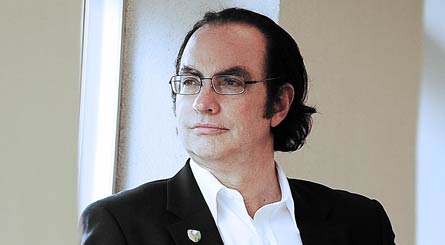
We’re not 100% sure, but we’d lay a fiver that Jeff Goldblum is copping his design-conscious / benevolent-scientist look from Singularity University’s Neil Jacobstein.
Making The Most of “The Future of Work”: 5 Resolutions
Our thoughts on Singularity Hub’s interview with Neil Jacobstein
You can read his full professional bio here, but if you want the Cliff’s Notes we can give ‘em to you right off the top: Neil Jacobstein is someone who has dedicated his life to a deeply scientific, multi-disciplined approach to thinking about the ways advanced technologies, and artificial intelligence specifically, will affect the future.
Which means he’s kinda cool, as far as we’re concerned. And if Jeff Goldblum knew who Neil was, he would totally like him. Cause really…what’s not to like?
Neil is the Artificial Intelligence and Robotics chair at Singularity University, and he was recently interviewed for Singularity Hub’s weeklong series on the future of work, which we discussed in our previous blog post.
We think the interview is well worth reading in its entirety – even if you have never thought that much about the way your work may interact with AI, Robotics, Nano-technology, or the future-economic climate these capabilities will bring about.
In reality, what you might discover is that unless you weave baskets for a living, your work is probably already, in some way interwoven (sorry, had to…) with AI. Well, unless you’re selling those baskets on Etsy…
One of the things that Neil points out in his talks is how ubiquitous (yet invisible) “artificial intelligence” has become. If you’ve flown in an airplane, driven a car, watched a weather report, or bought something online this week -- you’ve been dancing with smart robots. And if you watched IBM’s Watson kick-ass on Jeopardy a few years back, you already know that any game-show you win from here on out is simply a gesture of robotic charity. But hey: Watson is on to greater things – you’ll see what we mean if you read the Watson-Wiki article we linked to up there.
Watson’s going to be worth 10 Billion dollars a year for IBM?? Wow, sure…we saw robots in the future, but we never thought we’d see one owning a house in Aspen and a private jet!
Why Do We Like Neil’s Interview So Much?
There’s a rationality and optimism that informs his perspective, as he contemplates both the difficulties and the promise of technology. We thought we’d share five Insights we took away from his interview:
5 Resolutions we’re making based on Neil Jacobstein’s “Future of Work Interview”
1. We’re going to try to think practically about the future too. We might not be as good at it as someone who has done it for a living, but it’s clear from Neil’s talk that the future isn’t a mere phantasm of rocket-fins, jetpacks and artist’s renderings. It’s real – and it’s taking shape every day.
2. We’re going to go deeper. We agree with Neil’s advice to try to understand the mechanics of technology at “at least one level of abstraction deeper than our every day interaction.” Here at Tongal that means (for just one example) getting certified and using the tools our partners offer to optimize the distribution of content we create. For lots of people, it means repairing simple household machines by watching Youtube videos or logging onto Ifixit. We love that DIY spirit!
3. We’re also going to follow Neil’s lead on interdisciplinary learning. Neil suggests that specialization “is a very brittle model for problem-solving and creativity” – and frankly, we’re inclined to believe him. (Yes, we can totally hear those words in Deputy Kovacs’ voice too.) So, as we go one layer deeper, we’ll also learn the disciplines adjacent to & supporting the work we do. We’ve seen lots of people in our community do this (moving from ideas to filmmaking for example – or, the other way round). We are all about creative range.
4. We’re going to be proactive about the social ramifications of our business and or business model. Tongal’s mission, “Creativity Set Free” is a constant reminder to extend the benefits our platform and approach to as many people as we can. Today our primary focus is working hard to make that happen. It’s not the first time we’ve had this thought – but in light of all the observations above – we’re going to redouble our efforts to work smarter to accomplish that as well. Hey, if it’ll help, we might even ask a robot what to do…
5. We’re going to be optimistic. Not only because an “explosion of wealth and resource availability” sounds pretty great. But also because, as Louis C.K. reminds us in this spectacularly good clip from Conan, things are pretty cool right now…and they’re only going to get cooler.
Feel free to share your thoughts about the future and the future of work with us at ___info@tongal.com_____________.