

You can’t build a house without a blueprint. You can’t engineer an invention without a schematic. And you can’t create a film project without a budget.
A budget is a planning document that outlines all the details of your production and the associated costs - things like how many days your production will last, how many crew members you’ll need, how many cast members, where you’ll shoot, and what local taxes you’ll need to pay.
A budget is also a moral document that will help you make decisions throughout the production process. For instance, will you go the standard route of printing call sheets and scripts or save money by using a digital alternative?
There are a lot of things to consider, so let’s start from a high-level.
What does a budget look like?
The good people at Tongal have provided an example budget template to get you started with your “Top Sheet.” This is typically the first sheet of any budget and provides totals for each department. Usually, each department is assigned a broad number (e.g. Story is 1200, Director is 1500, Sound is 2900, etc.).
Generally, there are 4 key sections to the top-sheet:
Above the Line - This includes all expenses related to actors, writers, directors, and producers. Depending on the size of your production, this could be anywhere from 10% to 50% of your overall budget.
Below the Line (Production) - This includes all expenses for physical production, including salaries, camera and light rentals, production design, set construction, make up, location fees, boom operator and sound mixer, transportation, and second unit. Basically anything involving on-set activities goes here.
Below the Line (Post-Production) - This includes all expenses for post-production, including salaries, edit equipment rentals and licenses, sound design, music, CGI and titles (which are separate departments), and final sound-mixing.
Total Other - Some studios and production companies prefer certain sections be broken out on the top sheet, such as taxes, fringes (union payments), buffer, completion bond, insurance, and “Miscellaneous,” but not all do. Each studio and production company has a preferred budget format, so always make sure to ask how they want their budget formatted before beginning.
Underneath the top sheet, there’s the Accounts sheet, where each department’s expenses are broken down into accounts. So if the Sound Department is assigned the number 2900, you would break that down as the Sound Mixer’s salary is 2901, the Rentals are 2940, and Miscellaneous Items would be 2990.
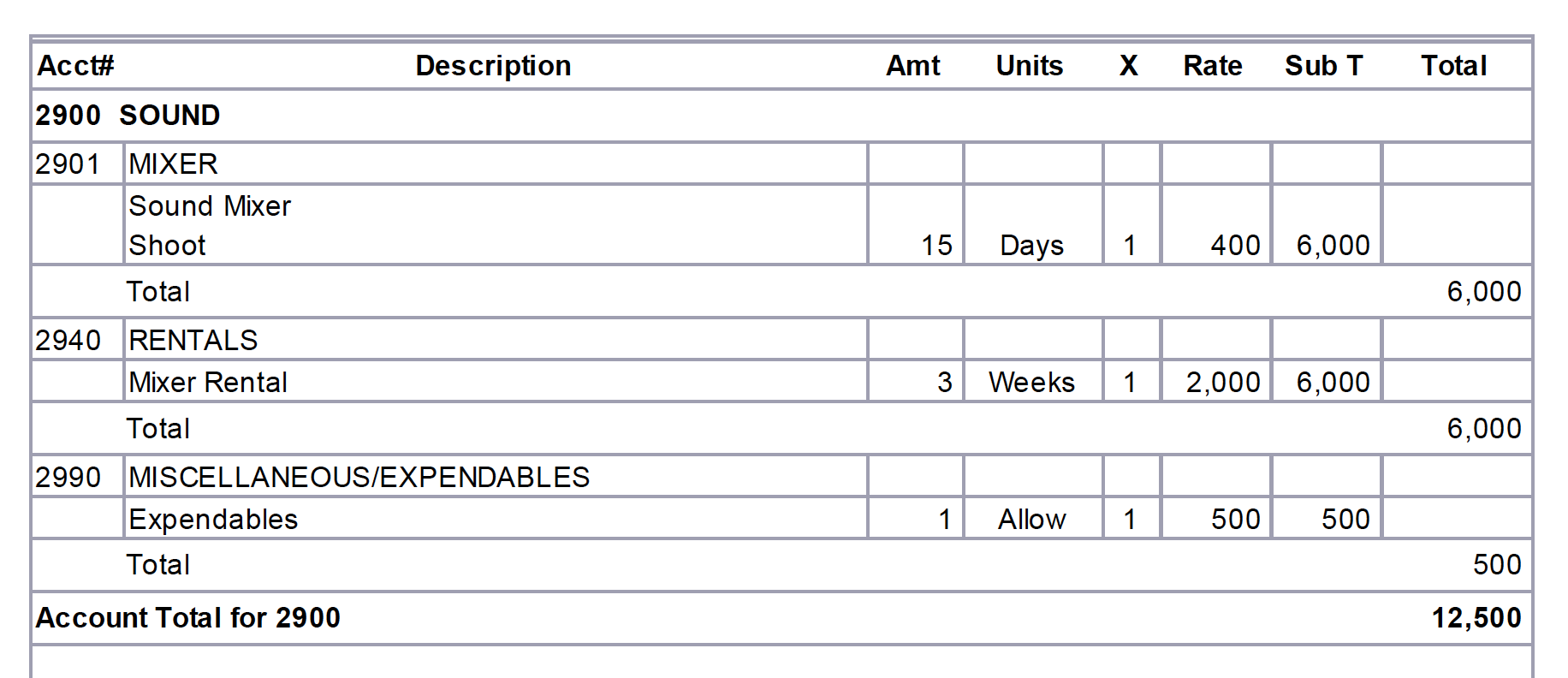
Example Accounts Sheet - Sound Department
Underneath the Accounts, there are the Details. Details are a granular breakdown of the Accounts. So, if the Sound Mixer’s salary is 2901, you would have a breakdown of, “Prep Local” for 2 weeks at X rate, “Shoot Local” for 4 weeks at Y rate, and “Wrap Local” for 1 week at X rate. I call out local, because if your crew member travels, then there is often a higher rate, and also additional costs.
What should I budget for someone?
Day rates can vary wildly, and while most pros will have a figure in mind, there may be room to negotiate based on the overall amount of work on offer - or other perks of the production at hand. For instance, has the DP always wanted to shoot a feature film or does the screenwriter have a proven track record so the final product is more likely to be a stronger calling card? Consider also how the demands of your production might require you to prioritize certain departments over others.
Let’s say you have a small production shooting in Los Angeles and you need to stick to a conservative budget. First and foremost, it’s important to have an understanding of minimum wage laws when calculating a day rate.
Let’s assume minimum wage is $10 per hour. The Fair Labor Standards Act (FLSA) states that it’s regular payment for the first 8 hours, then 1.5 payment for 8 to 12 hours, and then double payment for everything after 12 hours. Since the industry standard for film shoots is 12 hour shooting days, we can simplify this by multiplying the hourly rate by 14 (8+(1.5*4)), so our film worker with an hourly minimum wage rate of $10, gets paid $140 for a 12 hour work day.
Most major cities are moving towards a $15 per hour minimum wage, which means you should expect to pay a minimum of $15 x 14 = $210 per person, per day.
A note about acting talent
Typically, the number one thing that will impact your budget is on-screen talent. The first thing I will do to trim down a budget, is cut or combine characters. If a script calls for a group of 40 extras, challenge yourself to trim that number as much as possible. If the script calls for a hospital to have both a Nurse and a Receptionist, can you combine those into one part? Quality actors come at a cost, and it’s important to factor that in upfront.
Where else to save money?
These are some of my favorite hacks for getting good discounts:
Schedule your project for times of the year when productions don’t normally shoot, such as after TV shows have wrapped (typically May for Los Angeles, or January in most other cities), or during the holiday hiatus (in late November through December). This allows you to get experienced labor and equipment rentals at competitive rates.
You can also benefit from thrifty shopping. Not every piece of film equipment needs to be rented or purchased from a name-brand supplier. You can buy lights and cheap equipment from places like Lowes and buy second-hand via eBay, Craigslist, and sites like ShareGrid. For more ideas, check out this Tongal blog on the topic.
Another great option for post-production is agreeing to not push a rigid timeline for completing deliverables. This is usually the best option if you don’t have a set release date or a bond company breathing down your neck.
If you have a track record with your employees or vendors, and you have a confirmed project coming down the pipeline, you can bundle the costs for both projects, “If you do Project A for X price, I’ll give you Project B for Y price.”
Ready to get going? Start with a good template, be thorough and thoughtful, and soon this process will become second nature!
Mastered your production production budget? Check out some other helpful Tongal templates here.
__
Note From Tongal: "How to Draft a Production Budget" is part of a series of Tongal Community-written blog posts that were originally sourced in the Tongal Blog Open Call Project. The views and opinions expressed in this article are those of the author(s) and do not necessarily reflect the official policy or position of Tongal. Read more Tongal Community-written posts here and then Pitch us a topic you'd like to write about for the Tongal Blog!