Note From Tongal: “The PA's (Sort Of) Ultimate Survival Guide" is part of a series of Tongal Community-written blog posts that were originally sourced in the Tongal Blog Open Call Project. Read more Tongal Community-written posts here and then Pitch us a topic you'd like to write about for the Tongal Blog!
---
For many, being a PA is the first step into the exciting world of film, television, and commercials. From running coffee and locking up to signing paperwork and organizing hundreds of extras on set, being a PA (much to the disbelief of your parents, who want you to get a "real" job) can be a daunting task. To go from film school into the wild world of multimillion-dollar movie sets can be, at best, intimidating; at worst, bone-shaking and paralyzing. That said, there's not as much to fear as you think.
Everyone started somewhere; and, whether you have aspirations to become the next Kubrick, or plans to become a brilliant prop master or AD, there's something to be said about knowing what it's like to be at the bottom. What do you need on your first day? How should you act? What should you look out for? These are but a few topics that'll be covered in this essential piece. Essential because, hell, even Spielberg PA'd.
Where do you start?
Most work in the film industry begins well . . . on set . . . as a production assistant. To begin, what is a production assistant? Even here, the average person is murky on what a PA actually does. Yes, you are going to be running coffee, a lot of it; but the job, contrary to popular belief, is much deeper than that. From bringing important talent to and from set, to organizing and keeping track of hundreds of extras (known on set as “background”) and everything in between, the work of a PA can be daunting.
To be a good PA is to learn how to read needs on set. Every production is different. Each movie, television show, commercial, and music video is vastly different and comes with its own set of unique problems and complications. There are, however, commonalities present on every set that a new production assistant should become wise to before walking out of crew parking.
Let’s talk about what you need before you even leave your house.
Preparedness is everything. You need to be ready for it. To do that, here are a few things you can bring from home on your first day:
- Appropriate clothing – It’s funny to say, but this is truly one of the most important things you can have to prepare yourself for a successful day on set. Sure, you may look great in designer shoes and expensive jeans or dresses, but if you’re going to survive, be smart about what you wear. For one, be sure to not wear anything too revealing or controversial. If you’re working with an important client, presentability is key and could even be the difference in future employment. More than that, make sure you take account of the weather. Someone once told me that you can always tell who a crew member is because they’re likely wearing a cheap t-shirt and two hundred dollar shoes. DEPENDABLE SHOES are key. Comfortable, durable, and waterproof shoes are an absolute necessity for EVERYONE on set. While we’re on the subject of water; a rain jacket, even one you’ll just keep in your backpack, is a godsend when that surprise storm hits while you shoot in the woods. As for pants, pockets are important. You’ll be able to keep a call sheet handy along with all the pens and markers you’ll carry on set.
- A pen and a notebook – This one is easy. Taking notes on set as a PA is invaluable. Be it for remembering your 1st AD’s instructions, remembering which scene and setup the crew is on, or remembering people’s coffee orders; taking notes will help you organize thoughts on set and remember what is truly important. Personally, I prefer a classic quad-color pen. They’re a great size and save you from needing to carry multiple different pens that you’ll inevitably lose.
- Surveillance – Otherwise known as an earpiece for your walkie. You’ll avoid looking like too much of a freshman if you walk onto set your first day with your surveillance already on. Buy one early and keep track of it. Personally, I prefer a simple, Amazon-bought surveillance from Retevis with a Code Red ear mold. Remember to buy a TWO PIN connector, as most, if not all productions have walkies that only support TWO PIN connectors.
- Multitool – It’s my opinion that EVERY PA should have at least a multitool on their person. Though PAs aren’t necessarily expected to have one, it’s a good feeling when you can solve a problem without asking your always helpful Grip friends.
- Phone chargers and external batteries – Not every set is run like a Christopher Nolan set. It’s 2018 and phones have become a necessary tool on set. After all, communication is key; and, if you can’t contact the right person at the right time, you may run into some serious trouble. Carry a few extra chargers and external batteries with you as well. Though your phone is a priority, you’ll get major points if you can be the one to charge a key position’s phone when no outlet is available. Just be sure to keep track of your stuff.
- A lighter – Here’s an odd one. You may not smoke, but the person you might be trying to get close to on set for future work might. To be honest, you’ll get points if you’re that guy (or gal) on set.
There are a few other things you should bring with you as well. For one, a good toolbelt and pouch combo doesn’t hurt. Sunblock can save you on a hot day as well. Personally (and this may be too much information) I love to have a spare set of socks with me on set. A lunch time sock change is a beautiful thing.
Let’s talk walkies.
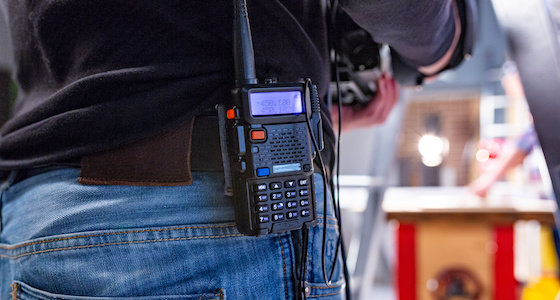
Like I said, though production is an ever-changing being, there are commonalities. Walkies; how you treat them, what you say on them, and the etiquette that goes with both are one of those commonalities. First off, it’s important to note: as a PA, you may be given the responsibilities of a “Walkie PA.” Though I won’t go too heavily into detail, it’ll be your job to make sure no walkies, batteries, antennas, or headsets are lost.
Now, let’s get down to some terms. It may seem overwhelming, but if you study them and pay attention on set, you’ll catch on quicker than you may realize.
- “Copy” or “Copy that” – Used to let someone know that you acknowledge and understand what they are saying to you. It’s often said either over-walkie or in person.
- “On it” – Used to let someone know that you not only acknowledge and understand them but are actively trying to achieve the task laid out by them.
- “[Name] for [Name]” – Said over walkie when calling for a specific individual. Used to let the person you’re calling for know who is calling for them. Voices tend to sound the same through your surveillance; especially when you’re moving and thinking as fast as you will be.
- “Go for [Name]” – When the above is said over walkie for your name, this is the appropriate response.
- “Take it to two” – Conversations on walkie are meant to be concise and brief; however, when a conversation on channel one cannot be completed in but a few words, it’s appropriate to call someone over to channel two. Get your points across in a clear way and the person on walkie will greatly appreciate it. To start that the right way, make sure you indicate your presence on channel two by saying: “[Name] on two.”
- “10-1” – A bathroom break. Yes, contrary to popular belief, PA’s ARE ALLOWED to use the restroom when on set. Just don’t disappear without letting someone know. Also . . . though I don’t often recommend saying it over walkie, “10-2” is said when you need . . . well . . . a bit longer of a bathroom break.
- “Standby” and “Standing by” – This is the appropriate call to give someone to hold for a moment while you complete a task and they’re calling your name (or vice versa).
- “Flying in” – Used to let someone know you’re coming towards them with the person or thing that they have asked for.
- “What’s your 20?” – Used when asking someone what their location is.
- “Go again.” – Used when asking someone to repeat themselves.
- “Spin that.” – Though this call is often directed towards one designated PA, it means to go to all of the used channels and repeat information said on channel one.
Once you get the lingo down, working on set as a PA is a game of recognizing patterns. Knowing on set patterns (i.e., department-specific behaviors, tasks to be completed, problems that often arise, etc.) is essential when working as a PA.
Here are some other things to keep in mind while you work on set:
- Be on time. In the film industry, being on time means you’re late. EARLY means on time. Make it a habit to be early. Your superiors and those around you will appreciate and come to respect your dedication and consistency.
- Stay safe. Safety is everything. I’ll keep this simple. On a film set, there are a ton of things that can hurt or even kill you. On every production, safety is everyone’s responsibility, even yours. Listen closely during your safety meetings and keep an eye out for dangerous situations that you can notify your higher ups about.
- Practice professionalism. This seems like an obvious one, but when you’re watching a car blow up while someone shoots a huge mounted machine gun towards an imaginary giant robot, it’s easy to forget that professionalism is important. Yes, film is one of the greatest, most fun jobs in the world, but please, don’t forget to carry yourself knowing that there are a dozen other people that would kill to have your job.
- Echo. Echo. Echoooooo. This is a simple one. When a 1st AD calls out a “roll” or a “cut,” it’s a PA’s job to echo that for the rest of the set to hear. A loud (when appropriate), confident PA is an employed one.
- When it’s locked, keep it locked. Lockups are a PA’s first job. When you’ve got a lockup, do yourself and everyone on production a favor and keep it locked up. “Locked up” essentially means keeping an area clear of anything that might disrupt a take. Be it for sound or for camera, a good lockup keeps the day moving.
- Don’t sit down. This may seem ridiculous, but when you’re on set early in your PA career, you’re expected to stay on your feet. If you’re not on your feet, you’re not doing your job. PAs stand. A lot. Though I almost consider it a pseudo-unspoken, pseudo-hazing technique of the industry, the image of a PA sitting while a more active PA stands and takes notes is a powerful one, especially to the ADs that are looking to hire a strong PA for the next job.
- Most importantly, RELAX. It’s just a movie. While I was a Key Set PA and AD, my number one rule for new interns and PAs was “JUST CHILL.” It’s a simple saying, but honestly, it’s easy to forget. Working in film and television is one of the greatest jobs in the world. I believe that, I really do. That said, don’t forget that we’re not saving lives. We make movies, and yeah, you could be working on something that millions of people will watch, but the world’s not going to end if something falls through the cracks. Don’t beat yourself up about something that may go wrong because trust me, something WILL go wrong. Keep your head up. Keep moving. Do the job with a smile as much as possible. If there’s ONE thing in this whole article that will truly lead to survival, it’s this: Just. Chill.
Everyone starts somewhere. Keep an open mind and you’ll come out of your first job with offers for your second and third jobs. Do the work well, respect your coworkers, and trust the process. Remember, as stressful as it gets, at least you’re not working at a boring office.
Good Luck!