

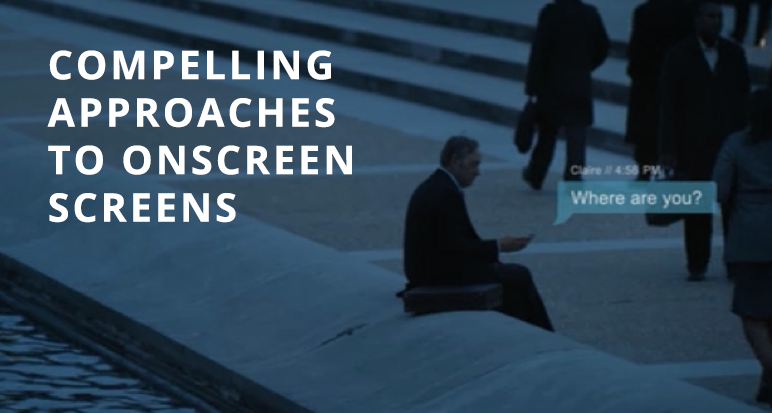
With the increasing prevalence of screens in our lives, from laptops to smartphone apps, filmmakers have been increasingly challenged to find creative ways of integrating them into their stories. Whether working with traditional cinema or online digital video, there are a variety of compelling examples to turn to for inspiration on how to do it properly. While there is no one right way to bring a screen to life onscreen, the most successful examples have one thing in common: They lean into the particulars of the medium to represent the unique information at hand by finding the most interesting way to depict it.
Traditionally, the standard process for how filmmakers have depicted content on-screen required a greenscreen composite, where the screen was added in post-production due to the fact that the brightness of screens was too much for the dynamic range of earlier cameras.
But, a static screen is intrinsically uncinematic. If you’d like to challenge yourself creatively and find more innovative approaches to bring into your own work, read on.
The Core Principle
The core principle to representing screens successfully is understanding the particulars of why a given screen is relevant or significant enough to include in your film or video in the first place. In other words, what specific aspect of a screen conveys information, summons emotion, or serves the greater story you’re trying to tell?
This principle is no different to capturing images generally. When framing a scene, you inevitably must include and exclude certain elements of the scene for the sake of narrowing the audience’s focus to what’s relevant. For instance, if you wanted to capture the subtle emotions betrayed by the expression of a character, a director would ask for a close-up of their face. This is because the particular content you’re trying to capture is best expressed through a particular formal technique.
Similarly, ask yourself what makes this screen interesting or useful right now to the audience? If a screen includes very literal exposition that can only be conveyed in text, like a scene where a character silently reacts to a shocking text message, then you know that you have to include text in some form.
Here’s how various filmmakers have achieved this core principle through different approaches.
All About the Text
House of Cards (2012) Photo Courtesy: Netflix.
Alternately, if a screen is being used to show a character’s monotonous relationship to endless scrolling on their news feed, that requires an entirely different setup.
Sherlock (2010). Photo Courtesy: BBC One.
Some of the earliest mainstream examples of how to seamlessly incorporate text from phone screens into a scene are the TV shows Sherlock and House of Cards. They opted out of showing the clunky and unnecessary user interfaces of the characters’ phones to simply allow the messages to exist on screen, decoupled from the tech that serves as the medium for the message.
This approach is successful because it shows the information as-is, without interrupting the rest of the scene’s elements— the framing, staging and most especially the tension from an uninterrupted shot.
Overwhelmed by Data
Kevin B Lee’s Transformers: The Premake is a short film with an online audience in mind that simulates the experience of using a desktop computer quite literally. Here, Lee documents the impact that the production of the third Transformers film had on Chicago. He gathers various internet sources and locates them in the city within Google Maps, with the camera tracking the movements of the mouse pointer as it opens and closes different tabs.
As a documentary and video essay, Lee’s film leverages the particulars of the form to lend a geographic sense to the vast pool of visual history available on the internet while staying true to the film’s more fundamental investigation into the interplay of mass media and society’s awe for spectacle. The digital form simulated by Lee’s documentary effectively holds up a mirror to how the media informs our appreciation of the physical world.
Screens as Montage
Documentarian Isaiah Medina integrates screen captures from real phones into the film 88:88 as if they were no different to any other footage. In making that choice, he bypasses the distinction between screens altogether to create an experimental film steeped in montage that is able to better serve its investigations of economic precarity.
In doing so, the film does away with the borders of screens while still staying true to the fact that these images are of screens. This is innovative because it shows that recognizing how the story’s focus on modern-day economic precarity specifically requires a distinctly digital refresher of the age-old montage. Since montage is the primary style, the images of screens are integrated insofar as they suit that style.
Adopting the Narrator’s POV
The entire opening act of my own short documentary, The Curve of the Earth, takes place within the context of a screen in real-time to create a first-person POV. We experience a conversation taking place on Facebook from the login. Exposition mirrors real-time conversation with the sound design further immersing audiences in the POV of the narrator.
The subject of this particular story—a friendship initiated through Facebook—makes it an inherently digital film thematically. To fully immerse the audience in that world, the framing of the film directly mirrors that of the narrator while he is on his computer. This device is utilized not only at the beginning in the first act while the character is on Facebook, but in the final one, too, when he is editing the film that the audience sees.
Physicalizing the Screen
.TV is a short documentary about the country Tuvalu, its financially lucrative country-code top-level domain “.tv,” and the predicament it faces as the current climate crisis threatens the very existence of both. You see, the sought-after domain suffix would technically need to be removed from circulation if Tuvalu were to disappear underwater.
The film cuts between YouTube footage captured by visitors to the country alongside the very websites that use the “.tv” suffix. We see all kinds of content being streamed on a screen in a room, as the camera slowly zooms in on the screen itself each time.
This use of mise-en-abyme shows that innovative physical manifestations of screens can still work, even though a lot of the earlier examples succeed for doing away with user interfaces or borders. Traditional cinematic techniques like slow zooms are known to create tension when used properly, so in order to conjure an ominous tone, director Anthony Svatek uses them while calling attention to the screen itself.
Conclusion
The ways in which screens can be integrated into your stories are infinite, so don’t be afraid to try something new. Doing VFX work can be daunting when you’re first getting started, but there are dozens of great YouTube tutorials to guide you through the process step by step.
And be sure to pay attention to how screens are represented next time you’re watching a TV show or movie—there is a lot to be learned from professional work!
__
Note From Tongal: "How to Make Footage of Screens More Compelling" is part of a series of Tongal Community-written blog posts that were originally sourced in the Tongal Blog Open Call Project. The views and opinions expressed in this article are those of the author(s) and do not necessarily reflect the official policy or position of Tongal. Read more Tongal Community-written posts here and then Pitch us a topic you'd like to write about for the Tongal Blog!