Note From Tongal: “Why Every Video Creator Should Watch Silent Films" is part of a series of Tongal Community-written blog posts that were originally sourced in the Tongal Blog Open Call Project. Read more Tongal Community-written posts here and then Pitch us a topic you'd like to write about for the Tongal Blog!
---
Creatives and clients know the drill when it comes to video on social media: Snappy videos without sound but with highly engaging visuals result in clicks. One could easily think that these conditions are highly limiting, and bode ill for the final product and its effectiveness. Yet we’ve been here before.
Brothers Lumière premiered their film L'Arrivée d'un train en gare de La Ciotat in 1896. A silent black and white presentation that lasted no more than fifty seconds. But what the clip lacked in technical presentation, it more than made up for in its effect on the audience. The crowd reacted with horror and anguish by the prospect of a train barreling into them. Some reports even mention people ducking or moving away from the screen. While this isn’t necessarily how you want your audience to react when promoting, say, baby oil you can’t deny that the Lumieres were onto something.
In an era where people have the option of watching high-definition VR movies whilst riding on an actual train, the pure technological wonder of presenting moving images has been somewhat lost. But there are several lessons that we can take away from the nearly forty years of silent filmmaking which today’s creatives can easily and effectively apply to our current media landscape where sound is often optional.
1. Show, Don’t Tell
This is one of the oldest filmmaking adages. The concept boils down to constructing your story in a way where visual on-screen action propels and informs the story -- without voiceover or characters delivering context. And with no foley or music at your disposal, it is essential to construct your video in a way where it plays and sells in silence. A simple test to make sure your video works on that basic level is to play it muted to someone outside the circle of people involved with creating it, and asking them to answer a few simple questions. Can they tell you what it’s about? What exactly happens? To whom? Why? Is your message coming across?
If none of those questions can be answered, you’re either in for a few more hours at the editing bay or dumping exposition via subtitles, text or voice over.
2) Play to the Back Row
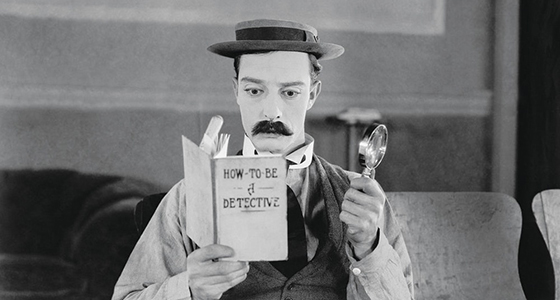
Charlie Chaplin, Buster Keaton, Laurel & Hardy. You’d be able to identify each and every one of these performers just by looking at their shadow and how they move. Can you do the same for Leonardo DiCaprio? Reese Witherspoon? George Clooney?
The point I’m trying to make is that on-screen talent in the silent film era couldn’t use their chops to show off their acting chops. This doesn’t mean your social videos should be based on prop comedy gags or death-defying stunts (especially if they revolve around the aforementioned baby oil), but it should lead you to direct and push your on-screen talent to elevate their performance, both in their physicality and the emotions they project.
Remember, you have seconds to capture your audience's attention with a steady supply of contenders lurking in that feed trying to do the same. Get your actors to make the audience stop and see what they’re doing for them.
3) Close, close-up, micro
D. W. Griffith’s 1911 film The Lonedale Operator ushered in the use of close-ups. It’s the money shot that reveals the protagonist wasn’t holding a gun in her hand, just a simple wrench. It changes the context of the film and retroactively reverses the tone. Griffith not only used a technical innovation where a lens could focus on such short distance but also cemented the idea of using such shots for story purposes.
The popularity of close-ups got exponentially bigger (yes, that pun is intended) as TV sets became bigger. Television audiences before were confined to a wider view that was easy to see on that tiny screen on the other side of the room. Now that we have screens in our palms, creators and audiences have a chance to go even closer.
With modern audience’s eyes inches away from a screen, you are now able to explore and show intense micro-cosmos of emotions and feelings. Tracking tears slipping down a cheek. Snowflakes hitting a hood of the car and melting away on its heated surface. Using such inflated visual story elements and acting can compensate for a lack of audio cues even more by setting up shots even closer. Deeper. Stronger. More visceral. Tactile. When someone is literally holding and feeling their screen, you have every tool available to fill it in a way that makes them feel for what you’re trying to show and say.
4) In the Cut
Editing. No matter what you wrote, storyboarded, and shot -- the edit can make or break your video. The sound and the visual elements should work in harmony to elevate your footage beyond the purely technical exercise of putting frames in sequential order.
If you’re using temp audio tracks, I recommend editing the visuals first. Evoke serenity with fades. Or, go for a frantic feel with many quick cuts. Split screens, collages, sweeps - there are many different tools in an editor’s toolbox. Since we’re creating for mobile, it’s also smart to use the features of that unique medium. Play with phone and tablet features: screen orientation, notch inclusion, different sized screens, Instagram’s square format - you get the idea.
Whatever you do, think about visually imitating a tempo that audiences can count in their head while watching your video with or without sound.
5) Watch Alfred Hitchcock’s The 39 Steps
Did you know that Alfred Hitchcock established himself as a silent film director? While there’s no need to dig into his earliest work, you should seriously consider watching Hitchcock's 1935 talkie The 39 Steps, a black and white piece of cinema that shows a master using a wide variety of tools and techniques he acquired through the years and applying them to the new medium. Lead actor Robert Donat looks like a proto Indiana Jones raconteur but becomes a far more cunning suave operator when he talks. The catchy interplay between Donat and Madeleine Carroll is heard through dialogue but also seen as they tumble through the third act of the film handcuffed to each other. The police chase through Scottish Highlands feels dynamic and tense as everyone dashes through shadows and fog, even when it’s painfully obvious it was filmed on an indoor set. Meticulously crafted mise-en-scènes inside a train compartment work on clear and simple setups and payoffs. Crucial information is revealed through news headlines. These are monikers of a silent filmmaker who’s firing on all cylinders as he wields the might of his talent to set up, serve, and deliver a narrative that excels just on visuals alone.
It wouldn’t be a stretch to guess that the inclusion of whistling as a major plot point of this picture wasn’t a coincidence either. After all, humans produce the sound of whistling by uniquely puckering our mouths. A physical activity the camera’s lens can easily pick up without the actual sound.
A distinctly human experience caught on camera.
Which is what we’re all aiming to do.