
Disclaimer: This post includes spoilers for seasons 1 and 2 and a discussion on violence and suicide.
Dark is arguably one of the most complex, yet well-rounded serial narratives of the past decade. Its masterfully crafted storyline is the product of a carefully structured screenplay, skillful direction, and, perhaps most importantly, great editing. Editing is not only about putting together a sequence of shots; editing is an art form in itself. In its most basic form, it creates meaning when we put two or more seemingly unrelated shots together. It is what makes motion pictures come alive. It is also important to note that the way a visual narrative is edited is impacted by the director’s treatment of the material and by the dynamic between the director and the editor.
When it comes to intricate stories such as Dark, every decision about when and how to reveal a new piece of information matters. This includes pacing, choosing a suitable shot composition in a scene, deciding when to eliminate a shot, determining the scene length, and scene placement within a certain episode. Watching and re-watching Dark is full of editing lessons if you’re willing to look for them. In this post, we will be examining some of the editing techniques used based on examples from the show.
Editing action
Ulrich Tries to Kill Young Helge
(trigger warning: violence)
As previously mentioned, directing and editing go hand in hand, and when it comes to action scenes, this might be the best and clearest example of that. While Dark doesn’t contain larger than life action set pieces, there are smaller-scale but narratively significant action scenes sprinkled throughout the series. When we discuss “action” we’re not necessarily referring to huge explosions and gun shootouts.
“Action” can mean a simple chase scene, like the scene (and scene re-visits) where the kids run from the cave and lose Mikkel, or the running-fight scene above from S1E8 where Ulrich tries to kill young Helge in his attempt to break the time loop. However, when we take a closer look at the scene, we will find that there’s nothing simple about it.
The scene begins with dialogue between the two characters before cutting to their close-ups; Ulrich gives his monologue and Helge reacts to it. The action—Helge deciding to run—starts in a close-up, and Ulrich’s decision to run also starts from a close-up. The music builds up perfectly to the moment Ulrich says the words “the future” which is when we start hearing the drums. Music is what helps to set the pace of the scene. Pacing isn’t only established with cuts, we also have to take into account what is happening in a certain shot. For example, when we see Helge run away into the forest, we transition into a sequence of profile running shots. This sequence establishes the rhythm in two ways: through the length of the shots and how fast the camera moves with the characters through the trees in the woods, both of which match the music.
This moment also serves as a great example for establishing spatial direction for the audience. From the beginning of the scene until the end, the viewer knows where a character is within the location at each moment as a result of the establishing shot.
Here’s how it plays out beat-for-beat:
Ulrich and Helge are sitting at the bottom of the stairs and start running up towards the house. The change of direction—down—happens in the master shot, but the bite is shown as a close-up.
We cut to the bite to clearly show what happened and because it advances the story—Ulrich loses his grip on Helge and falls.
Shortly after we reverse the camera towards the woods for the first time and this shows us where the woods are located.
Once we know that Helge ran into the woods, we begin the profile sequence described earlier where we shift the direction into movement from right to left.
As Ulrich catches up to Helge and attacks him, the pacing increases as the fight escalates. Watch how the cuts are quick, rhythmic, and smooth. This is because the editor continuously cuts on action, which is something we will discuss below. During this sequence, we also get an emphasis on character growth/change. This is communicated purely in a visual way and is achieved through editing. Just before Ulrich decides to hit Helge, we linger on his close-up. This pause shows the viewer that, for a moment, the character is torn about what he’s about to do and the scene ends with him going through with his decision.
Editing dialogue scenes
Dialogue-driven scenes are common, but they can also end up being some of the most boring scenes in a film or in an episode of a series. The way dialogue scenes are edited in Dark, are almost textbook examples of when dialogue scene editing elevates the story. Each cut is placed just right and each subsequent shot tells us something more about the story. In his book, The Technique of Film and Video Editing, Ken Dancyger puts this paragraph as a basis for editing dialogue:
“The meaning of the dialogue to the story as a whole helps the editor make those decisions [choosing the right shot]. A piece of dialogue that is important for advancing the plot requires a close-up or some shift in the pattern of shots to alert us that what we are hearing is more important than what we’ve heard earlier in the sequence.”
To demonstrate this, we can closely examine two very different but thematically connected scenes from season 2: older Jonas a.k.a. the Stranger meeting his mother (S2E1) and preventing her suicide; and young Jonas meeting his father (S2E6), which results in him indirectly causing his father’s suicide later on. Even though the visual treatment of these scenes varies for each one, the editing approach is similar.
The Stranger Meets Hannah
We begin the scene with an establishing shot: Hannah’s handheld mid-shot as she intends to kill herself. She only changes her mind when she hears the door opening behind her. She stands up, and it’s here where the first cut happens; on action. Cutting on action means cutting on any type of character, object, or even camera movement that is mimicked in two shots. It will create a smooth, almost unnoticeable cut. This might have been more obvious when discussing the previous scene, but the rule might be less obvious in more “static” scenes.
Here’s how the edit unfolds:
We linger on Hannah to see her reaction to the Stranger entering the house, then we cut on camera movement to her over-the-shoulder shot.
As the stranger’s face is still covered in the shadows she asks who he is, and then we transition back to her reaction shot which is an example of a J-cut. Notice how this time, we cut to a tighter shot of Hannah, to emphasize her reaction.
We L-cut back to the Stranger as he steps out of the shadow, revealing himself to Hannah.
Next, we get his over-the-shoulder shot to Hannah, which now reverses the points of view, simply by putting him into the frame along her side.
We get the regular shot (reverse shot sequence of the Stranger) as he begins to explain, and then we cut back again to a lingering Hannah’s reaction tighter shot.
Now the scene shifts back to Hannah coming to terms with what’s happening.
A little later, when Jonas reveals his scar (close up), we cut back to a similar framing of Hannah, but she rejects him.
This same pattern (shot–reverse shot, both over-the-shoulder) is repeated when Jonas continues telling Hannah his memories, and then we cut to Hannah’s close up reaction shot again, to see her slowly accepting what’s happening. After this, we establish a new pattern of shot–reverse shot, this time using even tighter framing, as emotions are boiling on both actors' faces, and as Hannah accepts Jonas and slowly hugs him. This is a commonly used technique, the shots get tighter as emotion increases in a scene.
Young Jonas meets Mikkel
Even though this scene appears later in the series and its visual treatment differs (static shots as opposed to handheld shots), the editing approach stays consistent. It also contains much less dialogue and shot variety.
The scene starts with the close-up of Jonas, who came to his father believing that he could prevent his suicide. We get a classic shot–reverse shot sequence as the characters meet.
However, as soon as Jonas decides to step towards his father and hug, we cut to a shot with both of them in the frame.
We’ve established closeness between the characters but as Mikkel slowly starts to suspect that something is not quite right, Jonas steps out of the frame isolating his father. This is the moment when the focus of the scene shifts from Jonas’s reaction to Mikkel.
As Jonas tries to tell his father that he knows, we shift back to the over-the-shoulder sequence.
Jonas shows his father the “Ultimate Fist Bump” which is emphasized by a close-up of his fist.
The next shot of Mikkel is a lingering close-up as he steps back, and the point of the shot is, again, to accentuate the emotion.
At the end of the scene, as they reconcile, they’re once again put into the same shot.
Even though this scene contains much less dialogue than the previous scene, when characters do speak, there’s the frequent use of L- and J-cuts to show the characters’ reactions and to elevate the emotional impact of the scene, rather than just showing us the progress of events.
Both of these dialogue scenes are very careful about preserving in-scene continuity and screen direction. We as the audience are aware of exactly where the scene is happening and who is placed where.
Editing montages
Thunder
Throughout the first season, there’s an established pattern of montages set to a song that occurs towards the end of each episode and this is mostly carried over into the subsequent seasons. These montages not only establish the unique style that can be attributed to the series but also visually communicates the advancement of the plot. These scenes are always placed towards the end of the episode.
One of the most frequently used techniques in these montages is split-screen. Its usage goes beyond just the visual aesthetic—it connects visual motifs that solidify the themes of the show and also allows for some creative scene transitions.
The specific example we’re discussing can be found at the end of S2E1. Because one of the major ideas of the series is about time happening at the same time and intertwining within itself, we’re introduced to characters on the verge of a major discovery, each in their own timeline, at the same time.
First, we’re introduced to Jonas and Silja entering the Dead Zone.
We transition to Charlotte using a match cut within the split-screen.
We cut back to Jonas and Silja again, connecting them visually with lights.
As they approach the nuclear plant we get another split-screen, this time visually relating the two characters approaching a building that contains a new piece of information.
Notice the shot connection from before, during, and after the split-screen. As Hannah realizes who her husband really is, we’re again connecting the two characters using the split-screen.
This same pattern is repeated with Egon and Ulrich and when we deal with the emotional impact of their discoveries, ending them with the two side by side hugs. The montage ends with the characters it began with, as they discover the unstable matter—and biggest immediate threat to the universe. The entire sequence is also edited so that it fits the rhythm and pace of the song.
“Understanding both the narrative and the subtextual goals of a scene will also allow the editor to follow and modulate the editing so that it clarifies and emphasizes rather than confuses.”
The opening credits
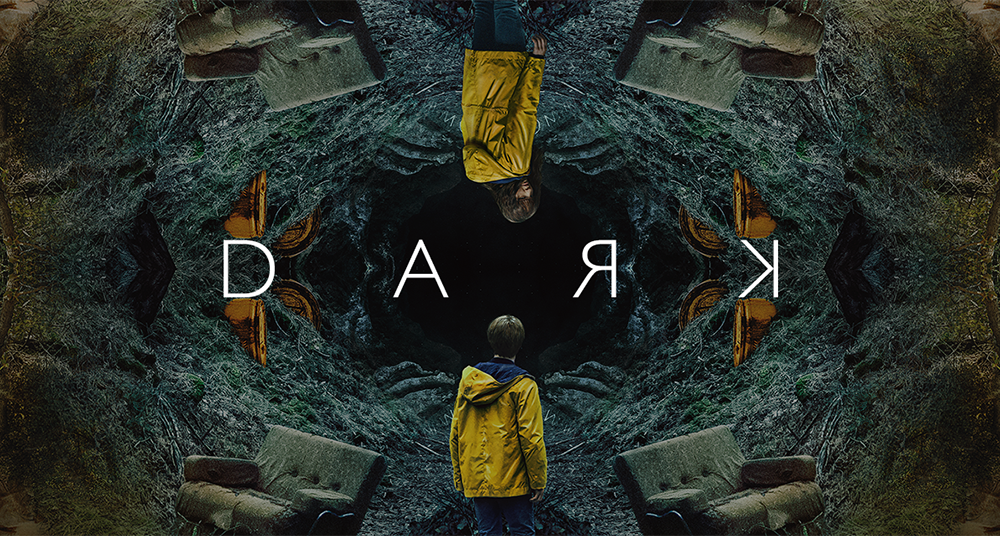
Dark is heavy with biblical visual symbolism throughout the series and the opening credits for all three seasons are no exception. The mirror effect used on these shots also serves as a visual reminder of what the show is about. The more we learn each episode, the more we can deconstruct the opening credits.
The opening credits also appear in the show after the first scene, which is a common placement when it comes to series as a format. We always start the episode with a short scene that sets the tone and asks a question (the cold open). This scene usually ends on a cliffhanger.
Because Dark is such a large and complicated narrative, it is impossible to deconstruct it within just a single blog post. But one thing is certain: carefully observing each episode within each scene can teach you a lot about not just storytelling and editing in general, but also how all of this connects into an epic narrative.
__
Note From Tongal: "What Watching "Dark" Can Teach You About Editing" is part of a series of Tongal Community-written blog posts that were originally sourced in the Tongal Blog Open Call Project. The views and opinions expressed in this article are those of the author(s) and do not necessarily reflect the official policy or position of Tongal. Read more Tongal Community-written posts here and then Pitch us a topic you'd like to write about for the Tongal Blog!