
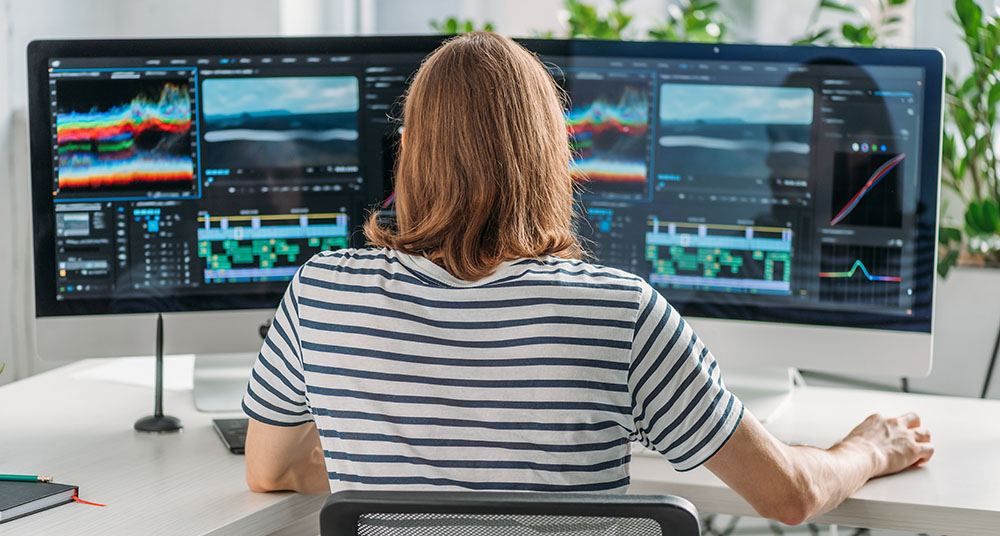
One of my favorite aspects of my job as an editor is how often my landscape changes moving from one project to another. With each move, my perspective on my craft changes, as I adjust my thinking to the needs of an entirely new set of deliverables.
Something I’ve grappled with recently, as I was finishing a year of work on a feature documentary, is that when you move from one editing format to another, it takes a while to adjust your concept of how editing works. I have to actively reset any habits that I've formed (deliberately or otherwise) in my previous work, or else slow down the workflow.
When I was just starting out editing documentaries, a mentor told me to hold all shots to a 3-second rule. Each shot was at least 3 seconds long so as to allow the audience to absorb all the information they needed to carry them through a 2-hour long movie. This proved to be a wonderfully helpful guideline when working in long format projects, but man, was it ever hard to adjust that rule in my head when I switched gears to work on political videos, music videos, or branded content. Universally my feedback was, “It’s edited too slowly”. After experiencing this several times I realized I had to switch gears each time I switched formats.
When I returned to long-form doc after a period of cutting shorts and political ads, I was thrilled to once again lock in a job on a single project I was passionate about for an extended period of time. However, like a lot of editors, I experienced fatigue running over hundreds of hours of footage, while trying out versions of the story in different iterations. In this early stage, many of the initial shot choices are mine to make and the possibilities can be endless. I learned how to practice what I call ‘intentional amnesia’ in order to find a way to approach the material with a fresh perspective every morning, rewatching material or cuts while pretending I had never seen them before, taking notes as though I were an outside viewer giving their fresh opinion. It was not an easy muscle to develop, as there were moments in the cut that my brain would pass over as though it were a chapter in a book I had read too many times and could therefore just skim in a cursory way.
With short-form content, I often finish an entire piece in a matter of days (or even quicker in some high-pressure situations). It’s worth noting that shots in shorter pieces, especially with branded content, have often been extensively discussed before the footage gets to me. Usually, that means that there is a limit to how much footage you have and therefore how many choices you can make in any given cut, so the turnaround can be much faster between different versions. My objective is to examine each shot in the cut to determine if it is the best possible choice to reiterate the messaging I am trying to express. It doesn’t matter to me how many times I’ve seen the footage because I am constantly trying to measure one shot up to another with the main theme or idea in mind. These choices have to come fast, and there’s no time for footage fatigue to settle in.
Long-form is a marathon. E.L. Doctorow once said writing a novel is similar to driving through the darkness with only a flashlight. You think you know a general direction, but you can’t see that far ahead of where you are. It’s similar when editing a documentary. Ideas are revealed to you as part of the process, and you can’t get where you’re going without fully immersing yourself. While I find short-form editing as immersive as long-form, I approach the edit differently. Generally, I know exactly what the idea is and where I am trying to get the piece to by the end of the process. The task is to make the footage express the idea as quickly and succinctly as possible so that it makes an indelible impression on the minds of the viewers. You want the viewer to connect to the thought/product, and take that imprint away with them.
Every habit or trick becomes a tool in your toolbox to be brought out for later use. The quick, frenetic pacing I have become adept at in short-form editing has become very useful in putting together montages in long-form projects, and I am no longer determined to have every shot last longer than 3 seconds in a feature film if the material doesn’t call for it. Longer storytelling techniques I have developed in documentary are often called upon when I need to help develop a narrative in a significantly shorter time frame. All these skills work together beautifully when I have to cut a 2-minute trailer out of a 2-hour film and quickly convey a sense of story and characters. Every project is an opportunity to stretch a muscle or develop a new technique, and that’s what makes the art of editing so fascinating.
—
Note From Tongal: “Video Editors, Adjust Your Sense of Time" is part of a series of Tongal Community-written blog posts that were originally sourced in the Tongal Blog Open Call Project. The views and opinions expressed in this article are those of the author(s) and do not necessarily reflect the official policy or position of Tongal. Read more Tongal Community-written posts here and then Pitch us a topic you'd like to write about for the Tongal Blog!