
Note From Tongal: “The Varava Brothers' Making of a Low-budget Movie to a Video Staff Pick" is part of a series of Tongal Community-written blog posts that were originally sourced in the Tongal Blog Open Call Project. Read more Tongal Community-written posts here and then Pitch us a topic you'd like to write about for the Tongal Blog!
--
The Fourth was a film that I set out to make not long after I moved to Los Angeles. I had just finished the film program at the University of Iowa, a school with a wonderful though, perhaps, excessively liberal approach to the craft. It was the type of environment that inundated its students with close analyses of the most revolutionary—usually alienating—films and encouraged us to do things like “find our own voice” and “push the limits of the medium.” The instructors were all minor celebrities in certain small-but-devout circles of the alternative cinema scene and, not surprisingly, they lectured very little on the “business” of modern Hollywood filmmaking. They were well-versed in the ways of film theory, drank mulled wine in their quaint, carefully cluttered homes, and, most fascinating to us, produced work that semi-consistently went on to screen in venues like MOMA and The Guggenheim. To me, having been raised watching mainstream fare like Hot Shots and Hot Shots Part Deux, this world was something new, a place where people had smart-sounding opinions about the most subtle, allegorical references in Man With a Movie Camera and discussed concepts like the femme fatale in terms of things like pistols and phalluses. It was exciting and romantic. To me, these people were artists. And that’s exactly what I wanted to be.
Needless to say, when I finally arrived in Los Angeles I didn’t have the most marketable reel. I had an intense understanding of the psychoanalytical theory behind Fritz Lang’s American work, sure, but frankly, my four years of production courses had produced a portfolio of carefully reconstituted New Wave and Italian Neorealist tropes set to a soundtrack of obscure 70s punk rock. Which, to be fair, is not necessarily a bad thing. I could’ve easily chosen far worse filmmaking movements to draw inspiration from (ahem, torture porn). And I still argue that those films were, and are, decent early efforts. Naïve, perhaps, but they were attempting to say something, genuinely trying to invent a new filmic voice. And, in the end, shouldn’t that be the mission of any responsible filmmaker?
If my move to Los Angeles taught me anything, it was quick and it was this: most people’s answer to that question is “No.” It’s the age-old dilemma—art and commerce—and an important debate. Is it worthwhile to educate oneself on how cinema has ended up at its current state, or should we simply embrace said current state in hopes of appealing to broad audiences and assuring ourselves long and financially prosperous careers? Personally, I’m a fan of education. I see the films I made in college as important stepping stones that eventually led to the type of filmmaking I now believe to be important—a more conventional style, though still very much on the fringe of the mainstream. And nowhere is this credo more prevalent than in the making of The Fourth.
The basic idea for The Fourth came directly from one of these movies I had made in college. The original version was shot on video in two days using non-actor friends and a crew that included myself and (sometimes) a sound guy. The script followed three hapless runners dedicated wholeheartedly to their four-by-one relay team despite the obvious handicap and, in turn, their inevitable failure. It was a fast, fun movie to shoot, and regardless of its own technical shortcomings, I got a good enough grade. But, still it kinda sucked. So, upon moving to LA, it seemed life offered up a chance to rectify that.
"The Fourth" (Short Film) from TAR+FEATHER on Vimeo.
I admit, while working on my film school projects I took a considerable amount of pride in the number of crew roles I was able to accomplish simultaneously. The Fourth, therefore, was to be the first production where I would make a specific, concerted effort to focus primarily on directing. And this meant hiring a crew.
Justin, my brother and frequent co-conspirator, set off on the script rewrites. We had the freedom to completely deconstruct the original story, working out the weaker parts and strengthening the themes we felt were the most universal—and, more importantly, it cost us nothing. We wrote with no regard for the difficulties that production would eventually bring and went on to include things like giant high school stadiums, functioning hot tub stores, three identical adjacent houses, etc. We were focused only on telling a good story and had no foresight as to the burdens we would eventually bring upon ourselves.
As the script took shape we began the process of meeting and coercing people to help us out. We had heard from friends who’d been living in LA much longer than us that people are surprisingly willing to work for free and—having not yet even considered putting together a budget—“free” became our standard pay rate. These same friends also gave us a handful of names for potential random crewmembers. We knew none of them, of course, but desperate to break this movie out of the small, secluded world that is the scripting process, we began cold-calling each and every one.
Sometimes, things just work out. I had dialed Damian Acevedo’s number one afternoon on my lunch break. Damian is a cinematographer. More specifically, Damian is a cinematographer who shoots—among many other things—music videos for folks like Katy Perry and Rhianna. My brother and I had checked out his website a few days earlier at the recommendation of a friend, and were both in immediate agreement that we must, by any means possible, recruit this guy. The phone call was awkward, as expected—me, gushing over his past work and hoping to entice him with a rapid-fire rant about the project’s stylized aesthetics; him, speaking slow and pointedly with questions about the project’s gaffer and shooting format (both which were met with an embarrassed silence). However, he didn’t seem too offended when, grimacing, I told him that we couldn’t afford to pay his typical rate—or any rate for that matter—and by the end of the conversation, although he hadn’t officially signed on yet, he did agree to read the script and meet us for lunch to discuss the project in more depth.
Plans were made to get together at a Chinese restaurant in North Hollywood. My brother and I took turns spewing our own theories and analyses regarding the film, while Damian just nodded and genuinely seemed to listen. We backed up our claims referencing various other filmmakers, authors, and photographers that had done work we felt helped to illustrate the movie we wanted to make, and related these works to actual scenes and shots in the movie. We, once again, discussed rates and pulling favors in order to keep costs down and Damian even suggested a few names of other crew members that he could talk to about helping us out. He emphasized that his AC and grips would not work for free, but would probably be open to accepting a fraction of what they typically make (phew!). It was also during this conversation that we were first posed the idea of shooting 35mm. Damian brought it up. 35mm was, of course, his medium of choice. We knew that money was tight and, though having never actually shot 35mm before, were doubtful. He tried to level with us, assuring that there were ways of working around much of these costs, that shooting 16mm wouldn’t save us as much as we thought, and was adamant that the vision we’d been discussing would only benefit from the freedom that 35mm allows during the telecine session. He also wondered if we had started casting yet, and when we told him that we had not, he gave us the website for an actor he’d just recently worked with, someone he thought might be perfect for the role. His name was Lucas Fleischer, and we called him immediately.
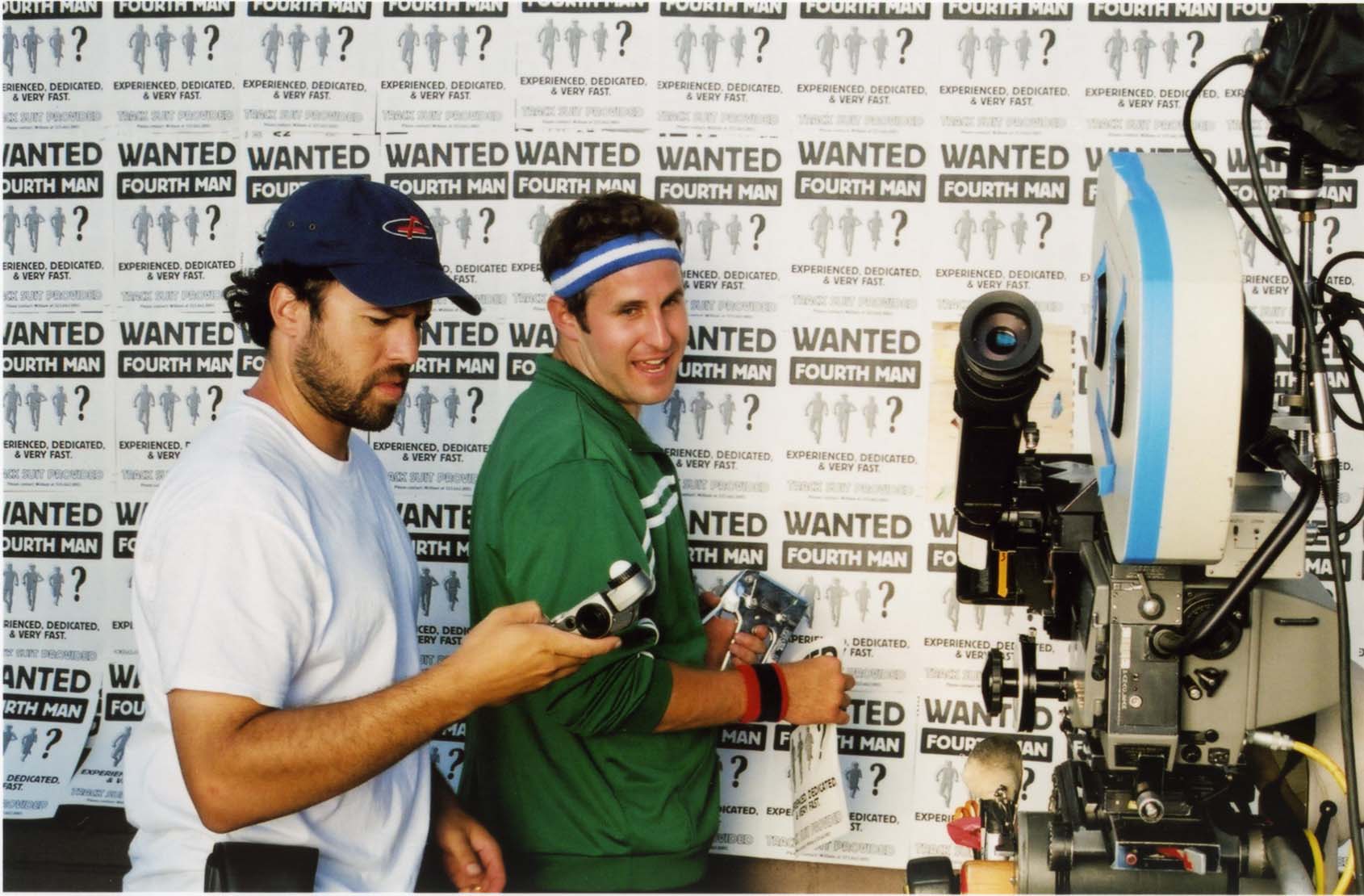
Damian Acevedo (DP), focused as always. Lucas Fleisher ("William"), smiling as always.
I met with Lucas at a coffee shop and when he arrived he was all smiles and contagious excitability. Turns out Lucas is brother to Ruben Fleischer—director of Zombieland. Not that that mattered much because after having watched a few of his films some nights earlier, Justin and I had already more or less agreed to offer him the role. Our meeting, then, became an opportunity to start dissecting the character and building an early solid base from which he could then build upon. His instincts were right on, and we were soon able to get into some extremely specific motivations that were not necessarily in the script. He legitimately loved the role, and approached it with the enthusiasm and professionalism of a paid actor—though for this film he was nothing of the sort. By the meeting’s end, we had not only agreed to move forward with Lucas, but had also been persuaded to cast his friend (and frequent co-star) Riel Paley in the role of Champ.
It wasn’t easy to convince Riel to play a character with barely any lines. He initially pushed for the more substantial role of Hank, going as far as to (without any direction from us whatsoever) interpret the character as a smug, villainous personality with sleek and angular mutton chops (which he diligently grew and groomed for several days before surprising us with the new look). All we could do was assure him that the role of Champ, though understated, was no less substantial, and, anyway, that we had written Hank specifically with someone else in mind. In the end we compromised—he accepted the role, and we let him keep his mustache.
The role of Hank went to Siaka Massaquoi. Siaka and I had gone to the same university and he had a small role in my film school thesis project. But while I moved to the coast following graduation he had opted to stay in the Midwest. Justin and I had been thinking of him for that role even during the scripting process, and figured that if he would be willing to split the cost of a plane ticket, we could afford to fly him out for the production. After a thorough Google search, and several wrong numbers, I finally dug up his correct contact information. As it turned out, he was working as a personal trainer at a gym and moonlighting on some small theater productions in Chicago, but seemed a bit frustrated with his life as an actor. He agreed immediately, and plane tickets were purchased that day.
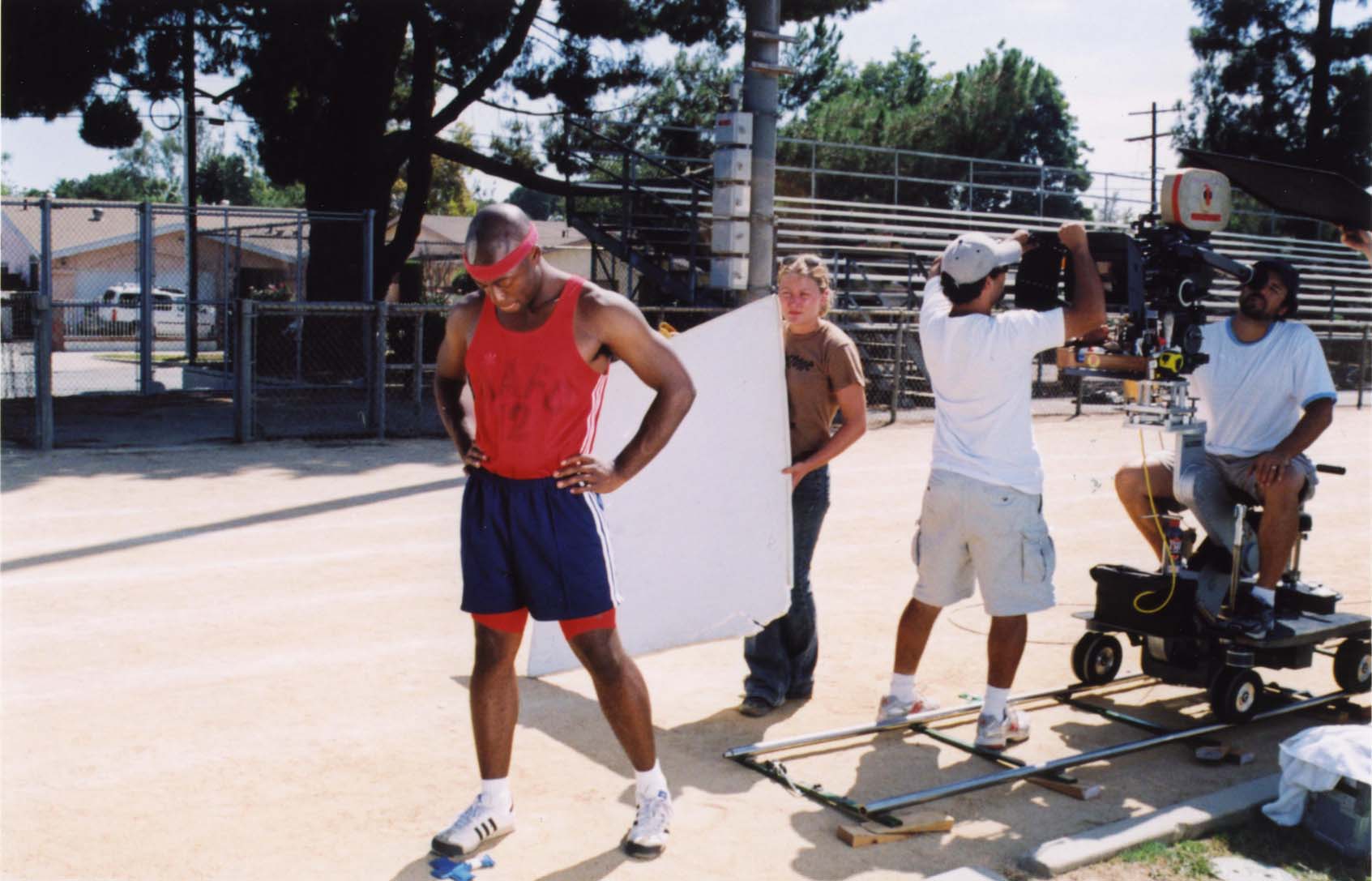
The crew sets up a shot of Siaka Massaquoi ("Hank").
The rest of the actors were compiled through equally eclectic means. With the cast set and Siaka shacked up on our living room couch, we began focusing very intensely on the logistics of the production, figuring out how exactly we were actually going to pull it all off. It was at this point that parts of the script—simple words on a page—became incredible obstacles. Gaining full access to a high school track was on top of that list. We had scouted several stadiums in the area and had gone through the proper channels with a few of them, only to be met each time by someone kindly informing us that they’d be happy to reserve the track for our shoot, just as long as we presented the proper permits and a few thousand dollars a day. Desperate, we spread the word to all of our friends in hopes that they might have better connections in the Los Angeles school districts.
Around this time, we had also, nervously, decided to shoot 35mm. It came from a conversation between Justin and I, each of us admitting to ourselves that we had no choice but to make this film as good—and as professional looking—as we possibly could. We were well aware that we might never get this opportunity again and agreed that we were both willing to sacrifice anything and everything in order to see it through. This, I’d come to find out, would mean selling my car.
Damian had a solid grasp on the look of the film, and now, knowing the medium, was able to tell us what equipment he’d need—not least of which was a Panavision camera. Having an established, respected DP on your side is an extremely valuable tool for an independent filmmaker. Damian personally knows the higher-ups at Panavision from his consistent commercial and music video work, and with his name we were able to secure a camera through their “New Filmmaker Program,” a grant that aims to help independent filmmakers by giving them access to 35mm equipment for extremely cheap, if not free (contact your local Panavision office for more information). The film stock was purchased at various shops around town and, in order to keep costs as low as possible, was compiled primarily using recans and short ends. Damian had also introduced us to some friends of his who were not only willing to Grip for $100/day but also had connections with local Grip and Electric rental houses, allowing us to get all of our gear for extremely cheap.
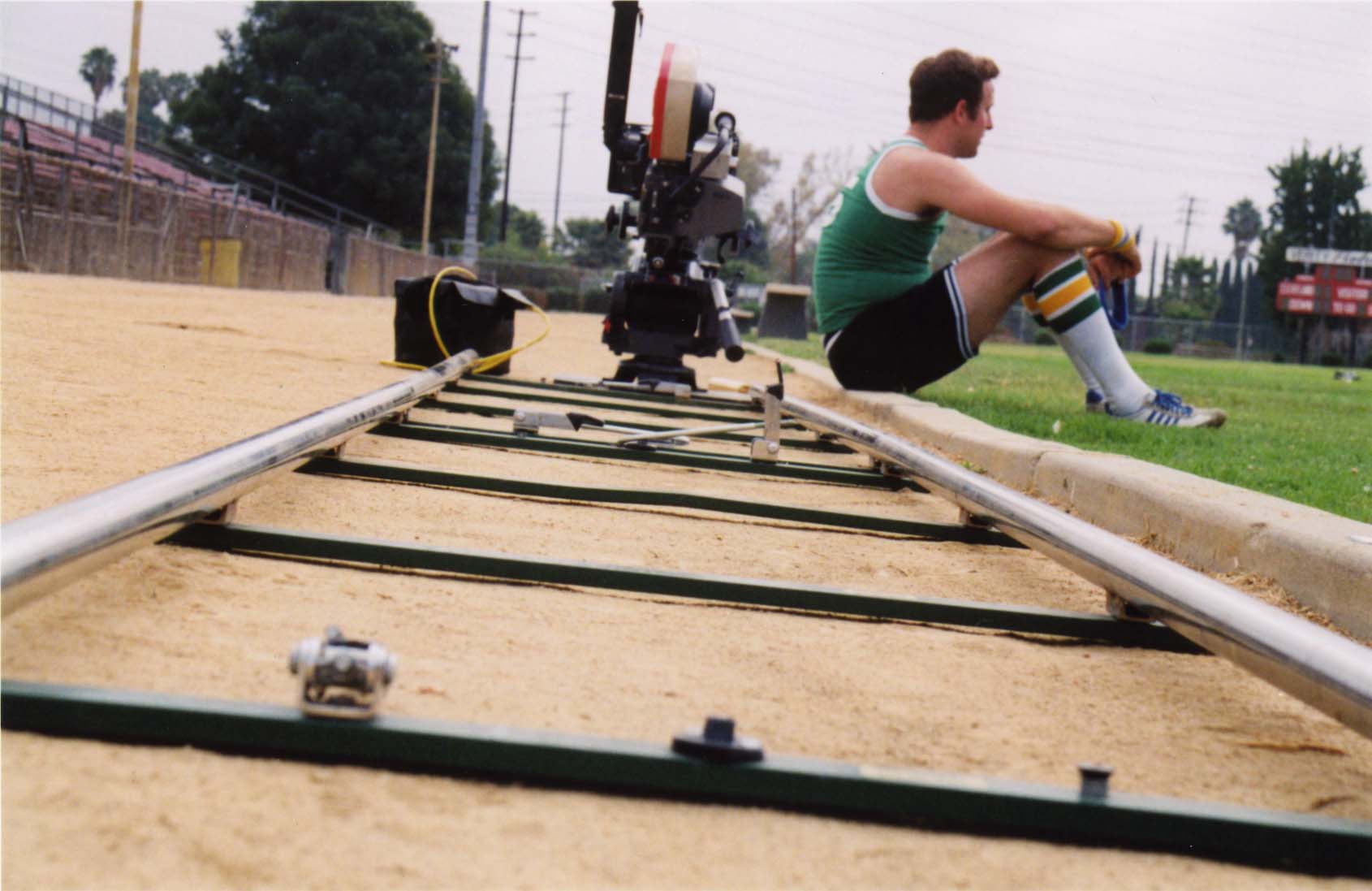
Lucas Fleischer ("William) takes a break from a day of running.
In the week before shooting, with the cast and camera department completely solidified, we turned our attention to some of the more detailed aspects of the shoot. Costumes and props were slowly acquired from Goodwill or Ebay, hot tubs were stolen from trash piles behind pool shops, rooms in our apartment were converted to shooting stages. Most importantly, perhaps, was our art director who, at the time, worked for Nickelodeon, supervising the storage warehouse for all of the shows that were not in production. We had access to all of the set dressing we would ever need.
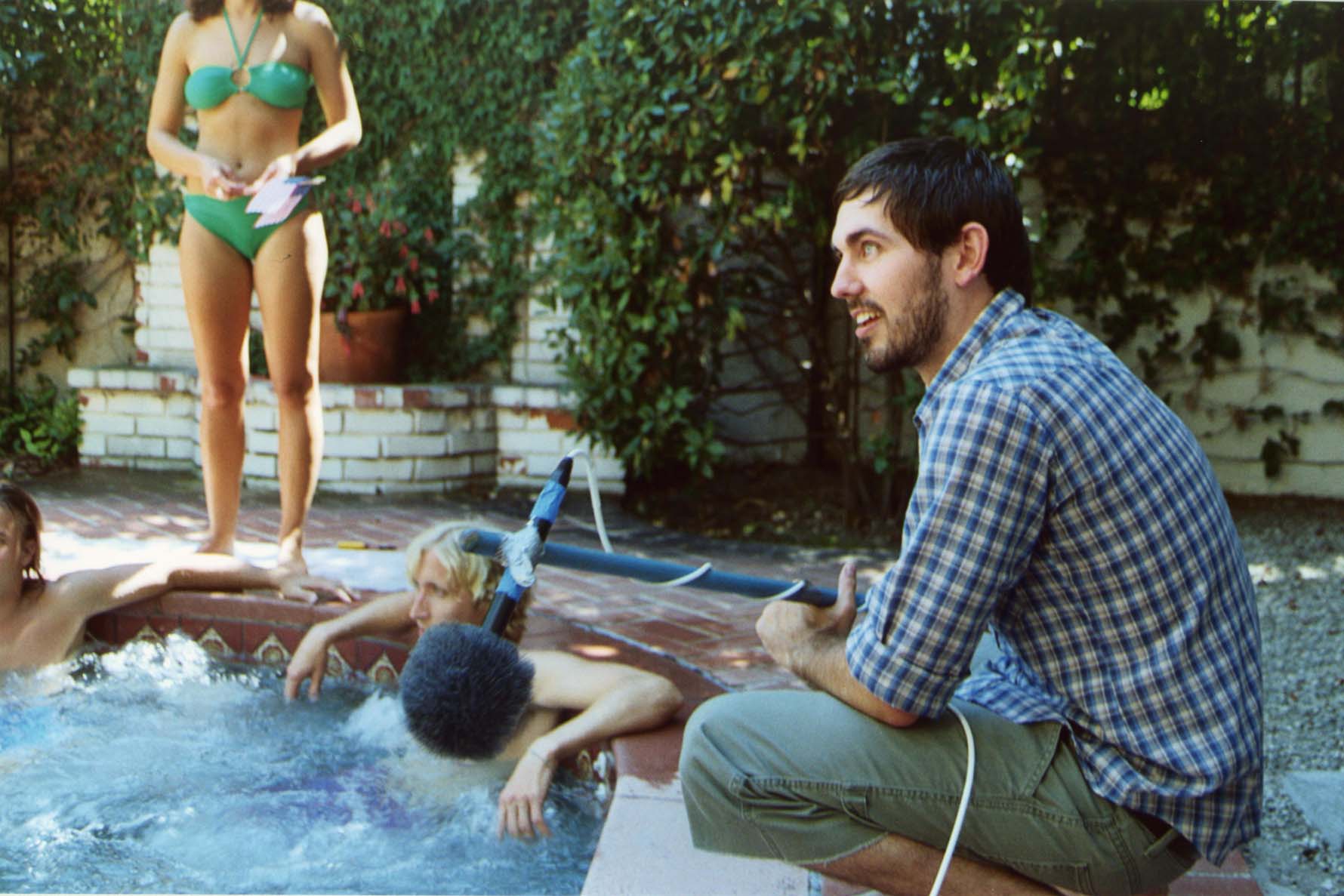
Justin Varava (writer) plays boom operator for a fake whirlpool commercial.
News about the track came in a few days before production. Apparently, a friend of a friend of a friend taught gym at a high school deep in the valley, and would be willing to accept a bribe of $500 in exchange for unlocking the stadium’s front gate. The hot tub store and the three identical houses were found under similar circumstances, mere days before shooting, though for these we were able to talk the owners into letting us use them for free. Sometimes, if you just ask nicely, people are incredibly willing to do you favors.
The shoot went wonderfully and still with much difficulty. It was at once exhausting and exhilarating, demanding and rewarding. We had fun and found ourselves pushed to what we felt was, at the time, our greatest possible potential. There was laughter and liveliness to our days that was, and still is, rivaled by perhaps nothing else in the world. We worked with ignorance to the outside world and to that which our normal daily lives used to be, and would surely once again become. We raced tirelessly to the end, cramming all that we could into 5 days, surviving off of craft service peanut butter sandwiches and taquitos, and when it was over, we slept with a sense of accomplishment and utter love for the opportunity to be a part of something so undeniably special, an experience that would stay with us forever.
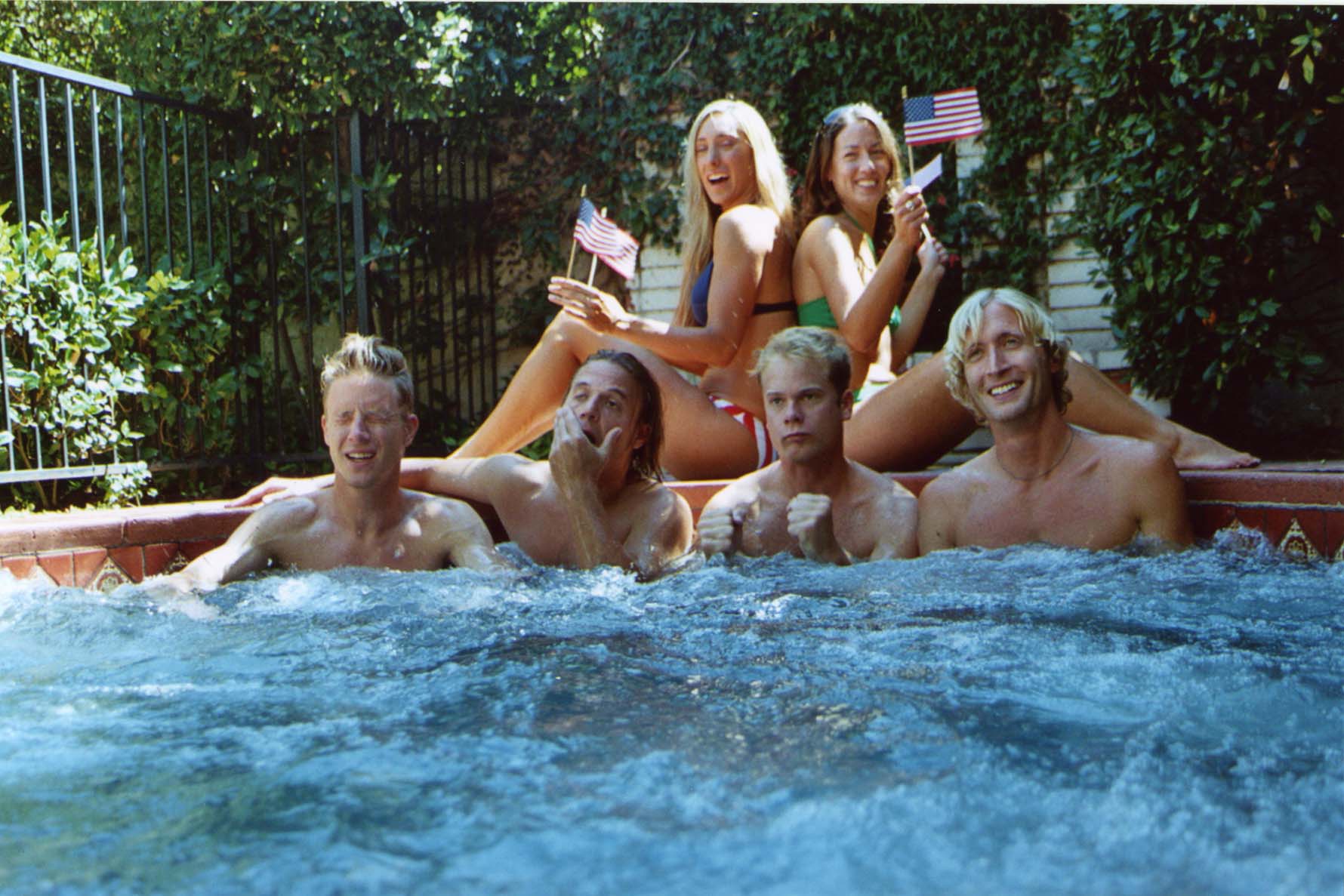
The Stryder Brothers.
After the shoot, by the time reality settled back in and the processing and telecine sessions rolled around, we had become rather seasoned in the whole haggling process. It became very clear that most aspects of filmmaking were negotiable, and we would take full advantage of that. As long as we were honest about our budget (or lack thereof) and could convince people that the project was a noble endeavor with genuine talent attached, we found that even the most expensive line items could be acquired for reasonable rates. We often lied about our phony student status to get better deals, we made up stories to the cashiers at Target as to why we were returning such an inordinate amount of gym shoes, and we pulled every favor we could possibly think of.
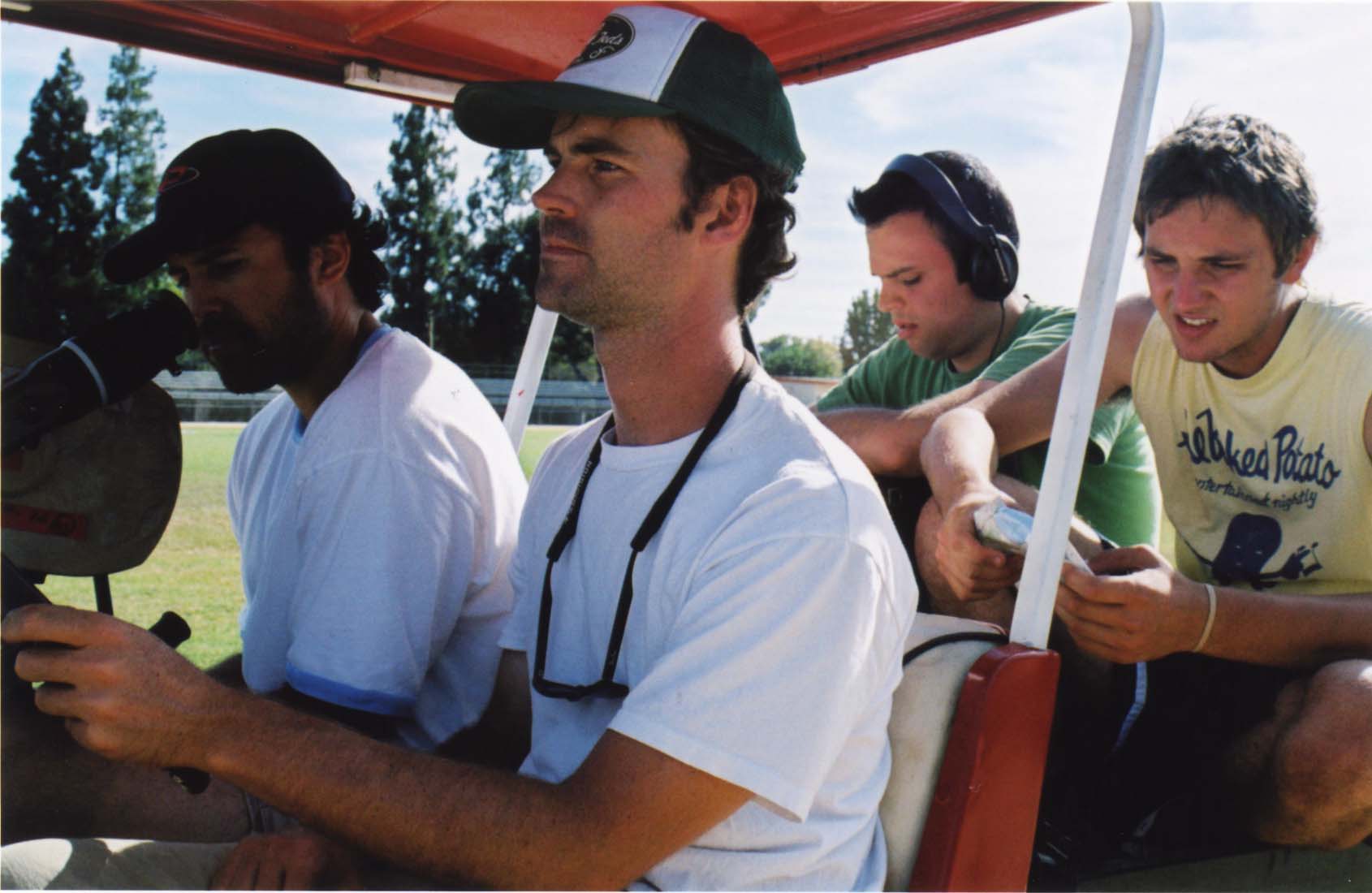
This golf cart was stolen from a nearby baseball field. It worked pretty well as a dolly.
Post-production consisted of three major favors. A friend and editor, with an Avid in his home, agreed to assemble the movie for us (a process that took a total of only nine hours due to the detailed planning and economy of our shooting style). The film’s sound design was completed by another friend, a musician, who was in the middle of engineering an album, and, as a result, had access to an entire recording studio complete with a full ProTools setup. And, the film’s wonderful music was being composed and recorded in Iowa, by an old friend from college. With the exception of a case of beer here and there, there were no costs accrued during the entire post-production process.
Movie done, we then went on to do a run of festivals. And after the festivals, we put the film up on Vimeo. And, bless their hearts, those kind folks emailed one morning to inform me that we’d been selected for a Staff Pick. Simple as that. No application required, no bribery involved. It doesn’t seem to matter who you are—bigwig, reclusive genius, family to a famous person—there’s no way to ensure yourself a Vimeo Staff Pick. They just like what they like over there and seem to genuinely dig deep to find it. Fortunately—after the entire slog of making the thing!—they awarded us a very nice conclusion, indeed.
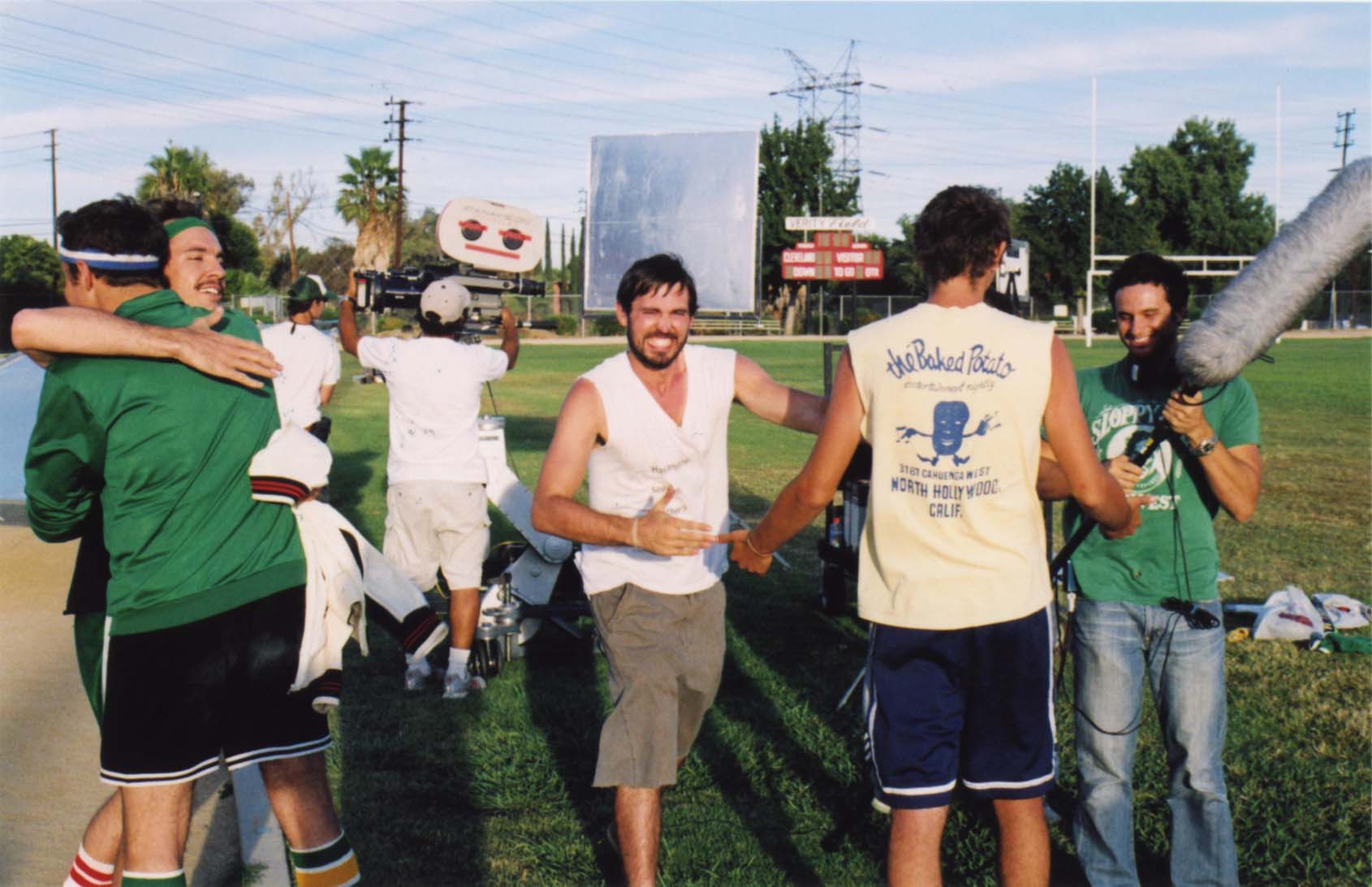
Wrap.
Making The Fourth was an intense learning experience. At the time it was certainly the most professional filmmaking I’ve ever been a part of, but also the most difficult. Since that film, production has gotten a little easier (stress, a LITTLE easier), more contacts have been made, past mistakes have been corrected, and I’ve acquired a better overall understanding of the process as it seems to work in Los Angeles. But independent filmmaking is really just an act of survival. It’s an uncompromising fight to accomplish something incredibly unrealistic, taking whatever steps necessary, by any means possible, to see it through to the end. It’s a medium of passion and commitment, of freedom and self-expression. And, looking at it in that way, it is important and—I think even my college professors would agree—it is artistic.
Here’s a behind-the-scenes look at the making of The Fourth:
"Go Fast" - Behind the Scenes of "The Fourth" from TAR+FEATHER on Vimeo.