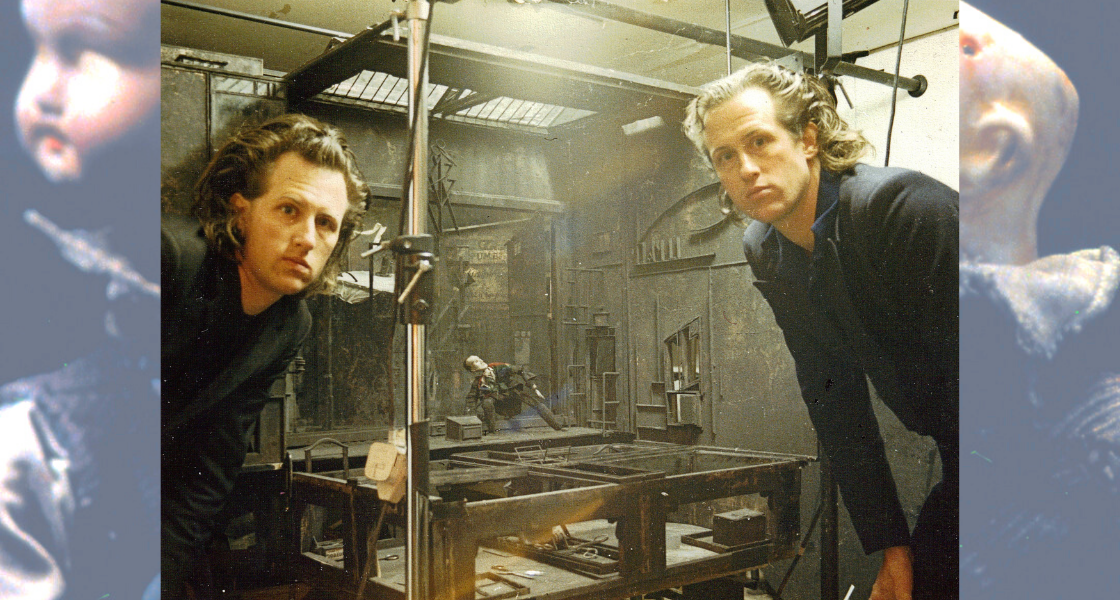
You may not be familiar with the names Stephen and Timothy Quay, but you’ve most likely been indirectly influenced by their work. Known as the Brothers Quay, these identical twins are best known for their surrealist and horrifying style of animation.
The Quay Brothers are often seen as the most renowned contemporary authors of “puppetoon” animation, a style of stop-motion animation where the puppet is replaced from frame to frame. Filmmakers as famous as Christopher Nolan, Tim Burton, Jordan Peele, Wes Anderson, and Terry Gilliam have cited the Brothers Quay's animation as a source of inspiration. Their animated shorts are even considered artistically significant enough that the Brothers Quay were given their own exhibit at the Museum of Modern Art in 2012. This is where I personally became familiar with them.
In this blog post, we'll break down five of their most popular works and how they have impacted some of today's most beloved filmmakers.
Arguably their most famous work to date, the Brothers Quay's "The Street of Crocodiles" is a surrealist exploration of childhood and memory.
Originally a short story written by Bruno Schulz about his childhood, the Brothers Quay took their own spin on the work in 1986, creating a 21-minute short film. "The Street of Crocodiles" and its animated dream sequences both revive and ridicule childhood and our adult memories of it in a grotesque, fetishistic manner. It provokes questions about the relationship between animation, modernity and the child's place within this lifeless, unfeeling world of technological advancement.
The Nine Inch Nails music video "Closer," directed by Mark Romanek, was heavily influenced by "The Street of Crocodiles." Watching the music video, you can view the same surreal and creepy atmosphere that we see in "The Street of Crocodiles." Both videos explore dark themes such as the human subconscious and the intersection of technology and humanity.
Another filmmaker who was influenced by "The Street of Crocodiles" is Tim Burton, who found it to be a major inspiration for his 1993 film The Nightmare Before Christmas. Both films transform a childhood world into something grotesque and adult, where inanimate objects become animate, adding to the creepy atmosphere. Just as the puppet in "Crocodiles" undergoes bizarre changes and questions their own identity, Jack Skellington in The Nightmare Before Christmas faces his own identity crisis and embarks on a journey of self-discovery.
The short film "Street of Crocodiles" remains a landmark work in the realm of surrealist animation, influencing numerous artists and leaving a lasting impact on the genre.
"In Absentia" is a short film commissioned by the BBC as a part of a series called Sound on Film International. This was a unique collaboration with the filmmakers The Brothers Quay and composer Karlheinz Stockhausen. The Quays used entirely natural light to film as it came through one of the east-facing windows of their studio. For a surrealist black-and-white emotional film, this was revolutionary filmmaking.
At the time of production, Timothy Quay didn’t have a home and had taken to sleeping in the studio. Taking advantage of this, the Brothers would pre-align the mirrors they were using to capture and direct the light. Then Timothy would wake up early at the studio and wait for the morning sun to hit the set before filming. This proved challenging because the sun changes positions from day to day, which forced them to track the lighting to ensure consistency.
Among the fans of the Quay Brothers is Christopher Nolan, who has cited "In Absentia" as an influence on his work. His films often employ surrealist imagery and non-linear storytelling, common themes in the Quay Brothers' works. Robert Eggers is another filmmaker who seems to have drawn inspiration from "In Absentia," both in terms of its visual style and its psychological themes. You can see this influence most clearly in his films The Witch and The Lighthouse.
Frequently called "Eraserhead in Prague” it’s hard to not see a lot of similarities between David Lynch’s works and this film. If exploring the Quay Brothers' work interests you but creepy puppets aren’t your thing, I'd recommend starting with this film.
Their debut feature film, Institute Benjamenta, or This Dream People Call Human Life, is a loose adaptation of Robert Walser’s 1909 novel Jakob von Gunten. The film follows von Gunten into a peculiar institute for the training of servants, where order is slowly breaking down.
Though chiefly a live action film, Institute Benjamenta captures the essence of the Quay Brothers' style. It depicts a dusty world as fragile as a cobweb, where people walk through chalk circles and witness Tarkovsky-like reverence.
The Brothers were not pleased with the film's length. In retrospect, they felt that it would have been better as a short film or a much longer piece of art.
Despite their regrets, the film has been influential, having an impact on directors such as David Lowry (director of A Ghost Story) and Ben Wheatley (director of A Field in England).
The Brothers Quay's "The Comb" is a short stop-motion film that revolves around a specific object: a comb. A man interacts with the comb, which exerts a strange influence over him, and it forces him to go through a series of disturbing transformations.
In "The Comb," the Quay Brothers explore the theme of both physical and psychological change. The man's physical appearance changes as he interacts with the comb, as does his behavior. One interpretation of the short film is that it's a metaphor for a crisis of identity. People's identities are fluid and can change just as easily as the man's when he finds the comb.
Terry Gilliam, who has expressed admiration for the Quay Brothers' films, explores similar themes in his 2009 film The Imaginarium of Doctor Parnassus. Also set in a surrealist dream world, his film features a main character who is forced to confront his true nature as he goes through a series of dramatic physical transformations.
Often called one of the best music videos of all time, Peter Gabriel's "Sledgehammer" utilized a groundbreaking combination of animation styles and innovative filming techniques. To create this video, Peter Gabriel laid under a sheet of glass while he was filmed one frame at a time. The Brothers Quay, working with Aardman Animations and director Stephen R. Johnson, then painstakingly combined those frames with surrealist claymation, pixilation, and stop motion animation.
In 1987, the music video for Sledgehammer won the most MTV Music Video awards in history, a record which still stands today. Ironically, it even beat Genesis’ “Land of Confusion” music video for the MTV Music Video of the Year award, despite that video featuring Quay-inspired puppets.
The Quay Brothers may not be a household name, but they have clearly had a lasting impact on the world of surrealist animation. From the unsettling exploration of childhood in The Street of Crocodiles to the absurdities of Sledgehammer, their work has left a lasting mark on cinema.
To learn more about them, check out Christopher Nolan's short documentary from 2015, titled "Quay."
What are your thoughts on these short films? Share your insights and let us know how the Quay Brothers have influenced your own work.
Want to develop a distinctive visual style for your brand? Tongal can help!