
Note From Tongal: “Seed&Spark’s Tools for Crowdfunding Success" is part of a series of Tongal Community-written blog posts that were originally sourced in the Tongal Blog Open Call Project. Read more Tongal Community-written posts here and then Pitch us a topic you'd like to write about for the Tongal Blog!
--
Seed&Spark is a resource for filmmakers and creators who are looking to jumpstart the crowdfunding and audience building portion of their projects' development. Unlike other crowdfunding platforms, such as Kickstarter and Indiegogo, Seed&Spark invests in its filmmakers, providing them with the education to move their project from funding to distribution and even a streaming service to feature those same projects once they have reached completion. And at 80%, Seed&Spark has the highest campaign success rate of any other crowdfunding platform (Kickstarter is next on the list at 30%).
As a filmmaker herself, Emily Best founded this start-up to create a new studio process for independent filmmakers who want to retain creative control of their projects and showcase diverse, original stories as they were intended to be shared. In 2010, Best created the first prototype for Seed&Spark to raise funds for her first feature film, Like the Water, along with the project’s director Caroline Von Kuhn and first assistant director Liam Brady. At the time, Kickstarter was known in filmmaking circles but not known as well in the broader community from whom Best, Von Kuhn, and Brady were seeking to gain support. Over the course of thirty days, they raised $23,000 ($3,000 more than their fundraising goal). During the film’s shooting, they received hundreds of thousands more from supporters in the form of donations of services, locations, material goods, food, and beverages.
I spoke to Emily Best to learn more about her take on how the film industry is evolving, what crowdfunding should be used as a tool for, and her advice for independent filmmakers.
Juliana Clark: What was the need in the independent film community that you were trying to meet with Seed&Spark?
Emily Best: In the beginning, I never meant to be in film. I didn’t like the way that women were being represented on screen. The whole business model for film is not built for people who want to do things differently.
When I was producing my first film, Like the Water, we needed to know why we wanted to make the film and how we wanted to make films different with this film. Crowdfunding helped us answer those questions, which contained essential information for us when we were building an audience and searching for distributors.
For this project, we made a wedding registry, which was set up to allow supporters to buy a concrete material good or service, like coffee for one day of shooting or rental fees for camera equipment. Audiences really glommed onto it, and more than 400 people got involved in the campaign and that was just on WordPress.
Other filmmakers started asking us for advice. Filmmakers and distributors were excited to know more about our audience because crowdfunding had given us a built-in group of people who wanted to see it. Overall, crowdfunding helps filmmakers build a relationship with the audience to change the power dynamic for distribution.
When we eventually went to Sundance with Like the Water, we asked filmmakers who had crowdfunded more about their experiences, and they all said that distribution is the hardest part because it almost always gets put last.
The internet makes it easy for filmmakers to distribute content. YouTube and Netflix were the companies that had promised to make those parts easier, but now those companies control audiences and data like the larger studios that they initially were trying to break away from. Crowdfunding allows filmmakers to take the power back from those companies by taking it out of their audiences. Ultimately, it’s a tool for building an independent sustainable career as a filmmaker.

Juliana: What are the classic mistakes that you see in crowdfunding platforms?
Emily: Funding and distribution are something that you earn, not something that you do. You earn funding by proving to audiences that you are making something that you care about. Distribution is work that you have to do through the very bitter end. Without it, you don’t make the movie.
Juliana: To what do you attribute Seed&Spark’s success?
Emily: Two things. First, we focus on national education. We teach live workshops over 100 times a year, which is built into our onboarding process. Second, we are real, live human experts who review the campaign and give feedback to help realize a project. Also, the team consists of filmmakers who all crowdfunded successfully on Seed&Spark. They speak from experience, especially from having helped hundreds of campaigns.
Juliana: How would you sum up Seed&Spark’s vision?
Emily: We want to build a thriving, sustainable middle class. What sets us apart is that we ask every filmmaker to make a public-facing statement about how their film increases diversity, which can be by age, class, ability, geography, or any number of ways.
Juliana: What was your reasoning behind turning Seed&Spark not just into a crowdfunding platform, but a streaming service?
Emily: We wanted to set these filmmakers up with a direct connection to their audiences. We have helped well over a thousand movies and shows be made. We are tired of pumping into a broken and opaque distribution system where filmmakers get paid terribly unfair royalties. Typically, filmmakers are paid six cents per hour of streaming. To tackle transparency, we have to tackle fair royalties. It’s a matter of closing the loop. If you are an internet entrepreneur, the one thing that you need is to have transparent access to the sales funnel to efficiently deliver to your audience/intended user.
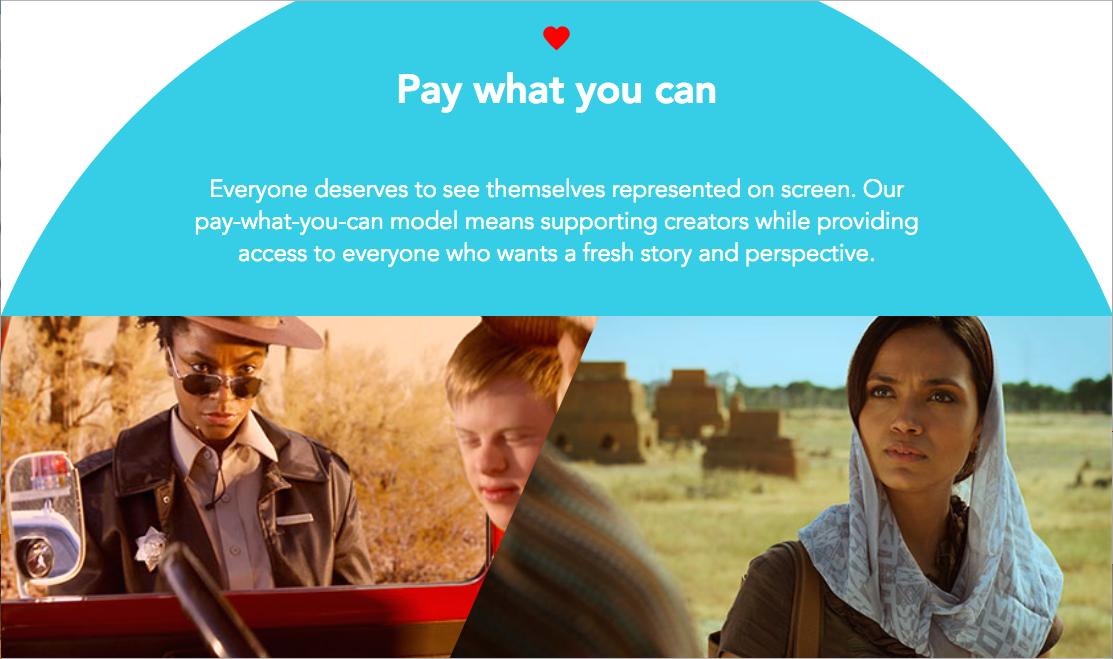
Seed&Spark pays a royalty of 18 to 30 cents per minute. We transparently share data in a way that is anonymized to show filmmakers where audiences are coming from and how they found a specific film, information that will be extremely helpful for marketing. Through streaming, we also want to create economic access for audiences. We are a pay-what-you-can service. Streaming services used to be the way to get out of paying for cable, but now, paying for multiple streaming services to have access to diverse kinds of content is going to add up to the same amount that a regular cable bill would. It’s ridiculous.
Juliana: Do you have book or website suggestions where filmmakers, who are interested in crowdfunding, can learn more about the process?
Emily: Go to the Seed&Spark website. Click the “For filmmakers” tab, then “Filmmaker education.” There, you will find a free crowdfunding class.