
Note From Tongal: “Preparing to Go Viral: 5 Things I Wish I Did Before My Content Went Viral" is part of a series of Tongal Community-written blog posts that were originally sourced in the Tongal Blog Open Call Project. Read more Tongal Community-written posts here and then Pitch us a topic you'd like to write about for the Tongal Blog!
---
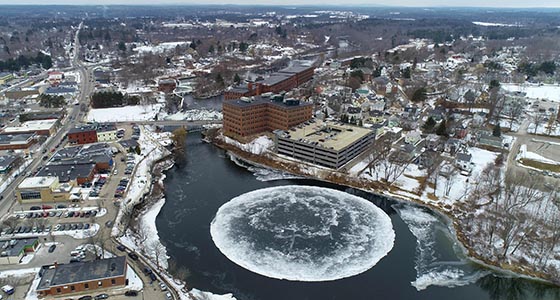
I’m not saying it was aliens, but it was aliens that helped my content go viral. “There’s a Huge Ice Disk in a Maine River. No, the Aliens Aren’t Coming,” read the headline in the New York Times. Some headlines compared it to the moon, some compared it to crop circles, not just because those references act as enticing clickbait, but because it really was an unusual visual spectacle that looked like those things.
When I was first tipped off about a huge circle of ice slowly rotating in the Presumpscot River in Westbrook, Maine - the city I am responsible for promoting - I figured since I was heading out any way I would take the drone and check it out. I launched the drone (after getting appropriate clearance from the FAA), and from the aerial perspective, it was pretty cool looking. It actually did resemble the moon.
When I got back to the office I grabbed a few frames from the video and posted them on Instagram in a routine and hasty manner, having no expectations other than a typical response to a normal social media post. I did not use much of a description, because, frankly, I didn’t know what to call it. After a quick Google search, I went with “Ice Disk” and went about my busy workday. Had I known then that it was going to go viral, I would have put a lot more thought
into the post, because before I knew it, amidst the government shutdown, a slow news day and the dead of winter, the images and video I captured of the giant ice disk began to spread…well…like a virus.
My phone started blowing up with calls from media outlets like the Weather Channel, local TV stations and prominent news organizations, and I worked my way through several phone interviews the remainder of that afternoon. From there, I went into full-on media management mode for the next few weeks.
Good Morning America and CBS Morning News were en route to broadcast live. I was inundated with calls and emails from all over the world, fielding constant requests in an effort to maximize the exposure for the city I am in charge of marketing.
The whole experience was very exciting, BUT had I known this content would go viral, I would have done a few things differently. Really, it is just a matter of being prepared, organized, and following best practices. So here are a few tips to prepare for your viral moment:
1.) Use Hashtags & Mentions Effectively
This is nothing new, if you are reading this you are likely a Tongaler and certainly know what they can do, but do you always use them? To be honest, I don’t, but in this case, it would have been beneficial, and it is good practice if you are a marketer.
If you expect to reach people outside of your immediate community, hashtags are key. Hashtags should relate to your content, your brand, or to the target audience you are trying to reach. They work very well at attracting viewers on Instagram and Twitter.
Think about search terms people will use to find your subject matter. Stay focused, and do not use too many hashtags in one post. Five is probably a good number. When your content goes viral and people use that keyword to search – in this case, “Ice Disk”– you want them to land on your posts so you and your brand will get the exposure. If you don’t use them, news agencies and other people hoping to get views will; and they will get the social amplification via retweets and shares.
You also may want to mention publications that may have an interest in your content. In this case, it would have been good to mention @NatGeo or @WeatherChannel, for example – although they found my content anyway.
2.) Protect Your Original Work
If you or the organization you work for are the original author, although not a requirement, it would be in your best interest to include a copyright notice on your work or at least a watermark. A copyright notice should look like this: Copyright ©2019 Your Company Name, Inc. All rights reserved.
Copyright law automatically gives the original creator ownership rights to their creation. For example, if you take a photo, shoot a video, or write a screenplay, you’ve created something new and original. Once you share that publicly and allow the public to access it, copyright law takes effect to help protect your creation. If anyone shares your work and it has the copyright notice on it, at least credit can be properly attributed to the rightful owner.
If someone violates your copyright, by copying your creation, claiming authorship, or attributing it to himself or herself, copyright law allows you to enforce your rights and maintain your ownership.
Lesson Learned - During my viral moment, a major news organization claimed copyright on YouTube to a video I wholly created. This prevented us from monetizing the video (if we were so inclined) until the issue was resolved. This is bad – your own content is locked up from monetization while it is trending on the internet. We had to file a dispute and wait until YouTube resolved it. This also could have prevented us from licensing our content until the claim was resolved. Do what you can to protect yourself from this by planning ahead.
3.) Media Contacts and Press Releases
Keep an organized, easily accessible list or database of media contacts. If you want the press to grab hold of your work and help share it, a press release can help spread your newsworthy content. You will also want to maintain control over the story. By sending out a press release you can typically provide more detail than a social media post and include key details of the who, what, where, when, why and how. What you put in that press release will become the bible. It will be copied and pasted into news stories all over the world and your name will be attached. Include contact information, attach your images and videos and let them know how to properly credit the content. If the Associated Press grabs it, every news organization across the country will likely use the same story verbatim – so it better be right.
4.) Digital Asset Management
Keep your digital assets organized, easily accessible, labeled, named and dated so when media outlets ask to use them, they can easily be retrieved. Tongal has a wonderful Asset Management Guide. Check it out and start using best practices for organizing all of your media.
In many cases, there will be follow up stories. Your viral content is their viral content. If it is an evolving story, you will want to re-use your media, and some media outlets may seek to use it for future works like “Weather Gone Viral,” for example.
5.) Licensing
How will you handle the sharing of your content once it goes viral? I suggest consulting a legal professional now and familiarizing yourself with licensing terms, agencies, opportunities, restrictions, and fees etc. As a video/content creator in the digital age, being informed about licensing options will help you make key decisions on how you will share your awesome content. You may even be able to profit (I couldn’t because I work for a municipality).
When your content goes viral, you will be asked for permission to use your content by news media all over the world. Sharing it for free will definitely give you great exposure, and there is value in that; but what if it goes beyond a news story? Knowing the terrain and doing the research now will help prepare you for when your awesome content explodes. Developing a plan or policy for how you or your organization will handle this will serve you well.
It may be helpful to have a standard response statement prepared that will grant permission for use and protect you at the same time. The statement should describe how your content can be used, how it must be credited and include your copyright notice.
If you know you won’t have time for responding to usage requests and media outlets, you may want to license your content. An agency/platform like ViralHog will manage the back-end agreements, seek out copyright violations and handle distribution. When and if you are offered a licensing deal, you will want to consider costs, profits, nonexclusivity
and whether or not you will be able to maintain a level of control and ownership.
If you are lucky enough to have your content go viral, you will need to facilitate the asks and needs of media outlets all over the world. Being prepared and considering the tips above will help you to maintain control over the story and content. So, my advice is - do the extra work now, because you never know when aliens or crop circles or even the next giant ice disk may show up in your neighborhood and you just happen to be the first to capture them with your
camera.