

Note From Tongal: “Oh Hi Mark: How Terrible Writing Makes Us Better" is part of a series of Tongal Community-written blog posts that were originally sourced in the Tongal Blog Open Call Project. Read more Tongal Community-written posts here and then Pitch us a topic you'd like to write about for the Tongal Blog!
--
When studying any craft it is always vital to consider the work of the masters who have come before and shaped the field. In screenwriting, there is much to be learned from the incredible works of the industry greats. The distinct dialogue, pacing, and action all assist in bringing great stories to life, thus providing textbook examples of exemplary screen work. While it is easy to appreciate and admire good work, there is also a case to be made for observing bad writing.
Most people are familiar with Tommy Wiseau’s The Room due to its cult following. The Room’s popularity has only continued to grow following James Franco’s adaptation of Greg Sestero’s book, The Disaster Artist, which details Sestero’s horrendous experience filming on set. Today, The Room is largely considered to be one of the worst films of all time, yet individuals within and outside the film community genuinely love it. Films such as these fall into the “so bad it's good” category. There are live reenactments, a fan-made video game, and the film continues to be screened regularly in theaters over fifteen years later.
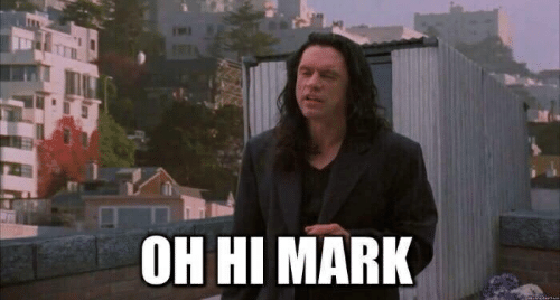
I highly recommend reading the screenplay in its entirety, but nowhere is the essence of The Room more clearly displayed than in the infamous rooftop scene:
Johnny is seen violently ranting aloud about a denial of domestic abuse climaxing with a dramatic toss of a water bottle. Then, without missing a beat, Johnny turns to deliver the legendary line— “Oh hi Mark!” It’s perfectly dreadful. The contrast is ironic and unexpected, leaving viewers with the feeling of directional whiplash. It’s jarring because it simply does not fit. In the following dialogue scene, Johnny laughs at a story about a woman being put in a hospital and Mark fumbles with a youth football. There is nothing discreet or smart about the way their dialogue plays out. Tension is destroyed before it exists. The scene is overloaded with non-related bits of information, and most fatally, nothing feels authentic. Every screenwriting rule is broken. All instincts are ignored.
The list of amusing cinematic blunders within the film are limitless (Go watch and see for yourself!). It is evident that The Room is a bad movie from the first scene when Johnny delivers a present wrapped in cheetah-print paper until [SPOILER ALERT] the audience views his very bloodied - still-breathing? - corpse. But why is it that so many viewers adore this film, as well as other similarly awful movies? Often the people who find pleasure in bad movies are able to do so because they have an understanding of what makes a film good. Viewers initially laugh at bad films because they subconsciously label what they are viewing as inappropriate. The gap between what constitutes “good” cinema and what they are viewing is what makes them laugh. It’s when we examine why we’re laughing that we can begin to critically evaluate what makes it dumb.
When at his surprise birthday party, Johnny addresses Mark with, “You’re just a chicken. Cheep cheep cheep cheep!” I can’t help but laugh. But why is that? There are many reasons. The line is delivered amidst a high-intensity scene, yet happens to be the least aggressive line. The other party-goers' reactions are over-the-top. There is the issue that no chicken “cheeps.” None of these factors alone ruin the scene but together they unintentionally create the perfect storm. This is the primary reason why The Room in particularly bad —the immense scale of its failure. The writing traverses blindly unaware like an intoxicated bull in a china shop. The Room aims to be a hard-hitting drama by tackling complex themes like adultery, betrayal, and suicide, but misses the boat by a long shot. Unlike other “bad” films like Sharknado or The Toxic Avenger which operate under a level of self-awareness, The Room stands blissfully ignorant. And a good film aficionado recognizes and learns from this ignorance.
Returning to The Room, here are some examples of how a film lover could observe a failed line and then analyze it in the context of a finished scene.
“… And I’m dying…”
When Claudette breezily announces she is dying from breast cancer, one would expect it to play some contribution to the plot yet this is not the case. A quickly noticeable fault in bad films is superfluous writing. Lines without intention do not serve the plot or character development and come across as non-sequiturs. Strictly-defined motives and goals should be the continued focus in every moment within a scene. With a central strand in which all other plot and dialogue relate to, any details or action outside this serves as a distraction.
“You’re having an affair with Lisa, aren’t you!”
Another tendency within bad movies is to destroy subtlety. Characters scream exactly how they feel and their intentions. Not only is this unrealistic, but it also removes any chance for deeper complexities or internal motives. Instead of asking the viewer to engage and interpret, they are told outright. When observed in the whole of the scene, it leaves very little to audience imagination and makes developing characters of depth very challenging.
“You’re tearing me apart Lisa!… Do you understand life?”
Johnny gives the most dramatic line of the film only to be followed seconds later with an earnest philosophic question. Rather than focusing on the lines themselves, the unnatural tone shift of the scene seems to be almost jarring. The pendulum swings from one side to the other with one emotional leap. Conflict must naturally build and subside during each scene to create tension. When this is ignored or executed haphazardly, it removes the audience from the experience.
These are just a few of The Room’s writing offenses which can also be observed in many other bad films. By viewing such films with a critical eye, students become aware of and learn to recognize the shortcomings more directly so as not to repeat them in their own works.
At the end of the day, a study of the Criterion Collection may prove enlightening, but don’t forget to make some time for Nicholas Cage’s The Wicker Man too.