Disclaimer: the video clips included in this article include scenes of graphic violence.
With Halloween fast approaching, young filmmakers everywhere often feel inspired to start creating horror content to celebrate the season. But before you crack out the fake blood and prosthetic limbs, it’s important to consider the fact that a successful horror flick is dependent upon a memorable villain that will cause audiences to squeal with terror and delight. Let’s take a look at five of the most popular villains of the horror genre in order to determine what makes them so effective. Hopefully by revealing the key qualities that distinguish these frightening characters, this article will provide you with a blueprint when crafting your own villain and help maximize tension and fear in your next horror creation.
Micheal Myers
In John Carpenter’s 1978 film Halloween, the psychopathic serial killer Michael Myers stalks and murders a group of adventurous teenagers in the small town of Haddonfield. This film successfully explores the nature of existential evil and showcases the dangers that exist just beneath the surface of modern America. Moving like a phantom, Myers vanishes and appears at will to terrorize his victims who are too frightened to protect themselves against his attacks. Why is he such a scary villain? Perhaps it’s because he appear almost human - as we can see in the included montage, the ghostly white mask that he wears throughout the film (which was based upon an image of William Shatner) is unassuming from a distance but when you get too close you quickly realize that it is the face of a dead man. This creepy image plays on Freud’s notion of the uncanny and gives the viewer the chilling feeling that what they are seeing is both familiar and strange simultaneously. Carpenter wisely chose to keep Myers’ face concealed from the viewer up until the very end of the film giving the impression that he is inhuman and almost otherworldly.
Jason Voorhees
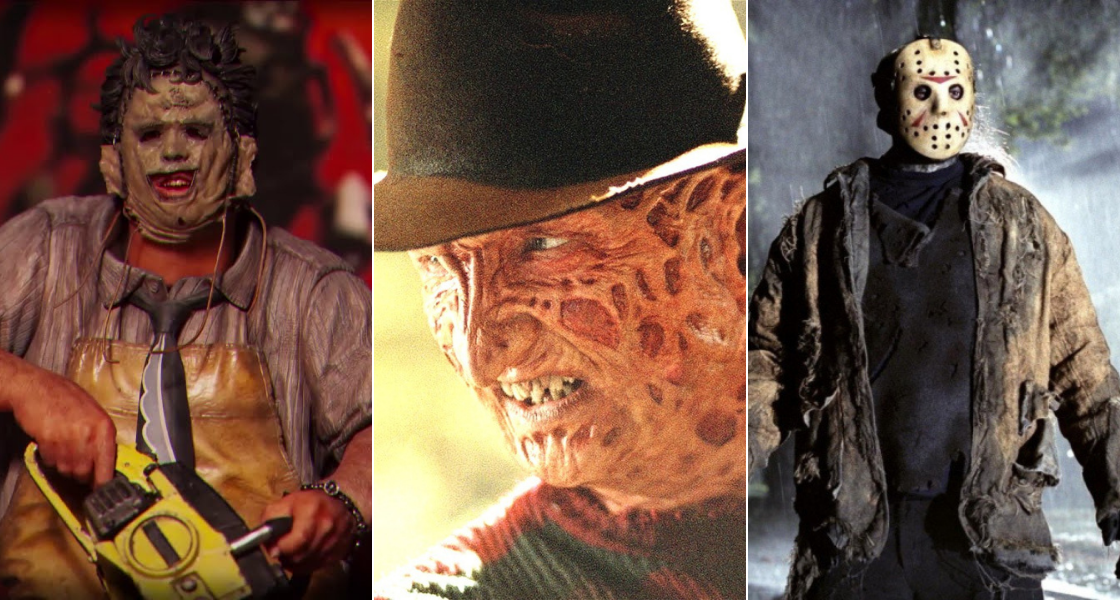
Jason from Friday the 13th is one of the most recognizable villains in horror film history. Hanging out at Crystal Lake, he murders generation after generation of camp counselors who visit the area out of anger over the death of his mother, Pamela. Jason’s rage is unstoppable as he has been stabbed, drowned and set ablaze throughout the film series, yet he always seems to resurrect himself. So what makes Jason such an effective cinematic villain? Well, his disturbing fixation on his mother and, as shown in this clip, he has the grotesque habit of collecting the dead bodies of his victims in order to create a shrine dedicated to her. Also, the creepy image of the hockey mask that Jason wears has become one of the most popular Halloween costumes on the planet, cementing his role as a horror icon.
Freddy Krueger
In A Nightmare on Elm Street, the teenagers of Springwood, Ohio are plagued by horrible dreams in which they are attacked by a scarred man with a razor-taloned glove named Freddy Krueger. Nancy Thompson, a popular and intelligent young woman tries to stop Freddy by uncovering the truth about his death only to discover that it occurred at the hands of her parents and their friends. Freddy Krueger is a particularly effective villain because he is able to control his victim’s dreams and, therefore, they are unable to escape his onslaught. As demonstrated in this clip, writer and director Wes Craven used grotesque surrealistic imagery to convey Freddy’s frightening powers and in the process created one of the most memorable horror bad guys. Freddy’s sadistic sense of humor also contributes to his terrifying onscreen presence as he often mocks and taunts his victims before killing them, thereby pouring salt into their literal wounds.
Leatherface
Leatherface, the central villain from the 1974 film The Texas Chainsaw Massacre is perhaps the most terrifying character on our list due to his hideous appearance. This film centers on five friends who go on a road trip through a remote section of Texas and accidentally find themselves at a home inhabited by a group of cannibalistic maniacs who murder them one by one. The leader of this homicidal gang is the chainsaw-wielding Leatherface whose name refers to the fact that he wears stylized masks made from the flesh of his victims. After almost fifty years, The Texas Chainsaw Massacre is still considered one of the most frightening films ever made, due in large part to the character of Leatherface. Why is he such a memorable villain? Perhaps it is because we never learn enough about this character to humanize him and thus he remains a horrible mystery that haunts viewers’ nightmares. Also, as shown in this clip, the mangled mask that he wears is a disturbing image that resonates with audiences due to the fact that it references death, disease and carnage.
Candyman
Of all the films included in this article, none is more socially relevant than Candyman. This film revolves around the story of a Black artist living in the 19th century who is tortured and killed by a mob after it’s discovered that he impregnated a woman whose portrait he was commissioned to paint. Like a modern-day Boogeyman, his spirit begins to haunt the shadows and alleys of Cabrini-Green, the grounds where he was murdered, and he can be summoned when his name is repeated five times. The film invokes numerous urban legends that are part of the fabric of North American lore and thereby allows viewers to associate with the characters and plot. The figure of Candyman is essentially an emblem of racial inequality and class disparities that exist in America and the film is an example of how the horror genre can be used as an allegory to address social ills. The fact that Jordan Peele recently produced a sequel to this film almost thirty years after its original release demonstrates the relevancy of this character and his story. As shown in this clip, part of the appeal of Candyman for horror fans is his iconic weapon, a hook, which replaced his severed hand when he was killed and which he uses to gut his victims. This weapon is featured in almost all of the key art for Candyman and has become an integral component of the film’s success among audiences.
So what have we learned from analyzing these terrifying figures? First of all, it is essential to maintain some degree of mystery when creating an effective villain, as this will pique the viewer’s curiosity and maintain their attention throughout the film. Keeping the villain’s face in shadow or concealed behind a mask is an effective method to build tension and obstruct the viewer from sympathizing with this character. Also, his motives should not be explicitly stated, but instead it should be left up to the audience to determine the reason for what is happening onscreen. For example, silence is an effective tool to create an air of intrigue and force the viewer to read into the actions of the villain. Furthermore, many of these bad guys have trademark weapons such as knives, chainsaws, hooks or machetes which have become synonymous with their onscreen persona. These tools of destruction and mayhem are iconic images that will resonate in the mind of the viewer and should be used effectively in the marketing of your film. I hope these observations prove helpful and can be put to good use when creating your next great horror villain. Good luck!
__
Note From Tongal: This blog is part of a series of Tongal Community-written blog posts that were originally sourced in the Tongal Blog Open Call Project. The views and opinions expressed in this article are those of the author(s) and do not necessarily reflect the official policy or position of Tongal. Read more Tongal Community-written posts here!