


In celebration of Earth Day 2023, we collaborated with Tongal Creator and green consultant Juliane Block to compile a series of quick tips to help make your next film production more sustainable.
According to a new report from AdGreen, when it comes to production, travel and transportation generate the most carbon emissions, followed by energy and fuels used to power spaces (The Drum). Understanding the toll production can take on our environment and educating ourselves on ways we can adopt more sustainable practices is an important first step in working toward powering greener sets year-round and decreasing our collective impact on the environment.
We hope you'll incorporate some of these strategies into your next production. And be sure to download a shareable version of these tips to help keep them top of mind.
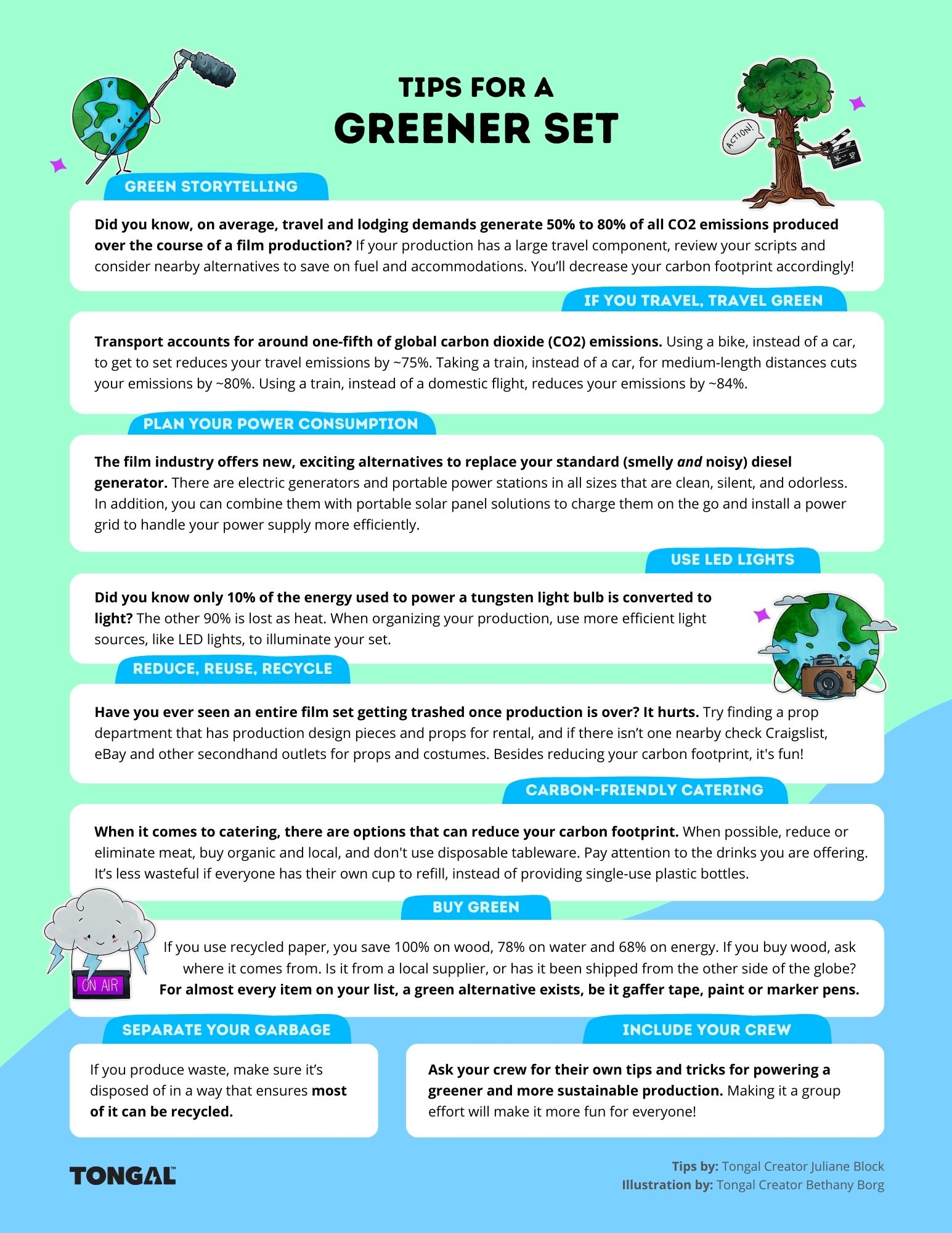
Green Storytelling
Did you know that, on average, travel and lodging demands generate 50% to 80% of all CO2 emissions produced over the course of a film production? If your production has a large travel component, be sure to review your scripts and consider nearby alternatives to save on fuel and accommodation costs. You’ll decrease your carbon footprint accordingly!
If you travel, travel green
According to Dr. Hannah Ritchie, Deputy Editor of Our World in Data, “transport accounts for around one-fifth of global carbon dioxide (CO2) emissions.” Choosing to bike to set, rather than choosing to drive there, can lower travel emissions by approximately 75%. Opting to take a train, instead of driving for medium-length distances reduces emissions by about 80%. And using a train, instead of taking a domestic flight, reduces emissions by about 84%.
Plan your power consumption
The film industry offers new, exciting alternatives to replace your standard (smelly and noisy) diesel generator. There are electric generators and portable power stations in all sizes; they are clean, silent, and odorless. In addition, you can combine them with portable solar panel solutions to charge them on the go and install a power grid to handle your power supply more efficiently.
Use LED lights
Did you know that only 10% of the energy used to power a tungsten light bulb is converted to light? The other 90% is lost as heat. When organizing your production, use more efficient light sources, like LED lights, to illuminate your set.
Reduce, reuse, recycle
Have you ever seen an entire film set getting trashed once production is over? It hurts. Find a prop department that has production design pieces and props for rental, and if there isn’t one nearby check Craigslist, eBay and other secondhand outlets for props and costumes. Besides reducing your carbon footprint, it's fun!
Consider carbon-friendly catering
There are catering options by means of which you can reduce your carbon footprint. When possible, (1) reduce or eliminate meat, (2) buy organic, (3) buy local and (4) do not use disposable tableware. Pay special attention to the drinks you are offering. It’s so much less wasteful if everyone has their own cup to refill, instead of providing single-use plastic water bottles and cups.
If you buy props, office supplies and material for set design, buy green
If you use recycled paper, for example, you save 100% on wood, 78% on water and 68% on energy. If you buy wood, ask where it comes from. Is it from a local supplier, or has it been shipped from the other side of the globe? For almost every item on your list, a green alternative exists, be it gaffer tape, paint or marker pens.
Separate your garbage
If you do produce waste, make sure it’s disposed of in a way that ensures most of it can be recycled.
Include your crew
Ask your crew for tips and tricks to become a greener production. Make it a group effort!
Juliane Block worked for clients like Siemens VDO, VW Autostadt, New Yorker, and Unilever from 2000 to 2005, graduated with a master’s degree in design at the University of Arts, Braunschweig in 2003, and lived as a freelance designer and filmmaker in Asia from 2005 to 2011, before returning to Germany. Her achievements include more than 10 short films, five feature films, music videos, commercials, and travel documentaries. Most recently, she worked in collaboration with Tongal for the LEGO Group, for whom she directed and produced the Walmart LEGO live-stream event, as well as the LEGO Masters Family Challenge seasons 1, 2, and 3. She also works as a motion graphic artist and green consultant for clients like Spiegel TV and ARD.
Want to learn more about Juliane and her work as a green consultant? Check out our interview with her here.