

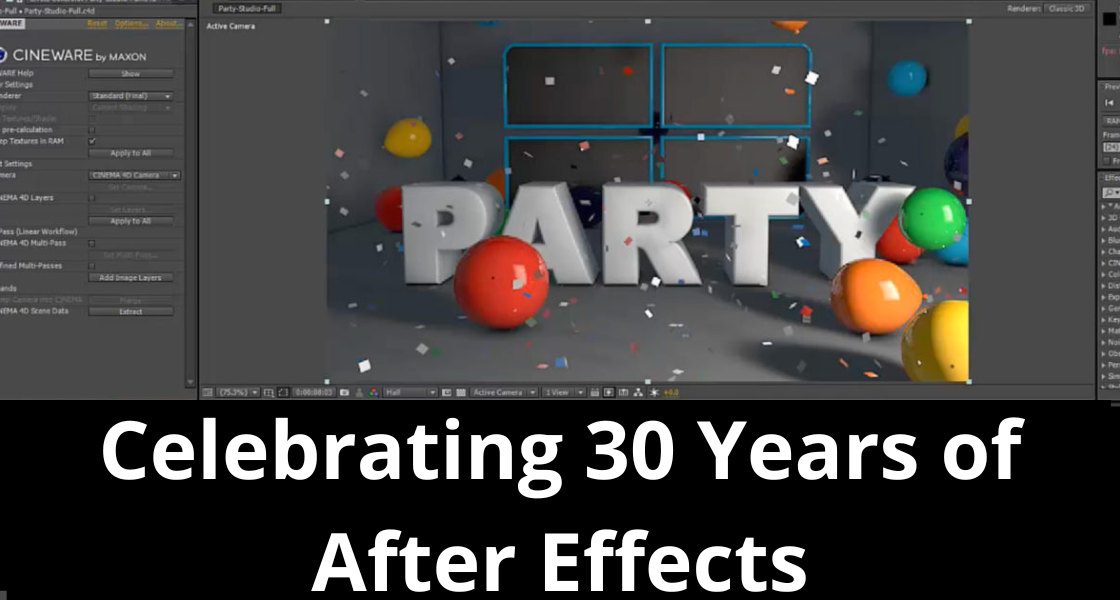
With its 30th anniversary approaching, let’s talk about After Effects.
I’ve been using After Effects for about twenty years, and it all started with one, single moment in college. Freshman year, my TA (now a successful television producer) said to me “learn After Effects and you’ll always have work.” And she was very, very correct. Going to school in Rhode Island, I had the honor of learning After Effects (AE) from someone that knew the Creators. My After Effects instructor was also the art director on numerous music-based games such as Guitar Hero and Rock Band. Strange but true, After Effects has origins in both counter culture music and early viral mediums.
Now known as Adobe’s After Effects, the original program was developed by a small software company located in Providence, RI, known as the Company of Science and Art (CoSA). CoSA’s first product, Lort, was software with the ability to stream animation off CD-ROMs. Unfortunately, the business plan was quickly suspended when Apple launched Quicktime, which was a better product with deeper color.
With very little money left to run the company, CoSA formulated a new product: After Effects. The codename for this was Egg, and it was named after the egg rolls at Apsara. Y'all, I kid you not, that restaurant still exists and is in my neighborhood.

Video compositing wasn’t an entirely new concept. Video broadcasters had the ability to composite images (for example: the background of a meteorologist) and large visual effects studios had been combining images for decades. But they ran off proprietary hardware, software, both, or used optical printing to achieve their effects. Ultimately, there was nothing at the time using prosumer systems like Macintosh’s Apple computer and making it so that anyone could purchase and use the software by just purchasing a copy on CD-ROM.
It seems that a lot of leaps in special effects can all be traced back to one one film: 1993’s Jurassic Park. And so it’s not too surprising that After Effects is part of the Jurassic Park story. Before JP, films mostly relied on prosthetics, puppets, and stop motion along with proprietary software developed by the company they hired. Pixar’s RenderMan is a good example of the proprietary software plus a studio business model. But Jurassic Park was a film in which specialists explored computer generated, 3D animation, and they needed a tool to quickly visualize how the CGI would combine with the 3D animation to see if this was a viable route. At the time, the pre-visualization artist Scott Billups “used After Effects because it was the only application that allowed him to combine all the 2D and 3D elements created to pre-visualize the scenes.” And with that, off-the-shelf software had just entered into the world major league, feature filmmaking.
After Effects is software made by people and was even recognized with a Scientific and Engineering Award from the Academy Awards.
After Effect’s flagship features were layered compositing with mask, effects, transforms, and keyframes. The software wasn’t created to connect media together. Rather, it saw video as pieces that could run at the same time instead. In short, it treated different media clips more like musical instruments that could be layered and mixed together. This logic fits if you know the Creators were musicians and not film editors.
It’s not well known that the founder and some of the staff of the CoSA were also part of a band called the Emergency Broadcast Network (EBN), a multimedia performance group that went on to work on projects for U2, The Edge, MTV, and Nico.
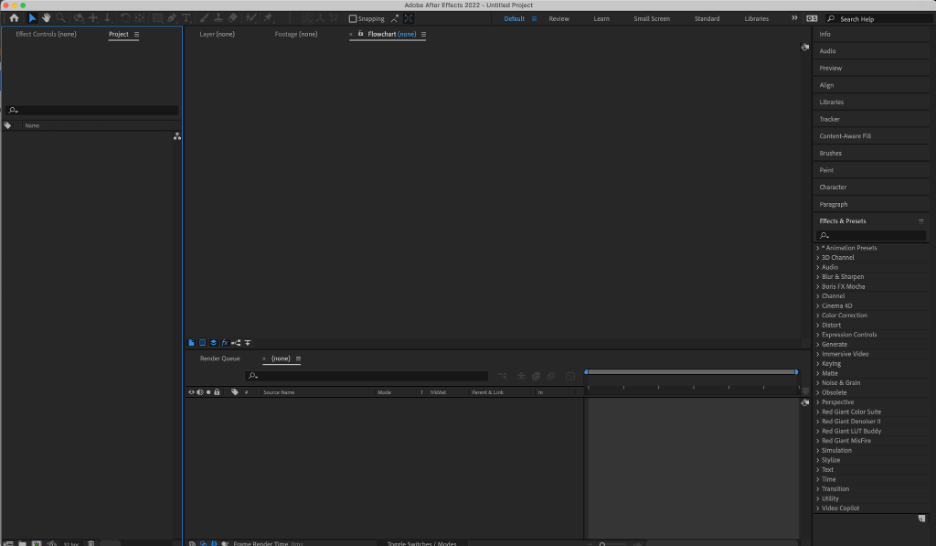
After Effects is unique because it took a radical look at how video could be put together and didn’t look towards the standard editing tools of the time--Steenbecks and flatbed editors--for inspiration. In fact, if you’ve ever tried to teach yourself AE, you’ll find that the canvas or viewer is frustratingly hidden when you start a new project. It anticipated the need for customizable screen sizes a full decade before cell phones changed the shape of video.
Being a long time user of After Effects, I can say there is a rhythmic, intuitive quality to the way After Effect’s keystrokes flow together. First of all, all the key commands are made to be operated by the left hand. It still refuses to match modern software convention that match the letter with the name of the tool. Instead, we have the Pen (G), Mask (Q), and Anchor (Y) tools. As a teacher of After Effects, I use the joke “WHY is the Anchor tool the letter Y? I don’t know Y, but it is.” The effect of this efficient (yet seemingly illogical) key commands creates a connection between eye, hand, and the work being created. It’s a piece of software meant to make the experience of blending images something artists will enjoy. It wasn’t made to replace technology. It was made to create art.
CoSA’s original plan wasn’t to break into the movies but to create a new world of streaming/synced video, pairing programmers with artists, and making content for the electronic age. They anticipated a media landscape where individuals and small teams would be making tons of art for a variety of markets and formats. Refusing to be standardized, After Effects has become the bedrock of visual effects and motion graphics workflows by centering the experiences of those creating.
Or maybe their success is that goat noise that plays when your render fails.
__
Note From Tongal: This blog is part of a series of Tongal Community-written blog posts that were originally sourced in the Tongal Blog Open Call Project. The views and opinions expressed in this article are those of the author(s) and do not necessarily reflect the official policy or position of Tongal. Read more Tongal Community-written posts here!