
The first Oscar presentations were held in 1929 and happened to take place during the last year the major studios were producing silent films. With the exception of The Jazz Singer, which was given a special award for “revolutionizing the industry,” the films recognized during that inaugural award ceremony had not one word of spoken dialogue. It would be the first and last year this would occur for the beginning of the award tradition coincided with the end of the silent era.
Many people today think of silent movies as knockabout comedies or overly dramatic performances, which would be true of many of the early films from the 1910s. However, by 1920, the motion picture business had honed its craft by trial and error and the universal silent film medium was thriving. The best films showcased realistic acting, and unlike today, incredibly original storylines – many of which challenged the puritanical way of thinking in the post-World War I era of prohibition.
Comparing the reviews from 1920 alongside a recent re-watch, here is a look at which films, actors and actresses might have been nominated had there been an award season 100 years ago.
For BEST PICTURE, in alphabetical order:
THE CABINET OF DR. CALIGARY: Like today, horror films were big business in the silent era and this classic from Germany is the grandfather of them all. Its unique set design and shocking surprise ending are still talked about. One can only imagine the impact this movie had on its audiences when it was first released a hundred years ago.
EROTIKON: While many couples in 1920 were likely bored with marriage, it was never talked about and certainly not the subject of entertainment. Erotikon may have been the first film to address the urges and temptations of cheating on one’s spouse. Though tame by today’s standards, Erotikon is a sexy, playful look at a one time taboo subject that opened the gate for films about women and sexual freedom.
HUMORESQUE: This moving story of one family’s optimism in the midst of New York City ghetto life is a film that must have given hope to the many who struggled to stay afloat in the harsh world of 1920s poverty. Though not one of the top-grossing films of 1920, Humoresque was a huge hit with the critics, earning the Medal of Honor in Photoplay Magazine, the top movie resource at the time.
THE LAST OF THE MOHICANS: This was the first of many adaptations of James Fenimore Cooper’s classic novel and the only one not to stray from the original story. The film follows two sisters caught in the middle of the French and Indian War. The violence is shockingly real, especially for 1920, making the tragedy of the story even more powerful.
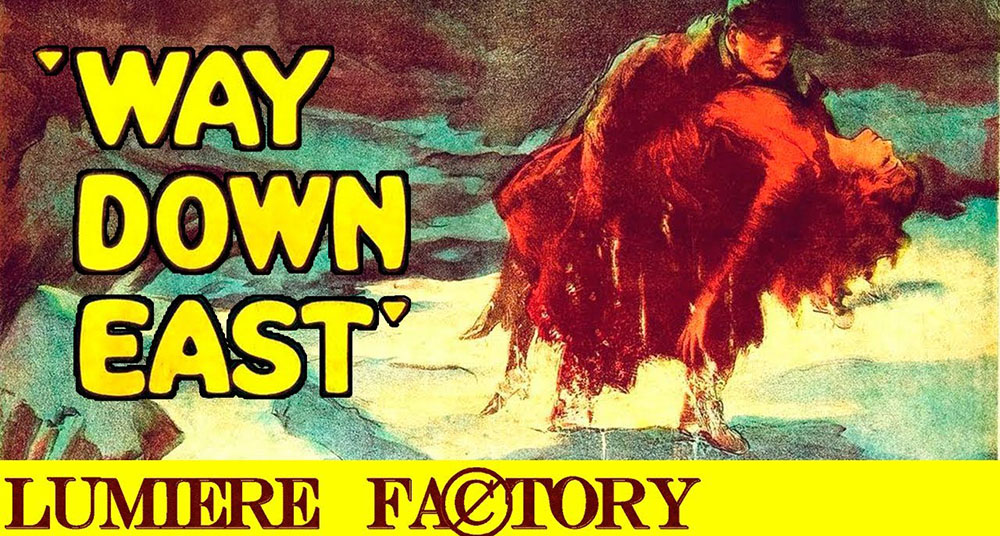
WAY DOWN EAST: It’s the story of an unwed mother, shunned from society, who hides her past after her baby dies while attempting to survive in a world full of judgment. The harrowing climax during a blizzard, featuring Lillian Gish on a slab of ice heading toward a waterfall, was the real deal. There were no stunt doubles, fake props or CGI – only sheer luck. Actor Richard Barthelmess had only one chance to save his co-star’s life. He did, and it’s all captured in this movie, making the drama and excitement more real than any modern film.
The PROBABLE WINNER: WAY DOWN EAST. With the acclaimed director D.W. Griffith at the helm, this epic romantic adventure from United Artists had just the right amount of romance and spectacle that most likely would have propelled it over the other award-worthy films.
Way Down East
Every year come awards time, there is always a movie that gets snubbed. The big snub from 1920 undoubtedly would have been Oscar Micheaux’s Within Our Gates. In the early days of motion pictures, a film directed by and featuring mostly African American actors making statements on Jim Crow America was considered a “race film” made specifically for a certain audience. Sadly, this powerful look at white supremacy through the eyes of a black woman certainly would not have been welcomed alongside the elite “white” Hollywood of 1920.
Due to the color of her skin, another Oscar snub would have been the lead actress Evelyn Preer, whose honest performance equaled any of those that would have been considered for Best Actress of 1920.
Evelyn Preer, In Our Gates
For BEST ACTRESS:
BARBARA BEDFORD – The Last of the Mohicans: Of the five talented actresses in this category, Barbara Bedford’s performance had the least screen time, but was possibly the most emotionally draining for the viewer. The tragic sacrifice her character makes to save her sister’s life is one of those scenes that will haunt viewers for years.
LILLIAN GISH – Way Down East: As an innocent young woman becoming pregnant after being tricked into having sex, Lillian Gish takes us on an emotional ride full of sadness, shame, heartbreak, strength, and eventually, love.
VERA GORDON – Humoresque: Even though her co-stars, Alma Rubens and Gaston Glass, were top-billed, it’s Vera Gordon who carries this picture. As the mother of a large family living in poverty, her character’s quiet strength and eternal optimism leave one with a sense of hope, which was needed as much in 1920 as it is today.
TORA TEJE – Erotikon: Through her multifaceted character, we see firsthand the disappointments of a loveless marriage. By flirting with one man while lusting after another, her loneliness is on display for all to see. It was a brave performance for its time and one that surely would have drawn some attention for Tora Teje had there been award recognition.
OLIVE THOMAS – The Flapper: There were many films showcasing rebellious youth, but it was the work of Olive Thomas in The Flapper that started it all. Sadly, this talented actress died of accidental poisoning four months after the film’s release, leaving her death more famous than her brief, but promising career.
The PROBABLE WINNER: LILLIAN GISH. She was the Meryl Streep of her time, and already having had a career full of award-worthy performances behind her, an Oscar would have been well-deserved recognition.
Lillian Gish, Way Down East
That leaves the most likely nominees for BEST ACTOR:
JOHN BARRYMORE – Dr. Jekyll and Mr. Hyde: Capturing the essence of good and evil at the same time is not an easy task, but John Barrymore made it seem so natural. It’s a memorable performance that elevates the movie from good to award-worthy.
RICHARD BARTHELMESS – Way Down East: As a simple country boy who falls in love with a woman with a shameful past, Richard Barthelmess gives a performance full of childlike charm and simplicity. His role is not as flashy as the other probable nominees, but equally compelling.
LON CHANEY – The Penalty: After his legs are amputated by mistake, Lon Chaney gives a terrifying performance as a man set on revenge against the doctors who operated on him. While widely known for The Phantom of the Opera, die-hard Chaney fans often cite The Penalty as his best work.
DOUGLAS FAIRBANKS – The Mark of Zorro: Douglas Fairbanks was a movie star, not an actor. However, he was both in this swashbuckling adventure. Playing the withdrawn, fragile son of a wealthy landowner, Fairbanks was able to showcase his acting capabilities. His movie star qualities come to play when the character changes his identity to transition into a Robin Hood-like hero aimed at protecting the common folk from corruption. The film is a lot of fun, but the success rides with the performer’s capability to switch from entertainer to actor seamlessly. Fairbanks does that and it is a pure joy to watch.
WERNER KRAUSS – The Cabinet of Dr. Caligary: Werner Krauss plays a mysterious carnival barker who brings a hypnotized man to his stage who eerily predicts the death of an audience member. His character keeps the viewers guessing his motives until the surprise ending when the viewer realizes how wonderful his work is in this film.
The PROBABLE WINNER: JOHN BARRYMORE. His performance is very good. Also, he was the most famous member of the acclaimed Barrymore family of actors. An Oscar would have seemed an instinctive fit.
Of course, because there were no award ceremonies a hundred years ago, no one knows for sure what the Oscar nominees actually would have been, but the names and films mentioned above would have certainly been in contention. The 1920s would prove to be one of the most creative decades in cinematic history. One might say, it all started 100 years ago with the Oscars that never were.
—
Note From Tongal: “1920: The Oscars That Never Were" is part of a series of Tongal Community-written blog posts that were originally sourced in the Tongal Blog Open Call Project. The views and opinions expressed in this article are those of the author(s) and do not necessarily reflect the official policy or position of Tongal. Read more Tongal Community-written posts here and then Pitch us a topic you'd like to write about for the Tongal Blog!