
When I enrolled in film school to get my MFA in Film Production from USC, one of my goals was to leave the program with a strong short film that demonstrated my directing talents. What I didn’t expect was that my thesis film would be about periods. Yes, you heard that right. Periods. Menstruation. That time of the month. Let me explain...
At USC, there are multiple ways to graduate: you can write a feature script, construct a producer’s package, make an independent short thesis film, or make a short film that’s funded by the school. That last option sounds perfect, right? There’s just one catch: you can’t write the script - it must be a script that someone else has written.
Now for most people, they want to write what they direct. And don’t get me wrong - I definitely have a soft spot for the writing process. But as someone who loves directing more than writing, I was very open to the process of collaborating with a writer. After being approved as one of the short-listed directors, I received a number of scripts that were eligible to be considered. A couple scripts caught my eye but one that left the biggest impression on me was a script called ON THE CLOCK, written by my friend Katharine Stocker.
It was about a young man named Lucas trying to get sanitary products for his little sister when she gets her period and starts skipping school. However, because of their financial situation, he’s not able to afford it and goes to great lengths to get the products she needed. At first, I felt the story was almost too simple: a brother who’s trying to get products for his little sister? Couldn’t he just borrow it from a girlfriend or a neighbor? But it wasn’t until I discussed the project more with Katharine that I felt like this was a script tailored to my directing strengths.
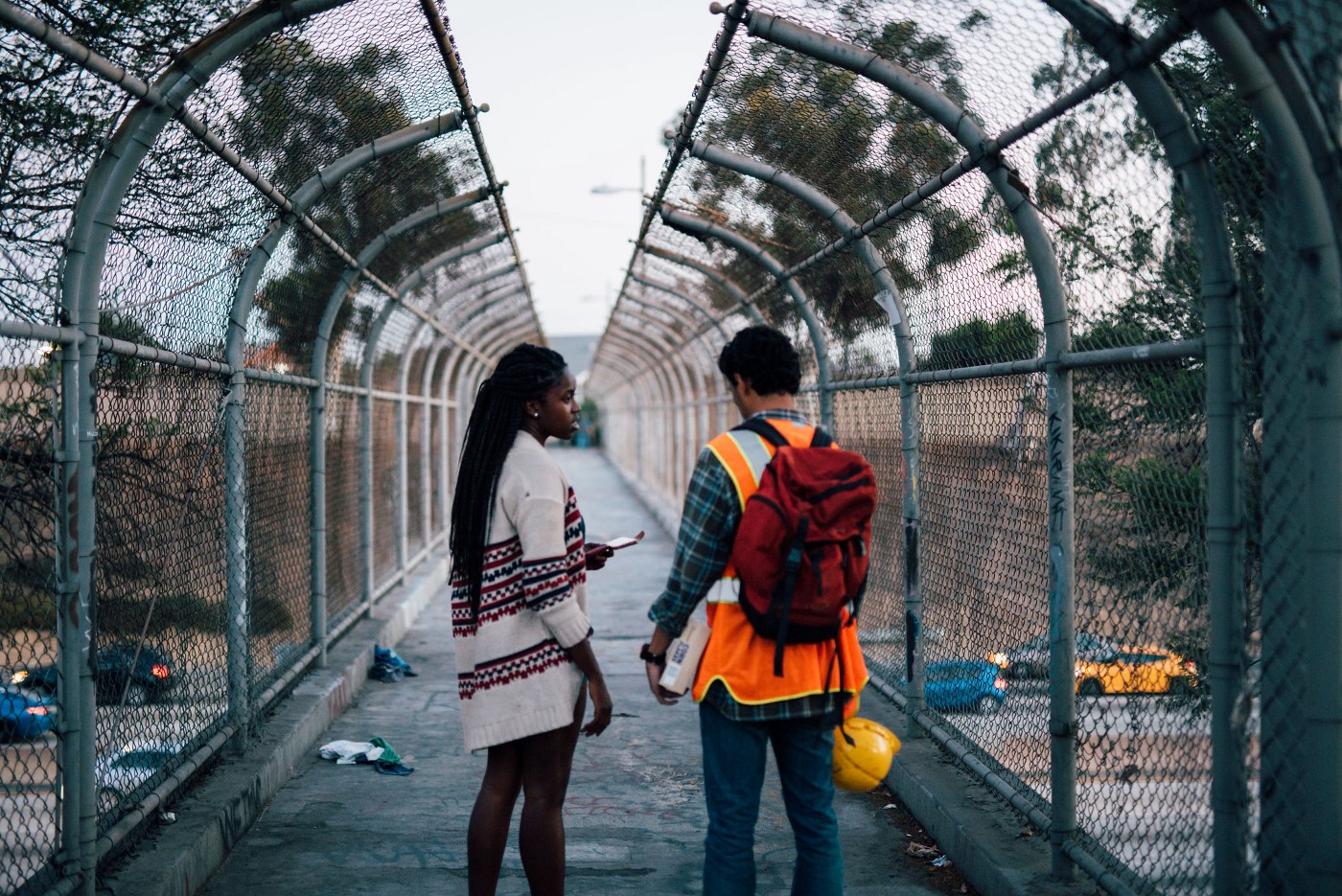
Director Tayo Amos and actor Victor Muños
When I asked her what inspired her to write the script, she explained to me that she read an article about how thousands of women and girls all over the world, but specifically in the United Kingdom, her home country, are held back in school or not able to advance at work because they’re not able to afford the products they needed. I knew that tampons and pads were pretty expensive (especially since I had to buy them for myself) but I had no idea of the larger societal implications of women not being able to afford those products. And I knew that, if I as a woman didn’t know this was an issue, making the film was even more important to not only tell a moving story about a brother and sister, but also to illuminate this very real issue of period poverty.
While we were developing the script, we got a bit of pushback from faculty, especially male faculty members, who were trying to prescribe their notions as to what a period should look like and how women get their menstruation products. The biggest question we were asked is if this problem really exists. Why couldn’t the brother ask a neighbor to borrow pads? Why couldn’t the sister’s character just borrow it from a friend’s mother? While I was in pre-production, Katharine sent me multiple articles about the issue assuring me that these issues are very real. I also did my own research in talking to workers at women’s centers in East Los Angeles, where we shot the majority of the film. Though we knew we couldn’t cover every narrative hole, we knew that if we centered the story around the real obstacles that women face and ground it in that reality, our audience would be connected to the story and these relatable characters.
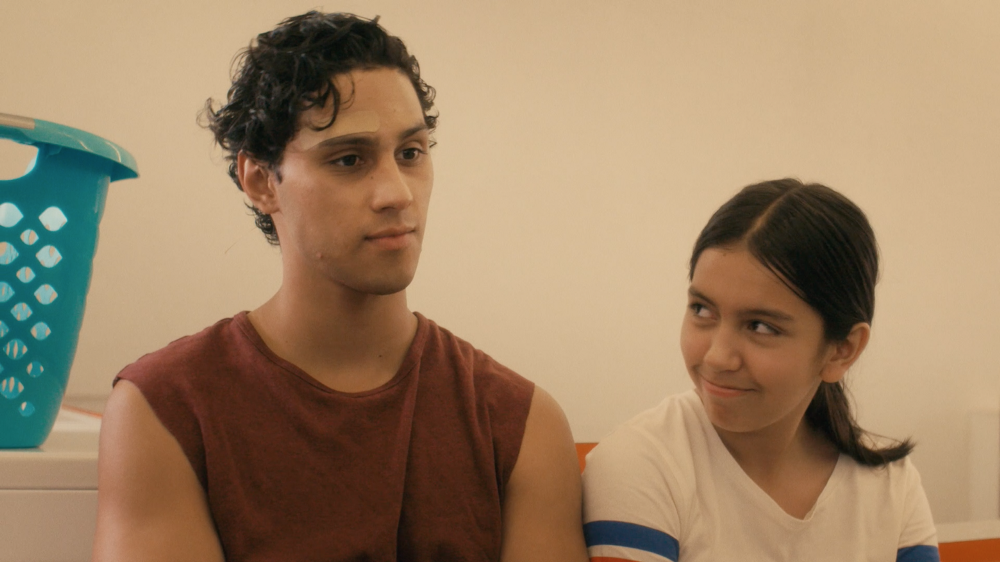
“On The Clock" still with actors Victor Muños and Crystal Avila
Another significant question was how to portray periods on camera. In one scene, the sister character gets her period while at school and she has to figure out what to do when she goes into the bathroom with one of her best friends. Our mentors asked repeatedly how we would show that she had her period. I knew that I didn’t want to do a closeup on her behind, as that reads very disrespectful and crass. I felt a simple wide shot with a tilt-down would suffice but I got feedback that maybe that move was too subtle. However, erring on the side of subtlety worked in our favor as it made the moment more sympathetic and heartfelt to the sister character. We also made sure to include notable dialogue and shots later to further drive the conflict home.
While we were on the festival circuit, it was so rewarding to hear from men and women alike on how this story moved them. Not only were they educated on the realities of young women in getting these products, they were also moved by the relationship between these two characters. We had a successful festival run - we premiered at the Diversity in Cannes Showcase where our lead actor Victor Muñoz won Best Actor, won Best Narrative Short at the Los Angeles Diversity Film Festival and screened at a number of other festivals all over the world.
In April, we premiered the short on Amazon Prime, where we’ve been able to share the film with a wider audience. You can also watch the trailer here:
I think what really helped me in crafting the project was seeing examples of how other creators were depicting periods. I was incredibly inspired when the filmmakers of PERIOD. END OF SENTENCE won the Oscar for Best Short Documentary. One of the filmmakers, Rayka Zehtabchi (who is also a USC film school alum), proudly proclaimed on the Oscar stage that their story brought the issue of menstruation to the film world’s most acclaimed platform.
I’m also grateful to activists and storytellers who are normalizing periods and doing great work in putting out more work that celebrates, rather than demonizes periods. Kiran Ghandi was in the spotlight in 2015 when she decided to run the London Marathon without a tampon. Notable celebrities like Meghan Markle and Gina Rodriguez have partnered with nonprofits to raise awareness of the issue of period poverty. By seeing the wave of notable storytellers and activists, I felt that I was further motivated to make this film to educate and inspire audiences
around the world. In addition to making a short film that had a social impact message, it encouraged us to partner with nonprofits such as #HappyPeriod who are doing amazing work in providing free/low-cost menstruation products to women and girls who need it.
Ultimately, what makes these stories so powerful is not the periods themselves, but what these characters do to overcome the obstacles of having a period. Audiences are invested in characters and, by grounding these characters in their relationship to others as well as their own futures, the audience is able to connect with them, even when dealing with something as uncomfortable and taboo as periods.
I’m grateful to have had this experience of directing this film. I learned so much about myself as a storyteller and creative. I never would have thought that making a film that focused on periods would force me to learn how to protect my own creative instincts without feeling guilty or ashamed. And that’s something to be proud of. Period.
--
Note From Tongal: "What I Learned Making a Short Film About Periods" is part of a series of Tongal Community-written blog posts that were originally sourced in the Tongal Blog Open Call Project. The views and opinions expressed in this article are those of the author(s) and do not necessarily reflect the official policy or position of Tongal. Read more Tongal Community-written posts here and then Pitch us a topic you'd like to write about for the Tongal Blog!