

Ever wonder what it’s like to be at the helm of a production set? As a Production Manager, you’re responsible for almost everything that goes on - from the smaller, day-to-day details, such as catering orders (and food allergies), and making sure there’s enough electrical tape, to the higher level, logistical stuff, like company moves, production vehicles, parking permits, etc. And if that’s not enough to keep you busy, you have boatloads of paperwork and timesheets and expenses to keep track of. Last, but not least, you’re balancing delicate interpersonal relationships, making sure department heads are creatively in sync, while checking artistic visions against budgetary considerations - not to mention maintaining the overall happiness and morale of your crew.
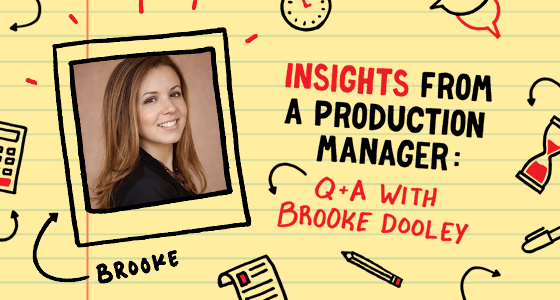
We spoke with talented Producer and Production Manager Brooke Dooley to get a glimpse into what it’s like to manage a set. Brooke has coordinated and managed numerous sets for Tongaler team Side of Fries, and has worked with brands from Lenovo to Jack Link’s Beef Jerky. We’re just glad we could catch her between shoots to give us some insights and practical advice for managing a well-oiled set, and how to keep those ever-shifting priorities straight.
T: Tell us a little about yourself and how you got your start as a Production Manager.
BD: I was born and raised in a small country town called Tracy in Central California. After high school, I went to City College of San Francisco for a couple of years before transferring to San Francisco State University (SFSU), where I received a B.A. in Cinema. In school, I watched A LOT of movies and wrote A LOT of essays. I wasn’t getting as much “real world” experience as I wanted so I took the initiative to find internships, in which I could earn school credit, via searching on Craigslist. I ended up interning for an independent documentary filmmaker in Oakland and for the Education Director at California Film Institute in Mill Valley. Then I found a filmmaking co-op called Scary Cow that I joined and paid $50 per month to connect with other people, all ages and walks of life, who liked movies and wanted to pursue filmmaking as a real career or just something fun to do on the weekends. Joining this co-op was a pivotal moment for me. This is when I truly realized I wanted to be a Producer. Through this co-op, I was able to jump in, take on the role as Producer and learn by doing. I’m a big believer in learning by doing. I produced about a dozen short films through this co-op, which filled out my resume and triggered more producing opportunities for music videos, other short films and even a couple of indie features. I was doing all of this while at SFSU and ended up barely being on campus because I was so busy with projects elsewhere. I was even producing projects for students at the Academy of Art in San Francisco! That is where I got my start. After I graduated, I moved to Los Angeles to see what this wild city had to offer and have been here since May 2010.
T: What are your priorities as a Production Manager and how do you keep them all in balance? What are some of the tools you use to keep yourself organized?
BD: For me, the most important aspect of being a Producer/Production Manager is to be alert to what’s going on in all departments so that I can best respond to any “fires” or general needs that pop up. After all, I’m the person crew members come to if they need something like Velcro to help hold a prop to a wall, or a different lens mount for the camera that we need to use for the first shot or getting a new HDMI cable to replace the one that doesn’t work so we have a monitor for the client. There are so many different things that arise throughout a shoot day, the priorities on my list are constantly shifting. I write pretty much everything down in the iPhone Notes app and set tons of alarms using the Clock app to remind me what I need to do at what time. I don’t know how anyone can get through a day without some sort of list or reminder system! These are two key tools that help me stay organized.
T: How do you keep department heads and below-the-line creatives in sync with each other, as well as motivated and happy?
BD: Well, keeping anyone in sync with one another is a challenge! Since most of the productions I work on are non-union with conservative budgets, I typically don’t have a full production team to support me…usually just a 1st AD and an Office PA. So this means I’m very hands-on during prep and production. I think keeping everything running smoothly and department heads happy starts with me. I strive to maintain a positive, calm and honest demeanor with everyone. This attitude permeates to the rest of the crew. For example, I am constantly walking around, observing and interacting with others. I’m looking for trash, looking at the crafty table, listening to the Directors, DP & AD discuss the shots to make sure they’re on track with the schedule, talking with the client, checking in on the actors, etc. It’s very important for me to have a presence with everyone.
T: What are some things you do during pre-production that helps production run a lot more smoothly?
BD: One of the biggest priorities during pre-production is hiring the right crew. So for each project, my goal is to hire crew that has worked together multiple times before so there’s already a workflow there with a common understanding of how each person can and likes to work. It always depends on who’s available for a job so we don’t always get the same crew for each project, but try to work with the same people as often as possible. Other things that I do in pre-production that helps things run smoothly on the shoot day(s) are: getting as much sorted out as I possibly can at least a couple of days before the shoot (including the call-sheet), printing plenty of talent releases & shot-lists & scripts, checking in with all department heads to make sure they have everything they need, checking in with Director(s) to make sure they’re ready and if they need anything else from me and finally making sure everyone received the call-sheet (that means texting, emailing and calling anyone who hasn’t responded and not giving up until they respond – back in the day I had a few no-shows because “they didn’t get the call-sheet”).
T: You’ve managed quite a few commercial shoots. What are some of the challenges that come with managing commercial/branded shoots and how do you prepare for those challenges? How does working with a brand change the production dynamic?
BD: Every project and client is different, but the largest challenge is to make sure the Director(s) and the Client are on the same page creatively. Sometimes a Director doesn’t want to do shots that the Client absolutely wants or needs and vice versa. So that usually ends up eating time during the day because we have to do double the shots to keep things civil. Sometimes I have to tell the Director to swallow their pride and just do what the Client wants because we’re like really out of time. I like having the Client on set because it means they are involved in the collaboration and they are there to address any questions we may have about the product as we’re shooting. This has helped us in the past avoid some post-production nightmares.
T: When negotiating crew deals and equipment rentals, what are some strategies and tactics you’ve learned that save on costs and help put the most dollars on screen?
BD: Honestly, I don’t believe putting more dollars on the screen means a better end product. The images on the screen are not the most important part of a project. A finished project absolutely has to look good and engage an audience as intended, but treating the crew and cast with respect is a major priority for me. My approach is to just be straightforward with what I have when negotiating crew deals and equipment rentals. I have my go-to vendors and no matter the budget, we can make something work because of the relationship we have. Also, a lower day rate does not mean a crappy production. I feel like I’m a good Producer/Production Manager and people enjoy working with me. So even though day rates tend to be lower than usual, the projects are still worth doing for the crew because it’s fun (as long as they don’t have a full day rate gig opportunity pop-up!).
T: What’s your process for when things get out of control? How do you stay calm and manage? Any harrowing stories of creative problem-solving?
BD: Things don’t really get out of control on my sets. The one issue that always comes up is there’s not enough time to get all of the shots (if only we had bigger budgets to schedule more shoot days). My personality is calm so I stay that way even when stress levels rise. When a “fire” comes my way (and there are always a few fires in a day), my process is to 1. Stop and listen to the situation, 2. Take a quiet moment to think it through, 3. Act immediately on the solution I’ve come up with.
Thanks for tuning in! We hope you’ve gotten a good glimpse into what it’s like managing a set and some tips for success. If you want to learn even more about how to work with a brand on set, check out this recent article we published: Brand on Set: Production Best Practices
If you’d like to share your own tips for running a tight ship while on set, please leave them below!


