

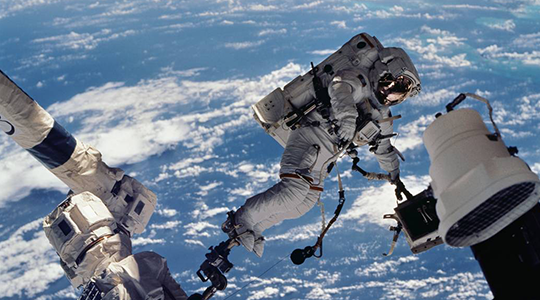
Before Netflix and Hulu, there was the International Space Station (ISS) streaming thousands of images and footage back to Earth 24 hours a day, 365 days a year. ISS Imagery Manager, Carlos Fontanot, spoke with us about how he and his team manage such a massive amount of visual data as well as how he and Dan Jacobs, NASA’s International Relations Manager for Gateway Program and the International Space Station, came up with a novel way to make use of this treasure trove of space imagery by bringing the CineSpace Short Film Competition to life (check out the 2022 competition here).
CineSpace is an annual competition challenging animators, editors, and filmmakers from around the world to create short films incorporating, or made entirely of, imagery and footage from NASA’s extensive (and free!) online archives.
But before we get into all that, a brief history of the International Space Station: Unlike the competitive, Cold War-driven Space Race of the 50s and 60s, the construction of the ISS was a truly collaborative effort among nations, including the US, Russia, Japan, Europe and Canada. Developed by engineers from over 15 countries for the purposes of scientific research and discovery, the ISS is a success story in how international collaboration breeds innovation.
Floating, or more accurately, free-falling in low Earth orbit, the ISS has been continuously and peacefully occupied by astronauts from different nations for nearly 20 years. As its 20th anniversary quickly approaches, this year’s CineSpace competition includes a special category prize for “Film That Best Depicts 20 Years of Humans on the International Space Station," which will be awarded to the film that best captures the accomplishments over the past two decades of the ISS’ peaceful global partnerships, its support for global space exploration, and the science and technology that has benefited humanity, using the tenets of one or more of the global peace awards such as the Nobel Peace Prize, the Goi Peace Award, World Peace Prize, U Thant Peace Award and many others as they relate to the ISS experience.
Maddie Mindling: Tell us about the fateful conversation between you and Dan Jacobs that sparked the international CineSpace Short Film competition. And how did the Houston Cinema Arts Festival and Richard Linklater eventually get involved?
Carlos Fontanot: My good friend, colleague and tennis partner, Dan Jacobs, was at home with his sons watching YouTube. This prompted the idea to get those content makers to produce films for NASA. The vast NASA imagery archives collected over more than five decades contained NASA footage that very few people had ever seen. How could this imagery be used? Dan then approached me and asked if I thought something like this was feasible, and how it would work. The initial thought was to organize a film festival, but with the input of Trish Rigdon, Executive Director of the Houston Cinema Arts Society (HCAS) at the time, we decided that a film competition in partnership with HCAS would be a better way to go.
During this time, the NASA-wide imagery community was already building an all-encompassing public database with archival footage dating back to the very beginning of NASA in 1958 that would eventually become one of several public websites with extensive NASA footage available to be used for CineSpace. As we organized ourselves and launched CineSpace and the first competition in 2015, Richard Linklater, HCAS board member, kindly agreed to be the final judge to select the winners of the competition. He’s been an enthusiastic supporter ever since!
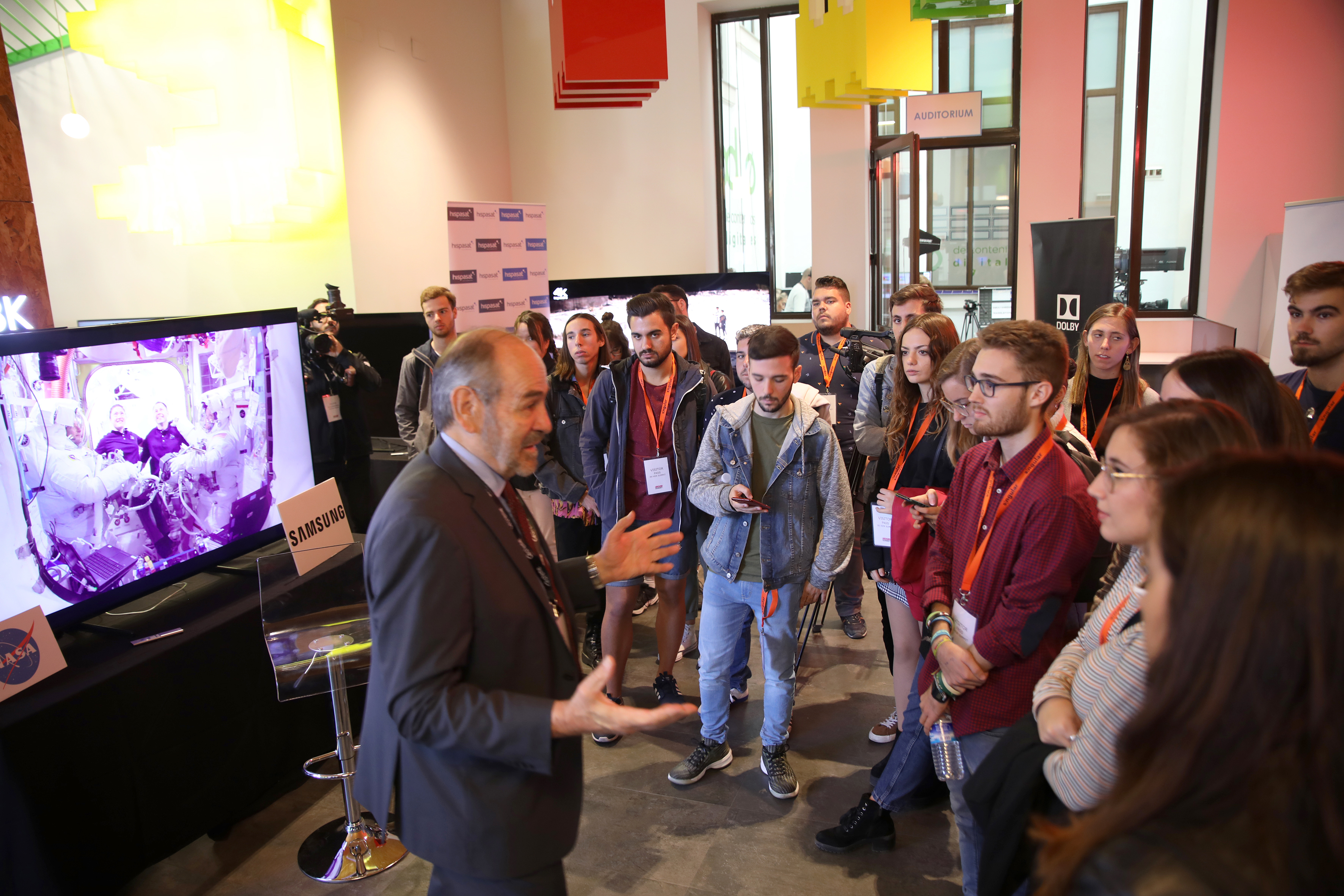
MM: You've overseen imagery since the beginning of the International Space Station (ISS) assembly over 20 years ago. How has the image-capture technology changed over time?
CF: When the ISS was first designed, the international team of aerospace engineers focused mainly on the avionics, environmental systems, structures and other areas that assured the success of a project of this magnitude. Not much in-depth thought was initially given to imagery and television. At the beginning, we had the Early Comm system, a very rudimentary and temporary slow scan live TV capability that was designed by the communications engineers. A couple of years later, as the ISS started to take shape, a Ku-band antenna was installed that allowed us to downlink four NTSC standard definition TV channels around the clock. [Ed. Note: “Downlink” means to send back to Earth through a telecommunication signal] In the early days, on board recordings on video mini cassettes were brought back to Earth on board the Space Shuttle for processing, cataloguing, archiving and distribution on the ground. Nowadays, onboard recordings are transferred digitally. Very few original recordings on drives are physically returned anymore.
In 2014, several upgrades were made on board the ISS and on the ground to expand the capability to a combination of up to six Standard Definition and/or High Definition channels being relayed back to Earth simultaneously from the ISS. The video streams may contain in-cabin views of the crew’s daily work and activities on board, scientific experiments, exterior views of the ISS, spacewalks, including helmet cameras, robotic arm operations, live crew conferences, and interviews, gorgeous Earth views from 250 miles above the globe, visiting vehicles docking and undocking, and practically any and all activities related to the ISS.
From its inception, we have always chosen commercially available, off-the-shelf cameras that were best suited to our needs on board at the time. We have had a variety of cameras on board such as Sony PD1, Sony PD100, Canon G1, Canon XL-1, Canon XF305, RED Dragon, RED Helium, Drift Ghost, Sony XC-999 minicam, and several others. Most of these cameras are integrated to the onboard Ethernet for downlink over IP. Today, we have Canon XF-305 cameras configured to AVN 443 encoders for live HD downlink around the clock. In addition, there are Ghost and Sony minicameras.
MM: As part of their training, do astronauts have to learn how to use the camera equipment on board the ISS? More importantly, is there a NASA film school, and if so, how do I get in?
CF: As new astronauts start their training, they get basic photography, videography and imagery classes by in-house specialists. This training covers the current on-board equipment. As crew members are assigned to specific flights, they get additional photo and TV training on new systems and cameras that may be on board when they actually fly. Advanced classes are offered to those crew members that will take the lead imagery specialist assignment for the particular flight. There are three levels of training: User, Operator and Specialist. Proficiency comes into the process when someone has received their training early and a proficiency lesson is needed to maintain their readiness.
There is no NASA film school per se. Perhaps one of the reasons is that space photography is specialized and unique and only actual astronauts will ever be in space acquiring images.
MM: With six different channels streaming 24/7, 365 days a year, how do you manage such a massive output of visual data and ensure that it gets to all the right places? And within that process, how do you decide what gets placed into the public archives where CineSpace participants go to explore and hunt for their submissions' imagery?
CF: The six channels of video that are received on the ground around the clock are displayed in real time at the Flight Control Room for flight controllers to be able to see onboard activities. The video is also received at the Video Control Center where operators in real time tag the video that is required for operations such as dockings, undockings, space walks, robotic activities, etc. The downlink video may also contain experiments, research, engineering, maintenance, and documentation of crew activities. About 20 percent of the video fits one of these categories and has a documented requirement to be acquired and retained for a specific team. The video operators enter cataloguing data into a database so that the imagery can be archived and, at a later date, searched and retrieved if necessary. The other 80 percent of the video is retained in a server for about two weeks and if there is no request for it, the video is discarded. The ISS exterior cameras are often pointed at the Earth and a large collection of Earth video is available, including views of natural phenomena like aurora borealis, noctilucent clouds, lightning, fires, storms and hurricanes, etc. Visit our Gateway of Astronaut Photography of Earth website for this type of imagery.
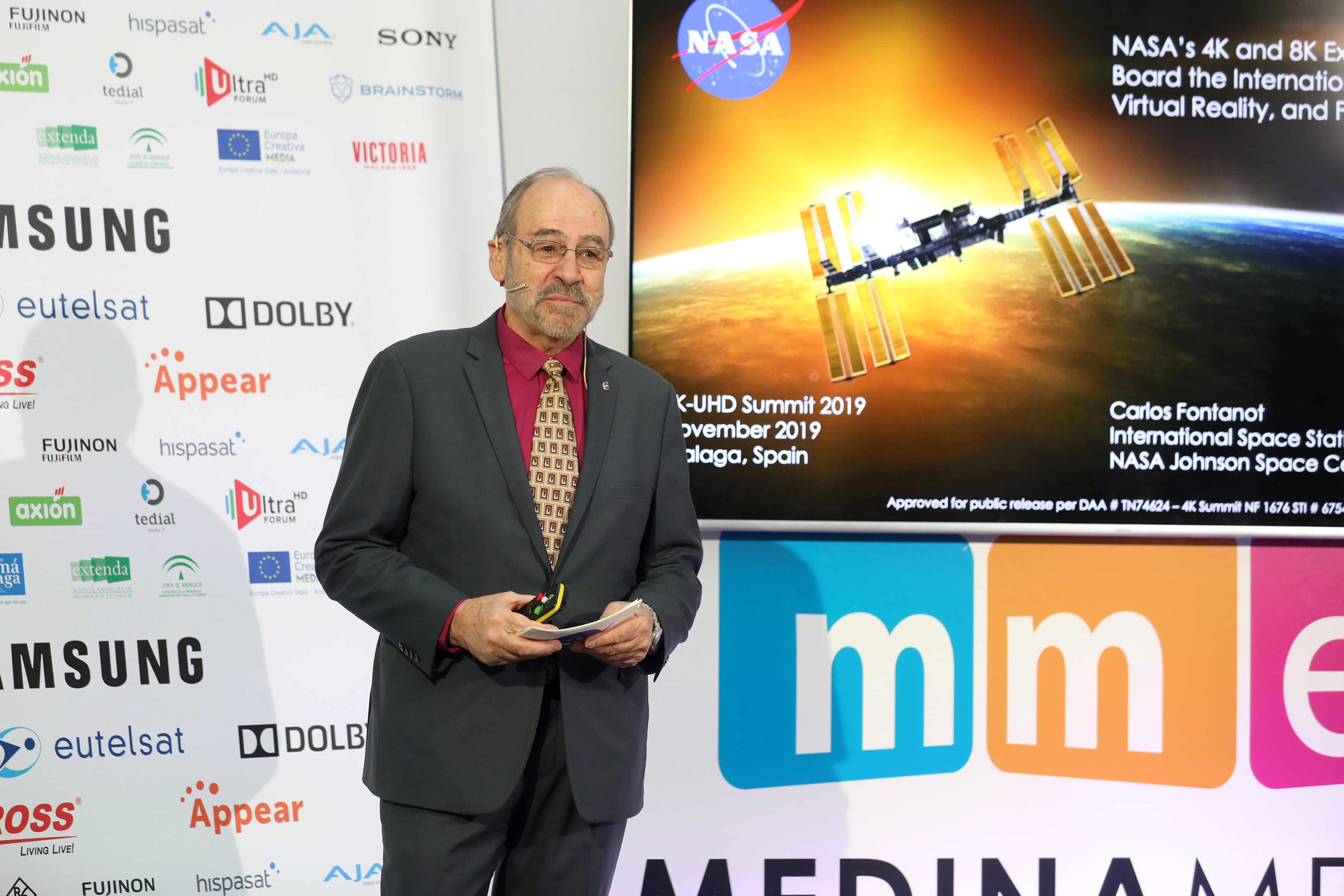
MM: Having just surpassed over 5 million stills captured by the ISS, what are some of your favorite still images and video footage that’s been captured over the years?
CF: It is hard to point to just one or a few images that are my favorite, but as a general category, Earth views and atmospheric phenomena like the auroras are among my favorites. The very best images are selected by our Office of Public Affairs and placed in the NASA Image and Video Library for the public and filmmakers to use.
MM: What preparations are you making to help with capturing imagery on the 2024 Artemis expedition, which will put the first woman and the next man on the Moon?
CF: Having worked on the ISS cameras and imagery systems for so many years, the imagery specialists and engineers working on the new programs and vehicles, such as Artemis and Orion often consult with me and ask for advice. I participate in Technical Interchange Meetings to discuss new technologies that may be applicable to our new vehicles based on lessons learned.
MM: This is of course an unusual year for CineSpace, and for humanity at large. Given the unique challenges posed by COVID-19 – social distancing, travel restrictions, etc. – what do you hope to see come out of this year's competition? What message do you have for creators hoping to make something this year and overcome these constraints?
CF: During this difficult pandemic where social distancing is key to health and well-being, film production in the traditional way is currently high risk and not advisable to filmmakers. However, given that the NASA archives offer so much unique material, it is absolutely possible to produce high quality short films based exclusively on archival footage and may not require creators to obtain originally shot footage. With that in mind, the current CineSpace 2020 competition includes a newly created category – “Best Film Using Exclusively NASA Archival Footage.” Our goal is to encourage creators whose ideas for CineSpace have been impacted by COVID-19 to take this time to reimagine their approach and find new ways to create as well as virtually collaborate with others. We also curated a gallery of past CineSpace finalist and winning shorts that showcase exceptional storytelling and originality using novel approaches and techniques that can be achieved at home by editing pre-existing footage, using a variety of practical or VFX effects, relying on character-driven VO, leaning into the lo-fi aesthetic, and any number of other techniques.


