

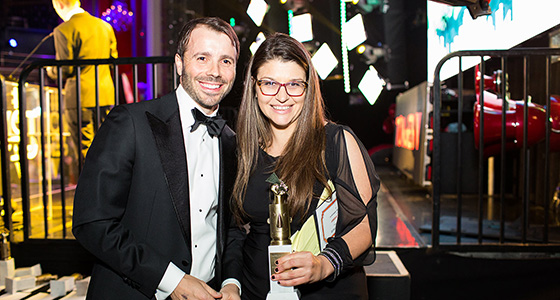
Jamie Newton, Head of Central Accounts at Tongal, and Jessica Sherry, Documentary Filmmaker
She’s explored the catacombs of King Tut, lived among the last remaining cargo cult in the South Pacific, and will soon set sail for the Galápagos Islands to watch the tortoises come ashore. . . this begs the question: What has Jessica Sherry, winner of Best New Artist and National Geographic’s Further Award at this year’s Tongies, not done?
National Geographic presented two Further Awards this year (one to Jessica, and the other to mother-daughter production team KR Squared). This award is given to “a person recognized as a leader in exploration and whose work is uniquely innovative, timely and impactful”. As you’ll soon learn, this describes Jessica to a T.
New to Tongal? Learn How Tongal Works
and check out our Open Projects to get involved!
Her work is driven by the belief that real life is far more complex, exciting, and intriguing than what we can write into a script. Jessica excels in capturing the true nature of her subjects. To induce someone to open up in front of a camera requires more work and preparation than you might imagine - and you’ll find out exactly how she does this in our conversation below.
If we’re being completely honest here, Best New Artist feels like a bit of a misnomer for Jessica, who’s been perfecting her craft for over 10 years and has an impressive, globetrotting resume. But in the relatively short period of time she’s been Pitching on Tongal, her work has stood out, winning two consecutive GE projects aimed at spotlighting real-life, innovative GE employees.
Here’s a look at her first Tongal Project - a short documentary about GE Additive Engineer, Josh Mook:
If you’re an aspiring documentary filmmaker or someone who simply appreciates the medium, we think you’ll learn a lot from this conversation.
Maddie: First, I just want to acknowledge the amazing year you've had on Tongal. From winning your first Pitch for GE's Employee Story Project to Best New Artist at the Fifth Annual Tongies, and forthcoming a trip to the Galápagos for Nat Geo's Further Award, can you tell us what this whole experience has been like for you?
Jessica: With these projects, Tongal really gave me the opportunity to stretch my creative legs and I'm very thankful for that. I pitched aggressive and stylized editing approaches for both of the GE videos and it's been so fun and a great challenge to execute those while staying true to the subject and the pitch. Being new to the community, it was a profound surprise to experience the creativity and class of the Tongies celebration and then to win Best New Artist and a trip to the Galápagos on top of that, well, that's just unbelievable.
M: When did you first realize you wanted to pursue documentary filmmaking and what are the most surprising places your career has taken you?
J: I went to film school at Northwestern University and there I was torn between the beauty of narrative film and the real-life grit of documentaries. I realized that documentary was really my passion when I started working in the field after college. It turns out that, at least to me, real life is more amazing, more complicated, and more compelling than anything you could imagine, and it can be just as visually beautiful, too. I find that the details of a person's life, the subtleties of their movements, and the realities of their day to day, give a depth to true stories that fiction can sometimes fall short on. I also think the world is an amazing place, with so much to explore and discover, and documentaries allow me to do that.
I've specialized in international work, so I've been around the world. Most memorably, I lived in Cairo, Egypt for a year producing a special about King Tut, and there I went into ancient tombs that had been closed for upwards of 25 years, opened just for me to scout. I also lived for several months in a small village in the islands of Vanuatu for my feature documentary Waiting for John (www.waitingforjohndoc.com) about the last surviving Cargo Cult - an experience that impacted how I think about the world.
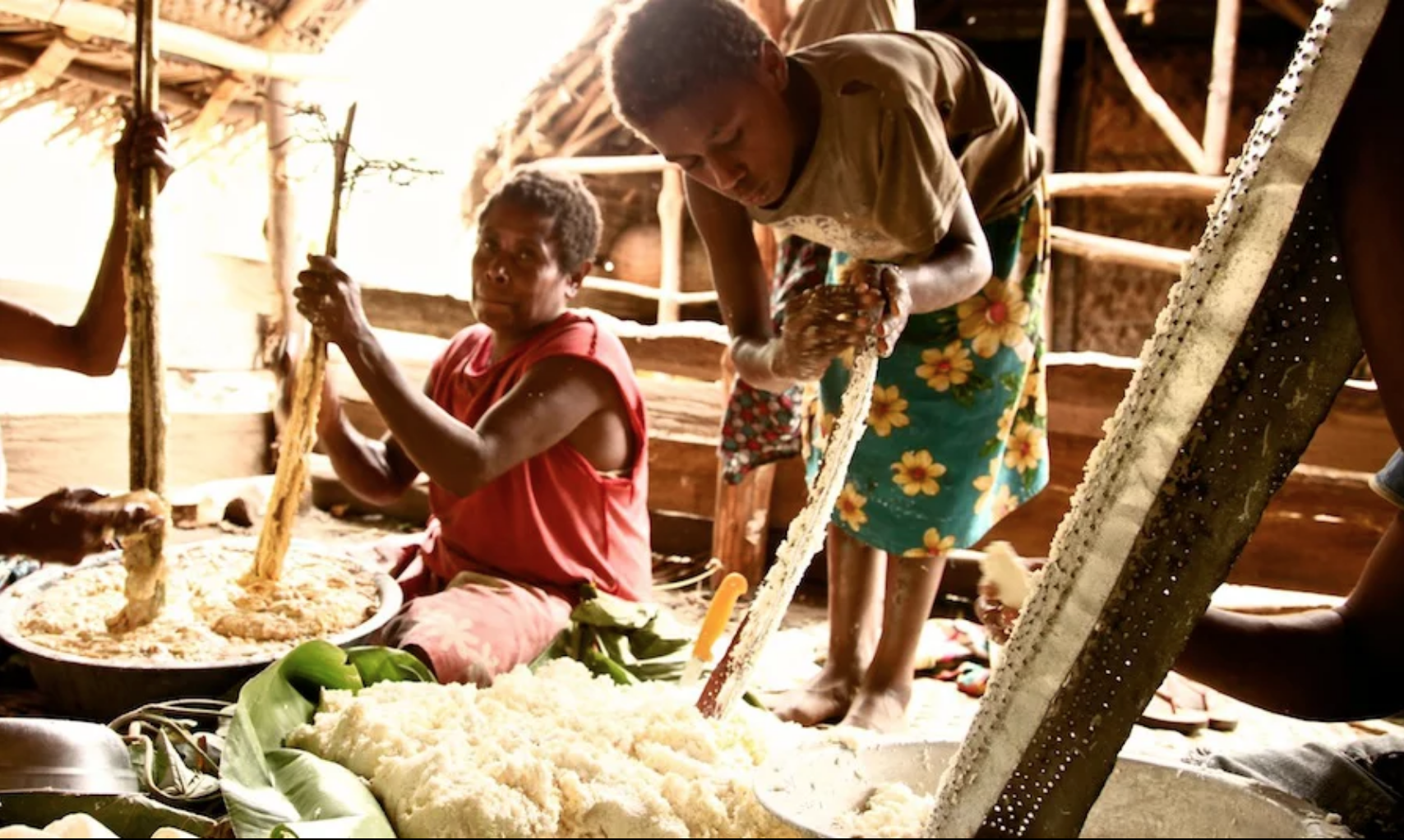
Photo credit: Jessica Sherry
M: Much of the work you've done so far on Tongal focuses on a single subject, such as Josh Mook, an Additive Engineer, and Beauty Mtshweni, a Project Manager, both of whom work at GE. How do you prep beforehand to make sure you get the most out of your subjects and what are some of the challenges you face during this process?
J: Some of my favorite work features personal stories. For preparation:
- I think having an initial pre-production call and listening to a person's story, asking questions and finding their moments of passion is really important. I try to keep an open mind about what their story is, rather than have it try to fit into a mold that I've already predetermined.
- I try to keep an open line of communication with the subjects, so if they have questions they can ask, and so that they feel some ownership of the project during pre-production and during the shoot. I like to check in and make sure that the approach feels good to them, too.
- I like to film in people's homes or their personal spaces, because often you can tell a lot about a person by their home and they are sometimes the most comfortable and empowered in that space.
- Since these videos, and many of my projects, are interview-driven, I make sure to leave plenty of time for the interviews. Both Beauty's and Josh's interview took about two hours for three minutes of content. This way I have plenty of options in the edit room and, by the end, the person isn't nervous about the camera anymore. I also try to shoot the interviews first, so I have some one-on-one time at the start of the shoot with the subject and so that the interview can inform other scenes I film. I vary the questions to avoid any pre-prepared answers and get to the most genuine responses.
I think the challenges are always keeping the subject comfortable and engaged, and being ready to adjust if a scene isn't working or if their story is a bit different than I had previously understood. I find that I'm always battling time on a shoot and I often have to cut a scene or two that feel extraneous. Also finding the clear narrative arc of the story, amongst all the details of a person’s life, the complications of the shoot day and the client goals, can be challenging and requires constant attention.
M: A number of producers you’ve worked with have told us that you put together a mean production bible and are very well organized when going into pre-pro. What is your advice for doc filmmakers in the early stages of production?
J: Thank you! Pre-production is really important to me. I think setting yourself up well with all the logistics, really leaves room for the magic to happen with the creative. One thing I do before each shoot is sit down and really imagine myself throughout the travel/scout/shoot day, at every step. I think about what the first thing I need when I get to the locations is (a parking space, contact info for the subject, etc) and, for each scene, everything I might need. I also try to think about contingency plans. I really like to connect with anyone who knows the locations or knows the subject matter well, to take a deep dive into any details I might not have and try to address any surprises before I'm on location. All that goes into the pre-production book.
M: By now, we know that you’re no stranger to traveling to distant places. We want to follow up with you after your trip to the Galápagos. But before then, what are you most excited about for your Archipelago adventure?
J: I'm so excited to see these islands - so many people say that it's a once in a lifetime experience. The wildlife sounds amazing. I can't wait to see these tortoises. I'm also really excited to experience the cruise aspect and to see the islands in the distance just as explorers and pirates did in times gone by.
-------------
Like documentary filmmaking? If you could travel anywhere to document anything, where would you go and what would you make a documentary about? Let us know in the comments below.


