
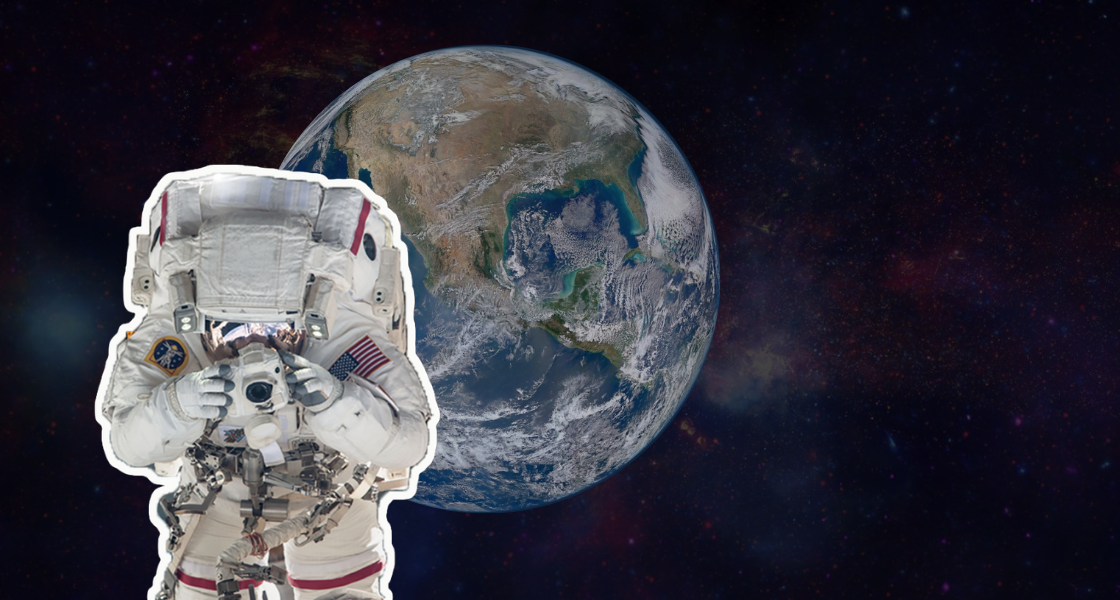
NASA and the Houston Cinema Arts Society are teaming up once again to host the annual CineSpace Short Film Competition on Tongal (check out the 2022 competition here), inviting filmmakers, editors, and animators from around the world to explore NASA's digital archives and create short films inspired by, and incorporating, real NASA footage.
In addition to the first-, second-, and third-place prizes awarded to the top films, additional prizes are awarded to the winners of the Special Categories competition each year. This year’s Special Categories are, “Educational Film That Best Highlights Impacts of Space and Science,” and “Film That Best Depicts Unity and Inclusion in Science.”
What we love about the latter category is that it recognizes the invaluable contributions to science and innovation that diversity brings. This year, filmmakers are encouraged to dive into NASA’s archives and unravel innovative moments that celebrate stories of underrepresented individuals in science and space exploration.
To get the creativity flowing, we rounded up some of our favorite past CineSpace films — both documentary and fiction — that speak to this very idea. For your viewing pleasure:
Not Our Thing by Rio Ananta Perangin Angin (Finalist, 2020, Taiwan): Told from the viewpoint of an engineering student from a rural village in Indonesia, this film shows how the International Space Station has empowered the children of his village to dream of something that is out of this world.
The Most Ideal Place by David Regos (Best Documentary Winner, 2019, Spain): When preparations were being made for the historic Apollo 11 moon mission, three space stations around the globe were needed to keep track of the spaceflight. One was in California, one in Australia, and the third was in a small, sleepy village in the middle of Spain. The Most Ideal Place shows the crucial role that the town of Fresnedillas played in the moon 1969 landing. This documentary tells the story of the local Spaniards who unexpectedly became an important part of this monumental event.
Juanita: Beyond the Borders by Elena Franco (Film Best Depicting Innovation and Inclusion in Science and Technology, 2018, Mexico): In 1985, Juanita was one of 16 Mexican women semifinalists in a contest that chose the first Mexican astronaut. A pioneer for women, she created an opening for females in a field historically dominated by men.
Kalpana Chawla: The Bright Star in the Sky by Sourabh Kumar Vinodiya (3rd Place, 2020, India): This is the true story of Kalpana Chawla, an American astronaut, engineer, and the first woman of Indian origin to go to space. Her story shows the many challenges she had to overcome to achieve her goal of becoming an astronaut and how she managed to do it through perseverance and hard work.
Lani's Space by Harriett Maire and Ferris Bradley (Film Best Depicting the Benefits to Humanity from the International Space Station, 2016, Australia): Do stars gaze back? Lani’s Space Follows Manu, a solo Polynesian father, and his realization over his daughter’s fixation with outer space.
CineSpace submissions are due July 14, 2021. Head to the brief for more information and to access NASA’s image archive. We can’t wait to see what you create.
__
Note From Tongal: "Depicting Unity and Inclusion in Science through Film" is part of a series of Tongal Community-written blog posts that were originally sourced in the Tongal Blog Open Call Project. The views and opinions expressed in this article are those of the author(s) and do not necessarily reflect the official policy or position of Tongal. Read more Tongal Community-written posts here and then Pitch us a topic you'd like to write about for the Tongal Blog!