

For this month’s Creator Interview, we caught up with Tongaler Shane Seibel to talk about his transition from cinematographer to highly versatile film and commercial director, as well as his latest project, the Chameleon
Shane offers some sage advice for all you social video creators out there, so let’s begin!
Maddie: Tell us a little about yourself, your production company Magic House, and how you got started as a commercial filmmaker?
Shane: One day, a distant cousin of mine - a woman I’d met only three or four times in my life - called me out of the blue and asked if I wanted to go on a
Whoa, whoa, whoa. That means I could have picked the Amazon rainforest or LOTR mountains in New Zealand?? Maybe Machu Picchu! Or the Pyramids of Giza!?
To be honest, I don’t really know why I picked London. Maybe I panicked - it’s not every day you get put in a situation like this. Regardless, I was grateful for the once in a lifetime opportunity! London has so much history, so many sites to see. I knew I’d want to remember those memories forever -
But I knew nothing of photography. Nothing. I think the first thing I typed into Google was “how to shoot good photos.” After that, there was no turning back - my love of photography erupted and consumed every part of my waking life and all of my dreams at night. After my trip to London, I knew deep down I was meant to be behind a camera and spent every moment of free time practicing my craft. My passion for photography soon developed into a devotion for cinematography.
After shooting dozens of short projects and even a few
Magic House is a film production company I founded in Texas many years ago. Since then we’ve moved to Boston, back to Austin, finally settling here in Los Angeles. I’d like to say we gravitate towards a particular style of
M: The Make It
S: Anyone who has worked for Tongal knows, 15 seconds is not a lot of time to get an idea or complex story across. There were two different types of Chameleon Cold-Brew in six different flavors, which we needed to showcase in as many recipes or methods of drinking as possible. We had so much information to squeeze into such a short duration that there
Montage is a really effective way to condense space, time, and information. It can be a powerful editing tool when trying to evoke a feeling in the audience, in lieu of telling a conventional, comprehensive “story”. We wanted these spots to feel impressionistic, tonal, suggestive -- there is no real narrative, no conversation between characters or exposition through dialogue. In most shots, the product was the most important part of the frame, not the actors. Instead of the actors moving the story forward, they were there to help establish an environment, a tone, a feeling. Actors sometimes fell out of focus or were partially obscured from view to help draw the audience’s attention elsewhere: the Chameleon Cold-Brew!
However, even in a montage, 15 seconds is not a long time. This is where the match cuts come in. We specifically chose actions and movements that could bridge the gap between different people, places, and types of drinks we were trying to represent. Could a shot of someone shaking a spray paint can “match cut” well with a shot of a cocktail shaker
M: Your Pitch thoughtfully took into account where the Videos would live because it was always your intention to capture the filtered snapshot feeling that’s native to Instagram. How did you accomplish this effect?
S: In our pitch, we envisioned these commercials with a heavily filtered “Instagram look.” We wanted to evoke feelings of warmth, shareability, summertime, hanging out with friends, and be relatable to our target demographic (millennials). Embracing that highly saturated,
The Sponsor wanted the Videos to capture and convey their brand’s messaging and ethos. Instead of going heavy on the “filtered” look, they asked us to instead
In post-production, we showed the sponsor multiple color correction passes and we settled on a happy medium: a saturated color palette that didn’t push the envelope.
M: Generally speaking, what are some of the challenges in making content for social channels, especially when it comes to creating a suite of Videos? Is the Sponsor looking to target different audiences with each Video? How do you make each Video feel distinct, but part of a greater whole, as well as feel native to its intended channel?
S: In order to make a suite of videos work as a comprehensive “whole,” you need a common element that ties the suite together. Some video suites utilize recurring characters, location repetition, voiceover duplication, or repeated plot devices. Since we were unable to rely on audio to carry our story (Facebook auto mutes ads), we took a visual approach and relied on “match cutting” to move the narrative along.
Once we had settled on the structure of the suite (each spot as a series of match cuts between 3 scenes of people), we could swap out characters and locations to showcase a wide demographic. We worked hard to give the brand a range of characters to choose from - professionals in an office environment, artists working outside, friends hanging out and enjoying each others’ company, etc. By mixing and matching these different scenes we could customize each spot to fit any target audience or demographic.
For Chameleon Cold-Brew (as you can probably tell from their name), versatility was immensely important. Their drinks can be enjoyed anywhere, anytime, any way you want it. It was our job to showcase as many of these scenes as possible and let the Sponsor decide which arrangement would be best suited to which channel or platform. This meant every shot needed to look beautiful in both 16:9 and 1:1 aspect ratios. To do this, we utilized in-camera frame guides in addition to blocking actors and important props close together or in the middle of the frame. This allowed us to consistently capture shots that would work in multiple frame sizes.
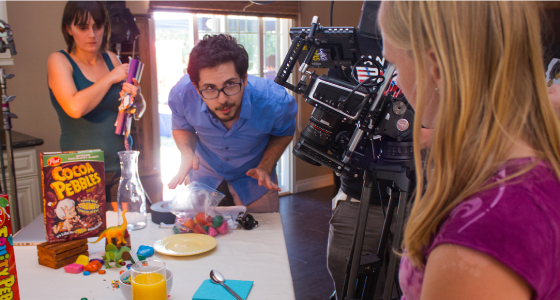
M: You brought on a very experienced food and beverage stylist for this Project. What is it like working with a food and beverage stylist on set, and what are some of the logistical needs you have to prepare for and be aware of?
S: Anna Lee was phenomenal! Last year, I saw a random interview of her on Buzzfeed - she’s worked on productions like Life of Pi and Silicon Valley - and I really wanted to work with her. At some point, I simply sent her a message via her website and we started working together! Isn’t the Internet awesome!?
It was easy to work with Anna on set because we communicated so heavily during pre-production. I made sure our Production Designer and Anna discussed color palettes, tableware design, food combinations, and ingredients - even down to which shape of
There were definitely a few tricky shots. We needed to create a white swirl of milk to match cut to a spinning skateboard wheel. In pre-production, we tried using every combination we could think of to get the intended effect - using whole milk, skim milk, heavy cream, light cream, using a syringe, stirring before adding the milk, stirring after, with ice, without ice, fast, slow, etc. Only one of the dozens of methods we tried actually worked as intended. The lesson here is that any work you can do in pre-production will give you more time on set to capture exactly what you envisioned.
M: You’ve won 19 projects on Tongal so far - incredible! Many of the Projects you’ve worked on are in the food and beverage category. Did you focus your energy intentionally on food and beverage spots, or did this naturally happen? What other areas do you see yourself expanding your portfolio in - and what other kinds of Projects do you hope to work on in the future?
S: Don’t stroke my ego too much! When you get complacent in your position, you can get arrogant and sloppy, so I try not to focus on how many “wins” we have and instead put my thoughts into the next task at hand!
I never intentionally focused my energy
As a cinematographer, I’ve shot four
Don’t get me wrong,
I’m in the middle of developing several long and short form projects and

Great job on these videos, Shane!!

Lots of great information packed into this interview, Shane! Thanks for taking the time to delve into your process.


