


For November’s spotlight we’re talking to Pangur Animation, the budding animation studio from Valencia, Spain! Since joining on Halloween last year, they’ve landed 3 huge stop motion animation projects with Play-Doh, Warner Bros (Scooby-Doo), and Best Fiends. They knocked those projects out of the park and are quickly rising the ranks of the Tongal elite.
We can’t get enough of this sleek recipe video, so we chatted with Ana, Ivan, Pablo and Vincente to find out all about their claymation process and where they got their name!
Nolan: When did you first become passionate about stop-motion animation? What were some of your very first projects and what did you learn from them?
Pablo: I actually started in live action. I was hired for the production of the stop-motion series “Clay Kids” as a light and camera grip but was promoted to DOP for the second season. There, I learned some of the basics of camera and lighting on this kind of production. Once you’ve worked in a stop-motion production it charms you and really makes you an addict.
Ivan: When I was a child my mother didn’t want to let me watch Nightmare Before Christmas because the characters are skeletons, vampires, witches… But one day I saw it and I decided in that moment that I wanted to do that! So I started to animate at home with a webcam. Little by little I became more comfortable working as modelmaker.
Vicente: I grew up loving stop-motion through Harryhausen’s movies or little claymation pieces shown in Sesame Street. I began to animate my own toys shooting with a domestic video camera. The dream became reality when I finished my studies and got my first job as an animator in a stop-motion series: The Snailympics. From that moment I haven’t stopped loving and learning this technique in every project I’ve worked on through the years.
Ana: I’ve loved this technique since I have memory: the movement, building things, creating little worlds. My first personal project, as a teenager, was the construction and adaptation of The Tell-Tale Heart. Some years after that came Feardom. I learned to organize the work, materials, timing, and above all draw inspiration from watching talented people working.
N: How and when did Pangur Animation come to be? How have you evolved over time?
Pangur: We first met at Clay Animation, a studio in Valencia, Spain that was producing a stop-motion series for TV. From co-workers we then became very close friends who wanted to make a difference and create things together. After we went to Annecy’s International Animated Film Festival in the summer of 2015, with our minds full of inspiration, we decided that we didn’t want to wait until someone else gave us a project to work on it, so we began making ‘Feardom’ our first short film as Pangur Animation just to see how things went.
Things have evolved so fast these past few years we’ve barely had time to process all the change. Two years ago we were filming ‘Feardom’ in Ana’s bedroom and most of our first commissioned works still were done in our own apartments. Luckily we applied for Tongal’s Play-Doh Town project and won. At that point we decided it was time to move to a small studio apartment where we could work more efficiently. Being involved with more Tongal projects, other commissioned works and developing our own productions, we needed to expand again and now we are in our second location in a much bigger warehouse.
N: How long does it take to shoot something like the Best Fiends Recipe video? Were there any major pitfalls you had to overcome during production?
Pangur: Well, the BFR videos involve a lot of work. Firstly we design the recipe, and the general look of the video. When we have tested (and tasted) it, we make a meticulous planning of the animation, then we start filming, and that usually takes about 4-5 days.
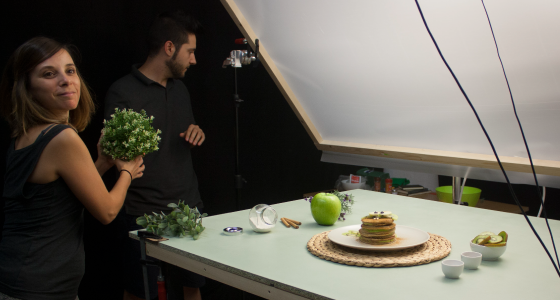
The greatest difficulty is that food decays over time so we need to plan things very carefully and shoot fast with some ingredients, e.g. Avocados, apples... Picking the tabletop paint was also quite complicated since we needed something that was easy to clean and repelled all the grease and stains that inevitably fall on the table.
N: I love how smooth all of the animations turned out. How do you achieve such a seamless ease effect on all of the kitchenware and ingredients?
Pangur: The secret is to animate carefully the accelerations, decelerations, and inertia movements. For example, using in-between movements to achieve a bouncing effect makes the object’s trajectory look more natural to our eyes. We call this ‘The Caballer Effect,’ named after David Caballer, a great Spanish animator and mentor. It’s delicious when you push the play button and inanimate objects come alive with their own personality.
N: What is your camera and lighting set up?
Pangur: One of the wonderful things about stop-motion is that you’re not shooting a video but a succession of still images. With that you can achieve great results with any DSLR camera, in our case we use a Canon D700. For the lighting we’ve built our own rigs that fit this particular project. Two rigs are placed behind a diffuser on top of the set acting as the main source while the third rig is used as a background light.
N: How much post production finessing goes on in a project like this? Or is it mostly done in camera?
Pangur: In stop-motion we always try to do as much as possible on camera, with a good lighting setup and an animation plan we save quite a lot of post-production work. This way our post-production department can focus on other tasks such as the removal of wires, rigs, stains and dust, and the addition of graphic elements. Occasionally we film objects separately so they can be placed later on different layers to speed up the workflow, or change the speed of some animations in the editing process.
N: What’s your worst production horror story?
Pangur: A stop-motion studio usually has a wealth of anecdotes, some of them are little hells which we remember with love. For example during the production of our first short film the blue plasticine constantly melted in our fingers. Which is an issue when the only character that appears in it was entirely blue and the animation was… difficult. Ana’s cat, the real Pangur, enjoyed stealing and eating some parts of the character’s body so we had to model these pieces a few too many times, but we still love him anyways.
When we moved to our first studio apartment, we had to immediately start the work without delay because of the schedule, even though the electric wiring or the running water installation wasn’t finished yet. Fortunately things went back to normal some days later.
N: Is there anything we should keep an eye out for from the Pangur Animation team?
Pangur: Of course, look out for the Best Fiends Bites series. ;) We’re also developing our own stop-motion original series and we expect to start looking for financing during 2018. Also a short film in a very early stage, we’re still working on concepts and script.
--
You can keep an eye out for Pangur’s short film on their website and Facebook page!


