
Since joining the community in May, Kuala Lumpur-based filmmaker Sam CF has been greenlit in not one, but THREE, Tongal projects. That had me thinking, “Dang, what’s his secret?” Sam’s also earned a bit of a reputation around the Tongal office for being great to work with. That further piqued my interest in getting to know him and made me wonder, “Who does he think he is, turning in solid videos AND being a delightful human being?”
Now that Sam’s first video with Tongal is out in the wild, created as part of the Solitaire TriPeaks Video Project, the time was ripe to reach out and demand answers to my burning questions. Read on to see what makes Sam tick!
(Click image to view video on Tongal)
Marissa: Hey Sam! Nice to chat with you! You’ve been on quite a roll recently, having landed video projects on Tongal for Solitaire TriPeaks, BetterHelp, and most recently, Homescapes. What do you think has been the secret to your success on Tongal so far?
Sam CF: I would be glad to share my limited experience [working] with Tongal. After checking out the average number of pitches a project on Tongal receives, I figured if I'm a filmmaker with average skills, I might have a chance of landing one project after 15-20 pitches [Editor’s note: Actually, we’ve found that it takes 5 pitches to get that first greenlight, on average!]. I tried everything from editing projects to video suites.
Around the 7th pitch, Tongal Producers Catherine and Quaid emailed me. I landed my first project for Solitaire TriPeaks. A few days later, Dom and Tommy emailed regarding the BetterHelp Direct Response project [see Sam's BetterHelp video here]. I worked on both while familiarizing myself with the Tongal website. Once the project for Solitaire TriPeaks wrapped, I immediately dropped in another pitch for Homescapes on the very same day. After some time, Alexandra, Scott & Rebecca emailed with the good news.
If there is a secret to landing these projects, I'm still not aware and wish I knew the formula. My uneducated guess is it’s a mixture of craft, the effectiveness of the pitch, and luck as in the project matches our filmmaking style the most compared to other pitches. A good balance of these elements which I'm still working on.
MN: Can you tell us a bit about your creative background?
SCF: I started out as a music producer for jingles and local artists in Malaysia. Soon I had the opportunity to start making local music videos. A few years later, I was contracted to a local production house to work on commercials. Then, my eldest daughter turned six. The school I wanted to enroll her in is in the suburbs which is an hour's drive from the city. I relocated, left the production house and tried my hand at freelancing which I've always wanted to do.
Three months of freelance and all I got was corporate video jobs. After several projects, I started to feel that my work was like a template. The same formula replicated across different project names and talking heads. I started to miss my previous production house.
One of the corporate videos I was working on required me to shoot in San Jose occasionally. As luck would have it, while in California, I saw a My/Mo Mochi commercial created by another Tongaler as I searched for ice-cream mochi online. That was how I discovered Tongal and I began pitching when I returned to my home country.
MN: What drew you to the Solitaire TriPeaks project, your first with us?
SCF: Out of the first seven pitches that I submitted, the Solitaire TriPeaks brief was the one which truly spoke to me stylistically and it was fun to develop the brilliant concepts further. I even made a pitch video for it, so I'm glad it is the one that landed.
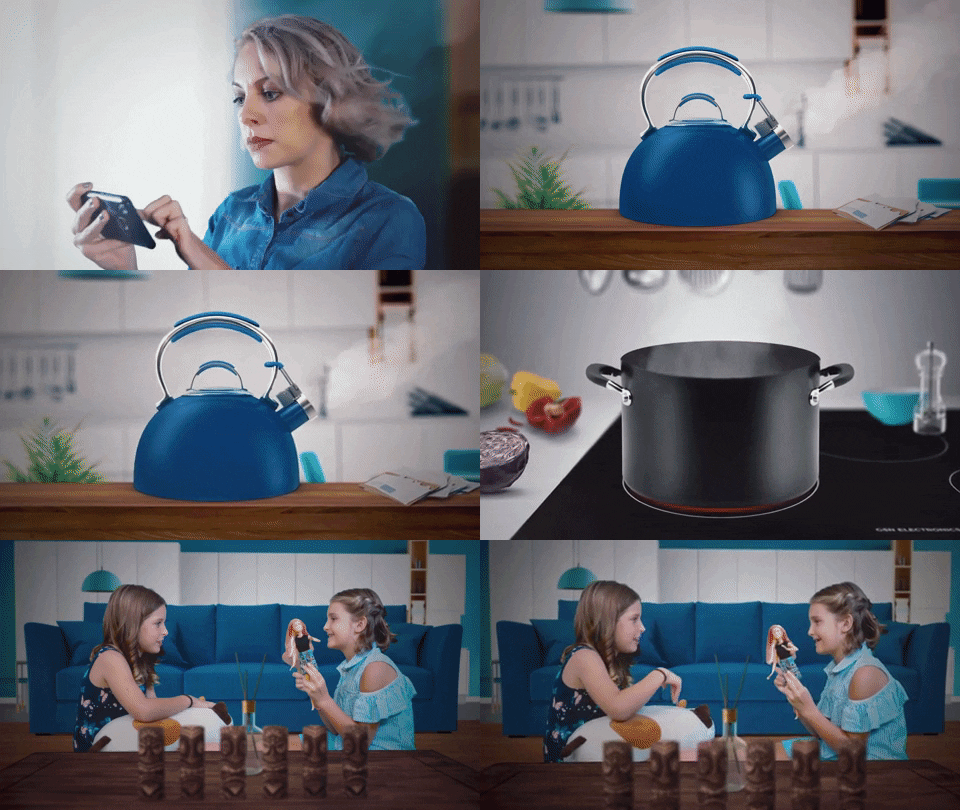
MN: I can see that you did a lot of compositing on the piece, placing the actors against greenscreen and building computer-generated backgrounds and props. Is this a style you often utilize and what tricks or tools did you use to achieve the look?
SCF: Compositing is a style that I occasionally utilize when needed. For this project, it was done using After Effects’ 3D camera tracker, a piece of technology sent to us by the video editing gods.
Achieving the look was done by planning the foregrounds and backgrounds ahead of time, matching the subject lighting during the shoot, and some trial and error during post-production until we got it right.
MN: We’re in California, you’re in Malaysia. This likely presents some very unique benefits and challenges. How did you manage the time difference and what’s the best part of producing international content in your home country?
SCF: I'm used to sleeping late or waking up early. Also being a coffee addict helps.
The best part is that I am able to build a portfolio of international works while working on them from my home country. What an amazing time we live in! If I manage to land a couple more projects on Tongal, I plan to start my own little production house and website where I will upload all my latest works. My involvement in my previous works before Tongal was only as a director, not a production house. Still looking for a name for the website though.
MN: Are you working on any passion projects right now or is client work your main focus?
SCF: I'm sure that every filmmaker has that one passion project they're thinking about doing or have already done, probably a short film or feature film. It's not my priority right now but I'm thinking of working on one in the future to test my long-form filmmaking craft. See if I have that in me. When I do, I hope to shoot on 8K camera and Zeiss Supreme Prime Lenses. Maybe next year's CineSpace Short Film Competition would be a great start.
In the meantime, client work with a bit of a creative challenge is what excites me.
Have any additional questions for Sam? Leave 'em in the comments!


