

Each year on Tongal, NASA and the Houston Cinema Arts Society host the CineSpace Short Film Competition (see 2022 competition details here), challenging filmmakers, animators, and editors from around the world to create original shorts based on selected themes. The catch? Each film must be comprised of at least 10% of images or footage sourced from NASA’s visual archives, which holds over 50 years of imagery. Special guest judge, Richard Linklater (Dazed and Confused, Boyhood), helps to decide the final CineSpace award winners.
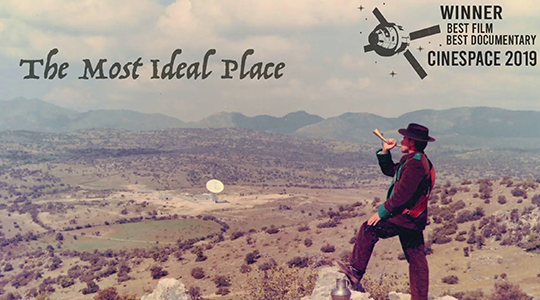
This year, documentary filmmaker David Regos was honored with two awards (a first in CineSpace history!), including First Place and “Best Documentary,” for his short doc The Most Ideal Place, about a small town in Spain that played an unexpected role in the first moon landing. The US’s achievements during the space race are often underscored by a great sense of national pride, but David’s film sheds light on a little-known part of the international collaborative effort to stay in touch with the astronauts as the earth rotated. In order to do this, NASA needed to set up communication bases in two other parts of the world: one in Honeysuckle Creek, Australia and the other in the Spanish hamlet of Fresnedillas, which is where David goes to tell this incredible story. He documents how this event changed the town and the lives of the people who worked in the station.
We had a chance to ask David a few questions about the making of his documentary, how he serendipitously came across the story and managed to track down the people who worked at the Fresnedillas space station.
Maddie Mindling: Tell us a little about yourself and your filmmaking background.
David Regos: I grew up in Sydney, Australia. After studying my final semester abroad at the University of California, Berkeley, I produced and directed my first feature-length documentary about the quirky world of artistic roller skating. After that, I worked for ABC TV in Australia, traveled across the USA filming people’s inspiring “Aha Moments,” and documented the ancient traditions of the Tibetans in India and the Q’eros of Peru. The last feature I produced “Divide in Concord,” a film about an 84-year old grandmother on a crusade to ban plastic bottled water, screened at festivals around the world. Apart from “The Most Ideal Place,” this year I also completed another short film “A Fistful of Rubbish,” an environmental documentary about the trash problem in Spain’s desert.
MM: What made you pursue the story of Fresnedillas and its unlikely role in the space race? Why was it so important to tell?
DR: In 2017, my film “I’m Here Now Somehow” was selected for CineSpace. In 2018, I wanted to make another film to enter into the festival and I started researching anecdotal stories around people’s experiences of the moon landing. I thought that there must have been some fascinating happenings on this planet taking place at the same time that men were walking on the moon. But when the idea was conceived I was working in New York and didn’t have time to develop the project. This year, I had a small window while working in Spain and decided to spend a few days researching to see if there were any Spanish stories around this theme. As it was the 50th anniversary of the moon landing, the first article that showed up when I searched for “Spain moon landing story” was about how the first men to hear the famous words “The Eagle has landed” were Spanish. I learned that one of the antennas used to track Apollo 11 was in a small pueblo called Fresnedillas, which was about 20 minutes from where I lived a few years ago. So within less than a minute, I knew that I had found an important and largely unknown story to tell. Often with such grand narratives, the details are lost or simply glossed over, so I felt compelled to focus on the characters and town that played a small but crucial role in such a momentous event.
MM: You do a wonderful job of capturing the character – and characters – of the Fresnedillas. How did you set out to do this from a directing standpoint?
DR: Because I had lived near Fresnedillas I knew that it was a very small town. And having worked on small-town documentaries before, I knew that if you merely spend enough time there loitering around, the characters will appear. But first I went to the local council and told them about the project. They were super helpful. They knew who was who in the village; they called up Santiago (the former bar owner) and he showed up immediately. And then we just walked around the village and hung out in the town square asking elderly people what their experiences were during 1969. We also went to the senior center which was obviously a great resource. Generally, people were willing to talk or point us in the direction of someone they knew who worked at the station. I like to work with a minimal crew so it was just myself and my cinematographer, Tomas. It’s less intimidating for the subjects, and since I have a genuine interest in their lives, they were willing to share openly. Excitement is infectious. We had an honest intention to discover these special moments and that helped to manifest the right conditions to capture the true sentiment of these characters.
MM: How did you uncover and track down the footage and images you needed for your film?
DR: Part of my job as a documentary producer is researching. So I was able to dig and follow leads. I tracked down some others who worked at the station who had some old photos. The town council was helpful and I met with a local historian who was a great resource, too. I also used the Prelinger Archives which is a fantastic website that allows video creators to use copyright free old public domain films.
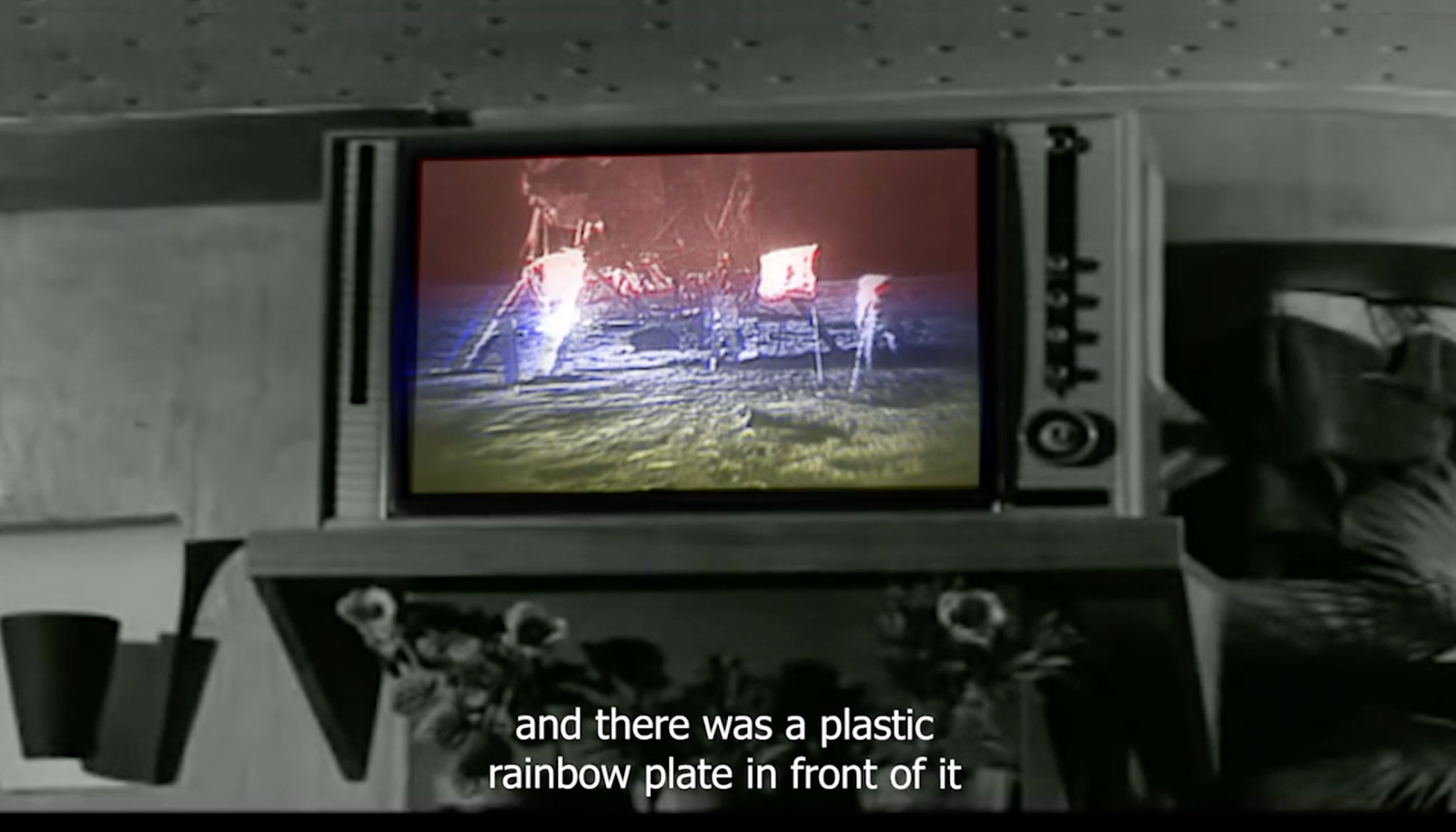
Still from The Most Ideal Place showing what the moon landing would have looked like to the people of Fresnedillas.
MM: In the last part of the film, you recreate how people in Spain would have watched and experienced the first moon landing – at their local bar on a small 1960s color-plated TV set. Can you talk about how you worked on recreating this experience for the audience?
DR: As soon as I heard that people in the town watched the moon landing at the bar with a color plate in front of it, I knew immediately that I wanted to put some sort of cheesy effect over it to recreate the moment. We’ve seen the iconic moon landing footage hundreds of times but rarely, if ever, in color. My editor, Liron, was pretty good at visual effects, so I told him my idea and he simply composited the landing footage over an old TV set and we played around with the color masking to simulate what it would have looked like in the bar.


