

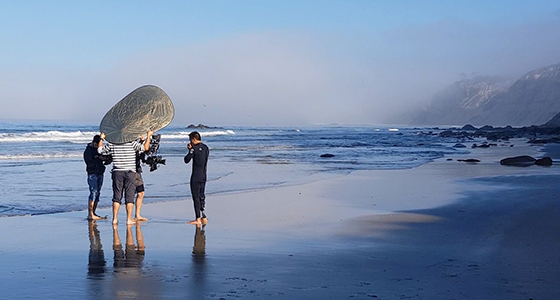
Late 2017, National Geographic put a call out to the Tongal filmmaking community to produce a new digital series that would help humanize their larger-than-life explorers. The only catch was, our creators wouldn’t know who the explorers would be - or where in the world they might be located - until they made it past the initial Pitch phase.
As you can imagine with a brief this sexy and mysterious, the competition was fierce right out the gate. From the 5 filmmakers who were selected to move into Pitch Development (and find out who’d they’d be working with), only one team would ultimately get the greenlight from NatGeo to travel far and wide capturing the inspiration behind some of the world’s most fascinating explorers. That honor ultimately went to a production company out of Bulgaria: Chase a Cloud Studio.
With the November 2018 release of the series, three videos featuring explorers Albert Lin, Asha De Vos, and David Lang, we thought the time was right to track down Chase a Cloud so we could share their story with the rest of the Tongal Community. Below, is the lightly-edited conversation we had with Chase a Cloud’s resident director, Stani Milev.
(Please reload the page if the video doesn't play)
Marissa: First, tell us about yourself and the Chase a Cloud team that produced this series.
Stani from Chase a Cloud Studio: My name is Stani (short from Stanimir) Milev and I am a nerdy filmmaker, nature lover, and a dad living in Bulgaria. I founded Chase a Cloud in 2008 with this naive idea to do things differently. Ten years later, it is not clear if that revolution took place at all, but we’ve done so many things and it’s been so much fun, that it has become a miracle on its own.
We got our start in outsourcing VFX for Hollywood movies and made shots on films like Speed Racer, Gangster Squad, and Life of Pi. I like to joke that we had a breadcrumb of an Oscar. But back then, Rhythm and Hues went bankrupt, the industry shifted, and we decided that being at the bottom of the vendor chain is not what we wanted. That’s how we moved to commercial and corporate animation, and eventually got into shooting live-action videos too.
When we got awarded the Explorers Series Project last year, we had to quickly assemble a small and nimble team that was capable of moving fast and making awesome stuff within a lot of logistics constraints. I had already worked on a couple of projects with Drago (camera), Viktor (assistant director, camera, post-production), Marin (camera assistant, post-production), and Lyusi (line producer) as part of our core team for years. Since we’d never done anything like [shooting a live-action documentary piece in extreme conditions] before we needed someone with serious field shooting experience. That’s how Vlad Donkov (a renowned outdoor photographer and adventurer) came on board. When talking about the team, I should not skip Sava (brilliant animator) who is a formidable creative force at Chase a Cloud. Even though his comfort zone is animation, he gave invaluable input in the pre-production of the series.
Left to right: Stani, Viktor, Drago, Albert
Marissa: Since NatGeo hadn’t nailed down which explorers would be available for filming at project launch, the pitch process was somewhat unusual on this one. How did not knowing who you’d ultimately be filming affect your initial creative approach?
Stani: Albert appeared in the project from the beginning and we based a lot of our initial thoughts & concepts on his story, but David and Asha got in the last minute. I remember writing David’s script on the plane to LA. On one hand, they were so different, on the other, they all had a similar experience, something was bugging them since their early days and they had to go out and figure it out. We wanted to find a way to bring structure to the series but also keep each episode open enough to adapt to the unique universe of each explorer. We knew that we couldn’t have a unified storytelling, that’s why we turned to the visuals and creative elements instead. The peculiar editing style and double exposures for example.
This approach allowed enough flexibility to fit anything Nat Geo would throw at us but also keep a consistent and unique visual language that will become a signature of the series and make them feel like...well, a series.
Marissa: And once you heard it would be Albert, Asha, and David, how did their backgrounds inspire the creative development even further?
Stani: Albert is absolutely incredible. The minute you meet him is the minute when things start happening. He has so many stories and floats through life with such grace. Our biggest challenge was how to fit so many things in just 3 minutes.
I am a big fan of the startup movement and David’s story clicked immediately with the way I see the world. Two guys in a garage trying to make a difference and inspire people. There is a special type of romanticism about it.
Left to right: Drago, David, and Stani capture an underwater portrait
Asha was a totally different story. Like us, she comes from a developing country and had to fight her way through a lot of prejudice, dogma, and constraints. It was truly remarkable to touch a story that proves the passionate, unconditional love for the job will always get you where you want to be.
What those three have in common is their vast, deep, and beautiful soul. I can rightfully say, that the best thing about this project was the privilege to meet Albert, David, and Asha and even for the short time we spent together, we built friendships that will last.
Stani and Drago capture Asha’s portrait shot
Marissa: What was the most surprising thing that happened on all your travels for this series?
Stani: So many things happened during the production, it will take me a week to tell you all the good stuff! But there was this absolutely crazy day, one of the first shooting days with Albert that will stick with me till the very end of days. We started the shoot at 3 am, drove for 3 hours to catch a sunrise over the desert plains of Anza Borrego. By 10 am, we managed to dig our production van into the sand, got busted by a park ranger and did a blues jam session with Albert (who brought guitars).
In the afternoon, we moved to Painted Canyon where our camera rig barely fit in the tiny spaces and the drone couldn’t get a GPS signal at all. Then we ended the day chasing the sunset over a beautifully shaped hill next to the Salton Sea, and also did a couple of night shots.
By 9 pm, this endless day was just about to wrap up, only to find that Steve (the lead Tongal Producer on the project) had lost his car keys somewhere in the desert. So we drove back 80 miles, searched the pitch black desert and miraculously found the key scattered into tiny bits and pieces all over the road, run over by a small army of trucks. Then even more miraculously Steve took this somehow untouched barebones chipset, got into his car, pushed the button… and the thing lit up like a Christmas tree.
All got back safely at 3 am, after 24 straight hours of raw, awesome adventures! You should ask him about it... I think he still runs his car with that tiny circuit board.
[Note from Steve: I was amazed that this little dime-sized RFID chip still turned my car on, and I actually drove my car for another 4 months using nothing but that chip, tucked into the pocket of my wallet. You could chalk those 4 months up to my laziness in replacing the key, but I like to think I kept at it because the chip was a constant reminder of our awesome adventure.]
Marissa: What a wild day! Up until this project, all your work on the Tongal platform has been in the slightly-less-perilous realm of animation. In fact, another video you recently worked with us to create is Explorer Academy: Brain Freeze, a 2D animated pilot that brings to life a new adventure book from National Geographic Kids.
How does live-action filmmaking help improve your ability to produce animation and vice versa?
Stani: Chase a Cloud has been an animation studio for most of its lifetime. We only got into live-action 2-3 years ago with the mirrorless/DSLR revolution and we fell in love with it immediately. It’s been a crazy roller coaster ride ever since.
We had to learn pretty fast how to work with cameras, lights, uncontrollable situations, flying drones, etc. Truth is, when it comes down to the creative process, animation and live-action are quite similar. And now, from my perspective, those are just different tools to tell different stories. Having more tools in our belt, helps us pick the right one for the job.
Animation teaches us precision and thoughtfulness. Live-action keeps us ready to improvise and use whatever we have in hand to make the best out of it. Animation brings to life all those imaginary universes, and live-action takes us to amazing, real, places. They kind of complement each other, and together we get the entire spectrum of fun. This is also probably our biggest advantage as we can build a unique experience and approach for our clients.
Left to right: Albert and Drago in the desert sunrise
Marissa: One last question: If you could time travel to any major moment of discovery in history, which one would you want to be there to witness?
Stani: Hah! That’s a hard one. Maybe I’m still under the strong influence of the First Man movie, but that would be landing on the Moon. Or maybe I shouldn’t wind back but rather go forward and see a landing on Mars. Truth is, if a time machine miraculously falls into my hands... I will probably abuse that situation a lot :)


