

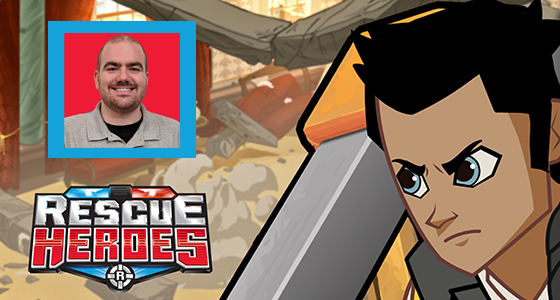
When Mattel called on Tongal’s writing community to reboot the popular animated kids series Rescue Heroes, it seemed like Tongaler Derek Pietras had been preparing for this opportunity his whole life. As a kid, Derek fell in love with watching animated TV shows like Rugrats, Tiny Toon Adventures, and Doug; he also spent countless hours creating original storylines with his toys. As he grew up, his passion for animation and storytelling remained constant. He pursued writing in college with the express goal of turning this life-long passion for writing animated TV shows into a career. Now, he’s one of the lead writers for Mattel’s Rescue Heroes, brought to life by the talented Bulgaria-based animation team Chase A Cloud, about a group of highly-skilled and inventive rescue workers, who team up to solve problems in high-pressure situations.
Check out Derek’s latest episode “Calm Under Pressure”:
Based on the popular toy franchise of the same name, the first Rescue Heroes series came out in 1999 and was written for kids ages 6 to 11. A few things have changed, however, since the end of the first series, namely in the way kids interact and watch their favorite shows. No longer sprawled out in front of the TV, kids are now watching on YouTube and in smaller (and shorter) digital formats. Mattel also wanted to gear the reboot for kids ages 3 to 5, so the challenge for Derek and the other writers has been to write this show for a completely new audience and format. In between all his writing, we had a chance to catch up with Derek and ask a few questions about what it’s been like working on this series and how he became an animation writer. Read on below!
Maddie Mindling: How did you get started as a writer for kids' animated series?
Derek Pietras: With how many cartoons I watched growing up, you could say I’ve been training for this my whole life.
My earliest memory is going to the movie theater with my mom to see The Lion King and being completely heartbroken by the stampede scene. I don’t know if it was in that moment that I knew I wanted to write, but it sure had a strong effect on me. From there, I devoured any cartoon I could get my hands on — Rugrats, Tiny Toon Adventures, Doug, Ducktales, and so much more. I never really grew out of that phase and I still watch cartoons regularly.
At first, I thought I wanted to write novels, but the more I researched that field, the more I realized it wasn’t for me. I knew I needed to try to make “animation writer” my career, so I packed my bags and moved from Massachusetts to LA to make it happen. I honed my craft, joined writers’ groups, got advice from some amazing animation writers, and after a lot of hard work, I was lucky enough to be able to write on Rescue Heroes with Tongal and Mattel.
MM: What was it like adapting Rescue Heroes for a new generation of kids? How is this new digital series similar to the original late-90s TV series and how did you update it for today's audiences?
DP: It was really fun! The Rescue Heroes are such great characters to work with, especially with all their tools and gadgets. I loved having the opportunity to modernize these characters for a new generation.
There are two huge differences between the new version and the 90s version: audience and episode length. This new show is written specifically for a pre-school audience, so it was a challenge to craft stories that would entertain and educate children within this age range, but also wouldn’t be too intense for them to handle. We worked closely with Mattel when crafting the lessons for each episode to ensure the message was clear and relatable to a young audience. I’d say we were really successful!
Episode length is honestly the hardest part of adapting this reboot of Rescue Heroes. We only get about 5 to 6 minutes per episode, so it can be a challenge to cram in everything we want. It becomes a balancing act of cool action and emotional character moments. I watch the episodes now and I’m impressed with how much we could fit into such a short timespan.
MM: How do you balance teaching values to kids while also keeping them entertained?
DP: It’s about making sure one element doesn’t overpower any other. If we have too much action, the episode can become a blur, and if we have too much emotion, it can feel slow. We pay attention to this right from the outline stage. We start by finding the emotional core of any episode — what the character learns through the rescue. Then we craft the exciting action around that core. By doing so, the action and emotion never drown each other out, but instead, work together to create a great episode.
MM: What are some considerations when writing specifically for preschool-aged kids (ages 3-5) and how do you address these considerations creatively, particularly for a digital environment?
DP: The key is to avoid writing down to the audience (since they can tell when you do that) while ensuring that the problems the characters face are something children can understand. A child may not know what it’s like to have a giant robot malfunction during a rescue, but they do know what it’s like to feel frustrated. That makes the characters feel real and allows the lesson to shine through. I think it’s because we’ve struck such a strong balance here that the show has had so much success on YouTube.
MM: Are there any passion projects you're currently working on? If so, can you give us a sneak peek?
DP: I don’t want to give too much away, but my current concept is an action/comedy show for 6 to 11-year-olds involving animal spirits, spooky ghosts, and magic Medieval knight armor. How it all ties together...well, that’s a secret! I have other projects in the works as well, so you will see more writing from me very soon.


