
Since 2016, Tongal has had the pleasure of hosting the annual CineSpace Short Film Competition, a joint endeavor between NASA and the Houston Cinema Arts Society, celebrating over 50 years of space exploration and challenging animators, editors, and filmmakers from around the world to create short films featuring imagery from NASA’s rich digital archives in new and exciting ways. The competition awards $26,000 annually and counts none other than film director Richard Linklater (Dazed and Confused, Boyhood) as one of the judges.
As creators get to work on this year’s entries, we wanted to revisit some of the award-winning films and their creators from last year. We were curious how they tackled such a unique challenge – creating a 10 minute (or less) short film comprised of at least 10% of imagery from NASA’s digital archives. How did they zero in on a specific theme, find the footage they needed, and more importantly, manage to impress Richard Linklater? And for those who had a chance to attend the Houston Cinema Arts Festival, we wanted to know what that whole experience was like as well.
One of the hallmarks of the CineSpace Short Film Competition is its global reach. Last year, 56% of submissions came from outside the U.S. We had a chance to interview five directors whose films were awarded during last year’s competition, including one from Ukraine and one from Mexico. If you’re planning on submitting this year, be sure to read on to glean some tips on how these CineSpace creators shot for the stars.
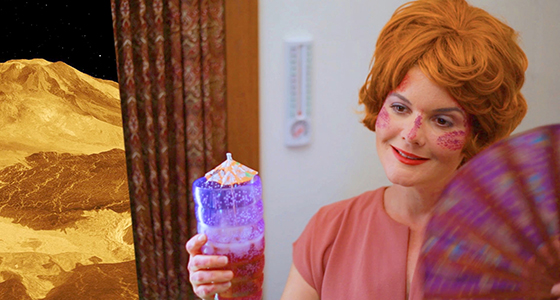
The Visitors by Horacio Rodriguez and Susan Spano
Maddie Mindling: Tell us a little about yourself and your creative background.
Graham Uhelski (Blackout Day, 2nd place winner): I've been a filmmaker since early childhood and was entrusted with an old VHS recorder my dad owned. Since then I've moved from shooting video as a hobby with friends into a professional career. I feel very blessed to have a job that allows for creativity and constant learning from everything I take on.
Horacio Rodriguez + Susan Spano (The Visitors, 3rd place winner): I have a background in digital content, writing, and photography. My writing and producing partner, Susan Spano, is an actress and voice-over artist. We live in Los Angeles.
Elena Franco (Juanita: Beyond the Borders, Special Category winner): I am always thinking about new projects. I have experience in theatre, television, and cinema, and I am also an actress. So, I can say that I live for this and for producing good products that send positive messages to the audience.
Orest Smylanets (Sleep, Special Category winner): I'm an independent filmmaker from Ukraine. I have been shooting for over 7 years. These are often independent films, experimental, as well as social and commercial advertisements.
MM: What originally sparked your interest in participating in last year's CineSpace competition?
Graham: Space has always intrigued me – it’s like this huge elephant in the room we tend to forget about here on earth with our day-to-day routines. Space is both terrifying and somehow so tranquil at the same time and for a storyteller that’s basically an infinite playground to explore. I heard about the NASA CineSpace festival years ago and I knew it was something I would pursue. I just had to think up a unique idea.
Horacio + Susan: We’ve always been fascinated by the space program and with NASA’s endeavors and milestones. It seemed like a natural fit to combine our creative filmmaking with our love for all things NASA.
Elena: Telling the story of my grandmother, Juanita Hernández, and how she could become the first Mexican astronaut [is what interested me].
Orest: As part of the competition, I wanted to claim that Ukrainian youth is interested in NASA and follows up on its activities. Ukraine has played a leading role in the development of Soviet space science. I dream that our potential will help realize modern space projects.
Juanita, Beyond The Borders by Elena Franco
MM: Space exploration, as we know it, provides a fascinating backdrop for us to explore the human condition. From 2001: A Space Odyssey to the recently released High Life, filmmakers have been using space to project all kinds of interesting, humanistic themes. How did you come up with the concept for your film and how did you thematically use space?
Graham: I wanted to push the theme of scale. The solar eclipse of 2017 was a celestial event I'd never witnessed in my life, so I knew that would be a good event to cover in a documentary style short for this particular festival. When you are witnessing a total solar eclipse, you really feel your size in the solar system in a profound way, it's truly an unforgettable experience. So for the edit, I wanted viewers of the film to feel a fraction of the emotion that I felt while witnessing the event. I coordinated with cinematographer Brock Howard to get vantage points from people all across the country to depict the event from as many perspectives as possible. I'm a strong believer that teamwork makes the dream work.
Horacio + Susan: For our film The Visitors, we decided early in development that we would try a comedic approach that still managed to showcase and respect the feats of NASA and the spirit of space exploration.
Elena: My grandmother, Juanita Hernández, gave me the inspiration for showing her life, or a part of her life, in a film. And the idea about the conquest of being the first Mexican astronaut delighted me. It is a great idea for giving new generations the message that our dreams can come true. That is why I wanted to share her story with everyone and, of course, the themes of universe, stars, moon, are things I am always very interested in. I also wanted to be an astronaut, too.
Orest: Discovering new horizons and opportunities, finding answers to the mystery of this world - these are the best motivation to do something. Space is our home. We shot what we felt. We tried to awaken the viewer's inner researcher.
Blackout Day by Graham Uhelski
MM: What was the biggest challenge in cutting and incorporating NASA imagery?
Graham: This was the most fun part for me because the footage available for use in NASA's archives is so incredible. I was careful to avoid using the common shots you see when NASA imagery comes to mind. In a lot of films, you'll see the same clips used over and over, I didn't want Blackout Day to suffer from that. After some deep digging, I found pieces to the video that felt seamless to integrate with the footage the production team shot on location.
Horacio + Susan: Our biggest challenge was finding the footage that reflected our script and vision. We had to narrow down what we needed from thousands of hours of available footage. It was a labor of love and inspiring to revisit so many historic NASA moments.
Elena: First, I had to look for specific footage related to the 1985 contest NASA and the Mexican Government announced. It was a real challenge because we did not have a lot of images or information about that event. So, it was a great opportunity to make a good documentary in order to give testimony of that 1985 contest and provide that information to new generations of Mexicans.
Orest: The main challenge was the transformation of technical information into artistic. But this process captures your heart.
Sleep by Orest Smylanets
MM: Did you get a chance to attend last year's CineSpace screening at the Houston Cinema Arts Festival? If so, what was it like to have your film screened there?
Graham: I was able to attend the event. It's always a treat to see things on a big screen. It was extra special for me because this particular festival had films that I was also very excited about seeing with like-minded people and curious souls. There were some extremely creative people that worked on films at this festival and I met some amazing filmmakers in the process.
Horacio + Susan: We were fortunate enough to attend the 2018 Houston Cinema Arts Festival! It was quite a thrill to meet other filmmakers, get a private tour of the Johnson Space Center and experience all the events surrounding the festival. Exploring Houston was fantastic and winning 3rd Place for our film The Visitors wasn’t too shabby!
Elena: I could not attend in person, but some of our talent attended, and of course, it was a wonderful experience for them!
Orest: Unfortunately, I was unable to attend the festival. I watched the work of the finalists online, each one is something special. Most of all, I remember The Visitors, Particles and Blackout Day.
MM: If you were to submit to this year's CineSpace competition, what kind of film would you want to make?
Graham: I would want it to be really weird, something completely abstract that would leave people with a feeling and not so much a message.
Horacio + Susan: We are currently developing several ideas for possible submissions to the 2019 CineSpace competition. We’re reviewing NASA footage now and plan to start shooting soon!
Elena: Unfortunately, I won’t submit this year. I am working on another film project right now.
Orest: Let's keep the intrigue.
MM: What are you working on now? Give us the deets!
Graham: I'm actually writing my first feature film right now and it has a solar eclipse scene in the middle of the 2nd act. My dream is for it to be on target to be shot on location during the next total solar eclipse in 2024. I'd be shooting a real celestial event in a film. I don't think anyone’s done that before... I don't want to give away much more than that at the moment – it's a work in progress!
Horacio + Susan: Along with our work on CineSpace, we have several films we’re developing with other filmmakers and artists. We’re excited about the creative possibilities.
Elena: It’s a surprise! I cannot say, but you will like it!
Orest: Let's talk about the most interesting one. I'm currently working on a script for my debut feature film. Its name, Remains of common sense, was created by a viewer. You can find the project here.


