

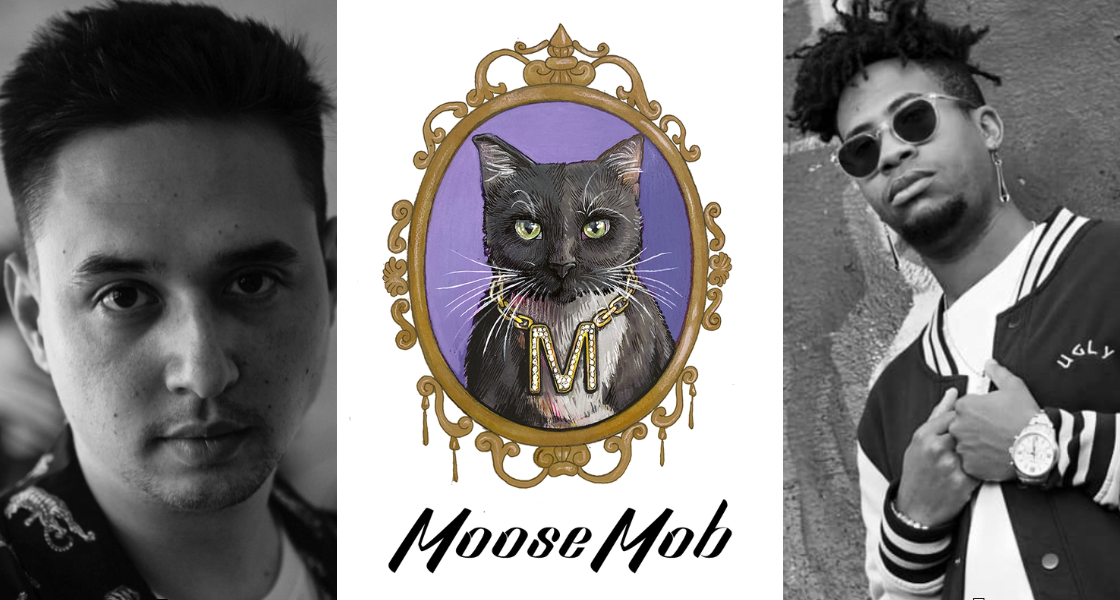
Two more Creators have crossed the finish line in our Branded Content Mentorship Program. Meet Moose Mob, a BIPOC-owned and operated production company based in Los Angeles. Christiaan Tahyar and Dorsey Britton III bring their passion for storytelling to every single project, whether it’s a commercial campaign, music video or narrative piece.
We had the opportunity to meet Christiaan and Dorsey in May when they started learning to make social suites with Tongal mentor, April Merl, (who can show YOU how to make them too!). April is an editor and animator with over 20 years experience in film, television and media, working for clients like HBO, SYFY, Facebook, and TBS.
We caught up with Moose Mob a few weeks after they completed the mentorship program to learn more about them and their experience creating social suites with April. Check out our interview with the duo below.
Where did Moose Mob’s journey in media production begin?And naturally, we want to know how you came up with the name Moose Mob.
Our journey started at Emerson College. We met there, but it wasn’t until after graduation that our creative partnership really began. After working and learning in the industry for several years, we founded Moose Mob Media in late 2019. We soon started directing commercials, music videos and comedy sketches to build Moose Mob production portfolio. In 2020, the pandemic had a big impact on production, and like most, we were blindsided at first. Notably, small-scale production, the niche we had planned to really stake a claim in, was hit hard. The change led us to expand into post-production, especially into video post-production of podcasts and related social media assets. Now we are also back to producing and directing again, which is amazing!
The name Moose Mob Media was inspired by our friend Moose, believe it or not! It doesn’t matter that he’s a cat. Our name and logo were made in his honor.
What drove you to apply to the Branded Content Mentorship Program?
Why did you two want to learn to develop social suites? And how do you see yourselves using what you’ve learned to take your creative careers to the next level?
A lot of post-production clients and leads were asking more and more for social suites or deliverables that require the same skill set. And while we had some fluency in the space, we felt that expanding our knowledge in the area was needed. So, when we saw the opportunity to learn/work with April Merl and the team at Tongal, we knew we had to jump on it.
Social Media has become such a big part of the industry at this point. Whether it’s for advertising or distributing content, it's a vital skill set in today’s landscape. We’ve seen first-hand during our careers how having that digital fluency can really take you or your work to the next level. So, whether we’re applying the skills we gained to client work or personal projects, having this knowledge helps get that content to audiences easily and efficiently.
Tell us about your experience transitioning from the podcast space to creating social suites.
We don’t produce podcasts so much as we work with the producers of podcasts to create the video side and social assets they need. And it’s really been more about adding the creation of suites to our other work. In the beginning, we did a lot of full episodes or longer formats for clients, as a certain amount of podcast listeners do like to consume the content in a video format. The interesting thing is that more and more it’s the social assets/suites that are prized above all. It’s because as a brand, podcast or really any show wants to expand its audience, socials can often be the first point of contact. The value can be enormous because social channels do double duty. They are trailers for bringing in new audience members while also being the everyday media that current fans love to consume and share.
The most important thing we’ve learned through our work is that it’s all about balance. As a content creator, you often must meet the audience where they’re at. People today have so many choices, why should they spend their time listening or watching you? Why are they going to click through on your ad? On the other hand, if you completely twist yourself up trying to chase a follower count, you can lose what makes you or your brand unique. So, it really is about hitting that place between the two needs.
Can you tell us how you came up with the fictional AmeriTowel brand? And why did paper towels stand out as a good product?
The decision to use paper towels came to us after looking through the program’s guidelines. After discussing the rules, budget and resources at hand, we decided that paper towels would be a great product to use. After all, it’s accessible and widely recognizable. That led us to the question: how could we make a paper towel brand stand out in a crowded market? What segment of consumers could we address that other brands weren’t? Research led us to realize that a lot of brands tend to target families and the messes parents deal with; that makes so much sense. But as millennials who have been in shared living situations, that wasn’t a message that really resonated with us. And that was the lightbulb moment, where we realized that, “the messy roommate,” problem was an under-addressed issue, but one that so many have dealt with.
The idea for the AmeriTowel brand came out of a discussion about color palette. As we talked about the various messes we wanted to showcase, we noticed that a red, white and blue theme started to appear. That led us to the idea of AmeriTowel. The thought was to make a brand that could appeal to a large cross-section of Millennials and Gen Z consumers.
Did you source creative inspiration from any advertising campaigns?
Absolutely. We’re big consumers and lovers of comedy. In fact, comedy content, suites and advertisements are each part of our main goal. So, we knew that we wanted the brand to have that edge. While talking about which brands’ comedic styles we have always loved, the ones that immediately came to mind were Geico and Allstate. The often-random nature of Geico’s humor has always been great at cutting through the noise of a crowded marketplace, we wanted that! Allstate’s Mayhem makes us crack up every time but is also so good at quickly highlighting the problem, we also wanted that too! Combining the vibes of Geico's Gecko and Allstate's Mayhem for the AmeriTowel spokesperson was where we landed on. We see the AmeriTowel spokesperson as that friend of yours whom you can call at 3am to help you but will give you a sassy earful when they pick you up.
Who or what are some of your comedic influences?
Oooh, such a charged question in today’s environment.
Christiaan – My Dad grew up in Indonesia/Australia, so he loves a lot of British humor. As a result, my first exposure to comedy were things like Monty Python, Black Adder and Fawlty Towers. I love that dry wit and absurd comedy. A lot of John Cleese and Rowan Atkinson. As I started to get older in the 00’s/10’s it was stuff like SNL, South Park, 30 Rock, Community and Parks & Rec. In terms of people, just to name a few, it’d be Tina Fey, Dave Chappelle, Maya Rudolph, Matt Stone/Trey Parker, Michael Schur, Donald Glover, Amy Poehler, Nick Offerman (Oh Ron!), and Dan Harmon.
Dorsey – The absurd is where most of my humor comes from. Luckily a lot of my family members are naturally funny, so I grew up in an environment full of humor and laughter. In terms of media influences on my comedy I would say it’s pretty diverse. Some shows that influenced my comedy are Spongebob, The Chappelle Show, That 70’s Show, Scrubs, The Office, The Boondocks, Letterkenny, Broad City, etc. As for individuals, I love stand-up comics the most. I can’t even begin to come up with a full list but if I had to just name a few Dave Chapelle, Ali Wong, and George Carlin.
What television shows or movies have you watched lately?
The best film we’ve seen this year has been, The Daniels, “Everything Everywhere All At Once.” It was amazing and you could feel the heart that went into making it. If you only see one film this year, make it that one.
We’ve also been on a real comedy special bender lately. If you haven’t seen them, check out Joel Kim Boosters, “Psychosexual,” Christina P’s, “Mom Genes,” or literally anything that Ronny Chieng is in!
On the serious side, we’ve of course been watching the Duffer Bros, “Stranger Things" Season 4, but if you haven’t seen Kim Eun-Hee’s period epic zombie show, “Kingdom,” give it a go! Those hats are so fresh, a bit of a slow start but stick with it, so worth it.
What is the most important lesson each of you learned about yourselves through the Branded Content Mentorship Program?
Honestly the shared lesson for us has been to stay hungry and hopeful; they’re both necessary to going the distance. Especially in this business, it can’t be tough to keep that mental space on the level. But with starting your own company and being the ones to run things, it’s important to know that you set the tone. Positive and focused energy is really the thing that can make or break you.
This experience was really a reaffirmation of how much we love to write and create. The last couple years have been hard, for everyone. We’ve all got to eat and to a large extent it’s been the technical side of our skill set that’s helped pay the bills. But the creative work has always been where our heart is and what drew us to the industry originally. To be able to get back to that creative side with this and upcoming projects has been a real blessing.
Last, but not least, we have to ask, how did you learn about Tongal?
We heard about it from a couple friends in the industry who used Tongal and worked on Tongal shoots. After checking out the website, we knew we had to sign up. For younger creatives who have been working for a few years and have the skills but need those chances, Tongal is the place to be.
Interested in joining our Branded Content Mentorship program as a mentor or mentee? Stay tuned for Season 3, launching this year!


