
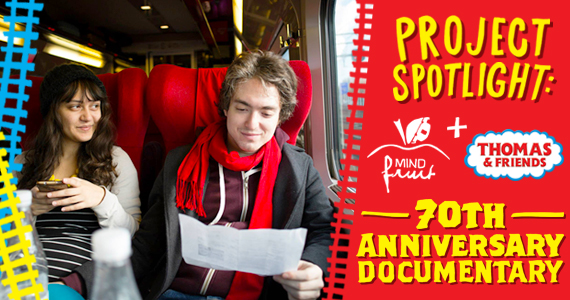
Drumroll please....the final cut of our Thomas & Friends™ 70th Anniversary Documentary Project has been released! This was a unique Tongal Project because the Sponsor wanted to celebrate the 70 years of Thomas history by choosing one filmmaker to create a 30-minute documentary! We interviewed the awesome winners, Mindfruit Studio, and asked about the epic 42-day journey they went on to capture the spirit of Thomas!
Izzy Francke: What’s your production background? Did you go to film school?
Mindfruit Studio: Damon and I met at USC film school. We were both very driven and had a nothing-to-lose kind of attitude towards filmmaking, so it was very easy to get along. We immediately started making movies together outside of school which, surprisingly enough, most of our peers were not motivated to do. Even before we had graduated, we started referring to ourselves as a company, though we did not officially become Mindfruit until several years later. Our first several years were very much concentrated on commercials and music videos. We love both of these mediums, but we have been trying to do more documentary work. Truth is always stranger than fiction!
IF: I admire your attitudes! What was the first travel documentary you worked on?
MS: Our first travel documentary was a feature that we shot last year. The subject was a man who had fled China at the age of eight, ended up in South Korea during the war, and finally moved to the US. He hadn’t been back to China in over 60 years. The documentary covered his return to China with his son, who knew nothing of Chinese culture. It was a family drama that took place all over China and also in South Korea. We did not direct the doc, but we were the cinematography team, so we did a lot of traveling and got very intimate with the subjects.
IF: That sounds like it was an incredible experience. How did you start to explore and produce travel documentaries?
MS: Shooting the China documentary was very empowering. It made future travel documentaries seem more possible. Our next trip was into the Amazon rainforest (and several forests in Costa Rica). This was a personal project, as both of us are incredibly passionate about animals and their conservation. It was a learning experience, as we had very limited wildlife experience. But we are looking forward to another opportunity to film some animals!
IF: That's great (and convenient!) that you share an important passion. What does Thomas mean to you and how has he influenced your lives?
MS: We both grew up with Thomas the Tank Engine in our lives. There are many memories of sitting in front of the TV watching with grandparents and siblings, and mulling over the harsh (but fair) lessons afterwards. Damon in particular was affected because his father is a big time rail enthusaist, and much of his childhood was spent in train museums and heritage railways. We also must say after seeing many recent Thomas movies and episodes for the purposes of this documentary that Thomas has maintained his charm.
IF: Thomas is indeed charming, and he definitely taught me some lessons as a kid. Did you get to visit any of the Thomas theme parks?
MS: We have now been to two! One was the Drayton Manor Theme Park Thomas Land in Staffordshire, UK. The other was Fuji-Q in Japan, which was actually the first Thomas Land ever built. In each we had the distinct privilege of a private tour with the park heads, and it was a great experience!
IF: Wow, you were total VIPs! How many weeks were you on the (rail)road filming?
MS: The trip was 42 days long, which is amazingly short considering that we went to 11 different countries! It was an utter whirlwind, but surprisingly you can do a lot in a city in only 2 or 3 days.
IF: Whoa! How did you plan, budget and pack for a trip of this length?
MS: Planning this trip was a challenge - so many moving parts, so many people to interview, times to schedule, and locations to get permission from. Our email inboxes before the trip were a nightmare to behold. Tongal was exceedingly helpful in this department, and helped us reached out to the necessary people. Scheduling everything out was made much easier by using the phone application TripIt, which kept all of our travel, hotel, and interview information in one place. Budgeting was the toughest part - we reserved all of our plane and train tickets before starting the journey, so these were set in stone. We found that AirBnB was cheaper than hotels in most situations, so we booked all of these ahead of time as well. But it was tough to predict food costs and on ground transportation (taxis, etc.) especially taking into account all of the different currencies we would be dealing with. We settled for estimates, and they turned out to be more or less correct (thank goodness!). As to packing, keeping the equipment safe was our biggest concern - but without making our luggage so bulky that we would have to bring more than one suitcase and backpack each. We ended up wrapping smaller pieces of equipment in our clothes, which is a super ghetto indie trick but hey - it worked! We also made a complete list of all the items we brought with us, down to the camera batteries. This insured we didn’t leave anything in one of the many, many places we stayed or shot throughout the journey.
IF: Your organization skills are impressive. Thanks so much for sharing those tips. What equipment did you use for this Project?
MS: We shot with the Canon 5d markiii and four different lenses. We used a small tripod for interviews and a fig rig for wandering around the cities and shooting in trains. The sound was recorded on a Zoom H4N, and we had both a shotgun mic and lavs. For lighting we brought a single light panel and a bounce. It was a very light package, and I think many of our interviewees were surprised by that.
IF: I'm surprised too! How did you decide which railways to take and why?
MS: Many of the railways we took were practical choices simply to get from one place to another. We had so little time in each place it wasn’t possible to take many of the ones we were hoping to see. Also, the timing of the project was unfortunate in that we shot entirely during winter months, when heritage railways are all shut down. So sadly, we didn’t get the chance to ride any real steam trains.
IF: Do you have a favorite train line or train station that you discovered on this trip?
MS: The best train we rode was definitely the Glacier Express in Switzerland. It cuts through the Alps and the view is of a spectacular winter wonderland.
IF: That sounds breathtaking. How did you decide on which people to approach and use as subjects in this documentary?
MS: We got very lucky in that we were able to speak to many of the people involved in making the shows, movies, and even the Thomas toys! They were all fabulous to talk to and gave very passionate interviews. Ryan Hagan, the head of the most popular Thomas fan forum, was a must to represent the adult generation of Thomas fans, and he was a pleasure to speak with. As for the children we interviewed, in many instances we simply got lucky with how adorable and intelligent they were. And of course, Christopher Awdry was wonderful to interview. He is definitely the star of the film and was such a pleasure to meet in person.
IF: That's so cool. Is there a particular answer (or reaction) someone gave you during an interview that really stuck with you?
MS: Ryan Hagan had some wonderful things to say about both Thomas and the world of trains in general. One remark that really sticks out is when he told us that steam trains are the closest thing to a human being that a machine can get. They breathe, they need to be cared for - and you get as much out of them as you put into them. We thought that was truly beautiful. It was also fascinating to talk to Ian McCue and Andrew Brenner, the current producer and writer of the show. They have so much respect for the spirit and feeling of the original Thomas stories, and endeavor to be loyal to that spirit in all of the current Thomas & Friends media. After talking to so many fans and seeing some of their work ourselves, we can say they are doing their jobs beautifully!
IF: That's great to hear. How long did it take to edit the footage together afterwards?
MS: There were six revisions, with client notes in between, so it took about four months to edit it all together.
IF: Wow, congratulations on getting it done! What was the biggest challenge you faced during the process?
MS: Editing a documentary is always the hardest part. We had so much footage, and many ways the story could be told. Is this a story about fans? Is it a story about the show’s creators? Is it a retrospective, or should it look to the future? What do we want? What does the client want? In the end it was a little bit of everything.
IF: We hear you, editing and finding a distinct narrative voice is definitely a feat! What do you think is your biggest accomplishment with this piece?
MS: Honestly, the biggest accomplishment was that nothing major went wrong! With such a quick trip and so many places with so little time to shoot, it was a very ambitious and risky endeavor. Our one major snafu was that Damon dislocated his shoulder in the first week of shooting. Fortunately, he only had to wear a sling for a week and was still able to operate the camera for the most part. After that, everything ran smoothly - we never missed a train, never lost an interview, and were never late!
IF: Ouch! Knowing that makes it even more impressive that you filmed it so well! Do you have any advice for other filmmakers making travel documentaries?
MS: Make copious to do lists and calendars, and use them! Pack light. Keep both physical and digital copies of all your important documents - release forms, itineraries, passports, etc. Do as much planning as you can, but also leave time to explore and see where the wind takes you. Oftentimes the best things you capture are unplanned.
Thank you so much for taking the time to talk to me! I loved getting to know more about your creative work and your time making this documentary come to life. We can't wait to see what's next for you – on Tongal or otherwise!


