
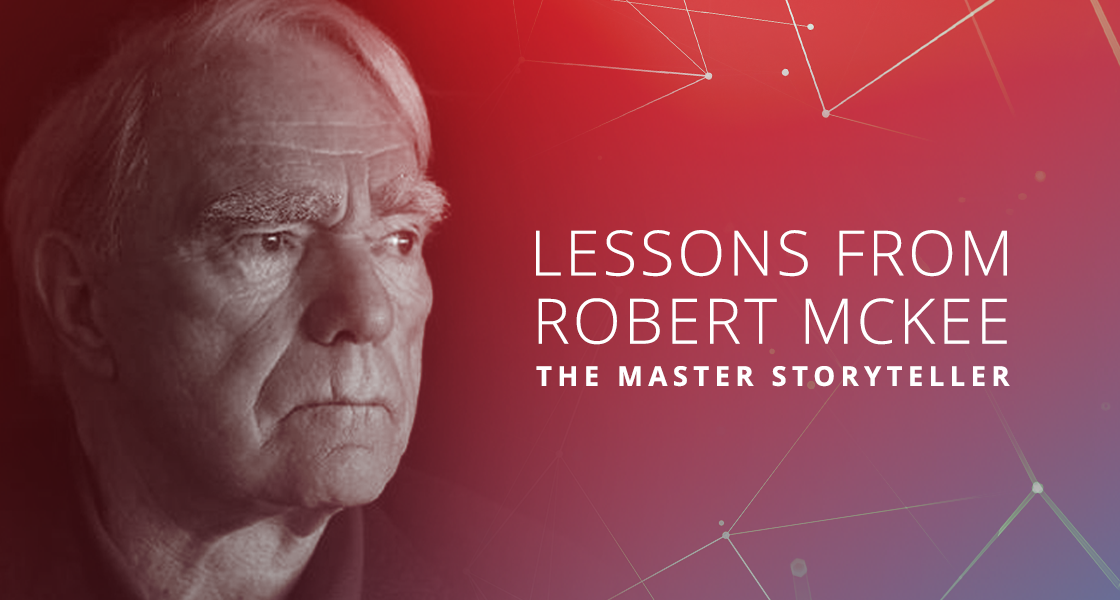
Attendees at our annual Spark Summit were treated to a special talk from a Hollywood living legend – Robert McKee. You may know him as the writing instructor who berated Nicolas Cage in Adaptation (where he was portrayed by Brian Cox), but should know him as the author of Story – probably the most famous tome on screenwriting out there. For years, professional screenwriters (including hundreds of Academy Award winners) have used his techniques to fashion compelling stories for the silver screen.
You may be thinking: well that’s great but how does that apply to advertising? That’s exactly what McKee was there to talk to us about. Here are four key takeaways from his talk.
1) Attention spans have not diminished. Interest spans have.
Consumers’ attention spans are the same length they have always been. But people have so many more options now than they did back in the days of three television channels. If your spot isn’t interesting, they’ll turn it off. In fact, consumers may even come to dislike your brand for wasting their time. Being interesting is of the utmost importance. And the best way to gain consumers’ interest is to tell a story.
2) Not everything is a story.
Sales numbers are not a story. The chronology of your company is not a story. A story is the fusion of creativity and emotion.
According to McKee, “Creativity is the discovery of a hidden connection between two things that already exist and a third thing that connects them that no one has ever seen before.” For instance, in Carl Sandburg’s famous poem, Fog, he writes, “the fog comes on little cat feet.” Sandburg found a relationship between two things people already knew (weather and cats) and created an idea no one had ever seen before.
But it’s not enough to make something new. You need to make your audience feel something. McKee says it’s very difficult to recall any memory that doesn’t come wrapped in an emotion. We remember things that make us feel happy, sad or even afraid. We are much less likely to recall something (especially an advertisement) that doesn’t make us feel anything.
So if you want consumers to find your advertisement interesting, show them something new and make them feel it.
3) Every story needs a protagonist.
Per McKee, there are three types of companies:
The type of company you are will help determine the protagonist of your story:
4) Make sure your audience can relate.
If you want consumers to be engaged by your story, it’s important they identify with your protagonist. If you’re a Service-centric company, that’s easy since the protagonist is your consumer. But Product-centric and, particularly, Resource-centric companies will have a tougher time.
So how do you get consumers to relate to your brand? One way is to personify your company or product (think of Apple’s “I’m a Mac/I’m a PC” campaign. Another is the underdog effect. Deep down, everyone thinks of themself as an underdog. Portraying your company or product as an underdog is a great way to help people identify with your story and build empathy for your brand. That said, bragging and claiming to be the “best” is not a great tactic when trying to build said empathy. Nobody likes the "overdog."
For more insights from the master storyteller himself, we’d encourage you to pick up McKee’s Story – which is pretty much the bible for Hollywood screenwriters. And for a list of creative best practices to keep in mind when developing your content, check out our video cheat sheet.


