

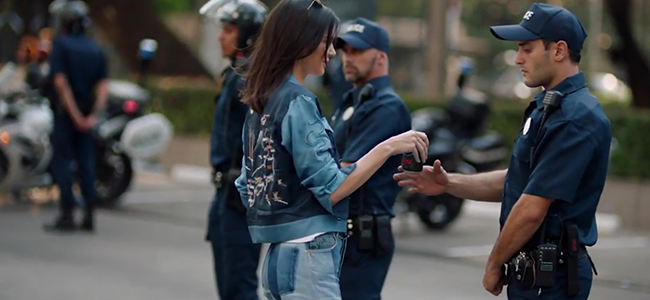
(Photo Credit: Pepsi)
Creative is hard. And when you’re sandwiched between the same three white walls and a computer screen for 12 hours a day, creative can be near impossible.
To amplify the "bang your head against said white walls" problem, the pressure is on. Industry veterans talk about attention spans shorter than a goldfish, the rise of ad blockers, and increasing audience fragmentation – a ten on the Richter scale of stress.
As brands struggle with “opt-in only” audiences in a digital world, we see misfires so incredible they become fodder for viral SNL skits.
And then, six weeks after SNL lambasted the industry with all the ways a Cheetos ad could appropriate some of the most emotional moments of 2016 to sell snack food, Pepsi’s in-house creative team brought us one of the biggest misses of all time.
But here’s the thing. It was not a foregone conclusion that this ad would fail. In fact, it’s not thematically far off from “Carry,” Cadillac’s 2017 Oscar Commercial. And, to give credit where credit is due, the quality of the spot is high. The production value, art direction and music are gorgeous.
And so, between three walls and a computer screen, what happened?
To paraphrase screenwriting guru Robert McKee, the definition of “creative” is finding a new, real connection between two unrelated topics.
The humor in the SNL skit is not because the advertising world placed a cause next to a brand. We love brands with causes. From REI’s #OptOutside to Tom’s One for One, we care when brands come from a place of purpose.
The problem – highlighted by the SNL skit – is that the “ad executives” did not create an authentic connection between the cause and the brand.
And that is where Pepsi’s commercial with Kendall Jenner missed a step. It did not create a real connection between an authentic cause and a brand truth. The cause was uncertain. The diversity was forced. The talent is known for being a-political. And no brand truth was established at any point in the spot.
“Carry,” Cadillac’s spot, was extraordinarily similar on the surface and, yet, it hit every beat. The causes were real – they showed us real footage of real people. The diversity was inherent – again, based on real footage. There was no “talent” – just real participants in real events. And the human truth – that we carry each other forward – can be directly tied to a brand truth about Cadillac; the car has literally carried humans forward for a century.
So how did Pepsi, whose team we’re sure is filled with talented, hardworking people, miss this one tiny, critical element – that everything on the surface could be beautiful but the connection underneath had to be real to resonate?
Perspective.
Between three white walls and a computer screen, it’s hard to find perspective. Between coffee and energy drinks, it’s hard to find perspective. Between new ad platforms and the intense competition of the attention economy, it’s hard to find perspective.
But there is a solution. Talk to people. Bring in new ideas. Invite an open dialogue. The people inside the walls have the best understanding of brand equity. But the people outside the walls will keep you grounded. They will keep you relevant.
Embrace the people outside the walls. Think of your team as limitless. Bring in hundreds of ideas from hundreds of ideators. Bring in dozens of pitches from dozens of filmmakers. Because those external ideators and filmmakers haven’t been staring at the same three white walls and computer screen for the last 12 hours.
Creative is hard. But with a limitless team and limitless perspective, it can also be relevant, inspiring and authentic.


