


By Marianne Hayes
It's time to face the facts: viewership numbers are tanking across cable and television, with Business Insider going so far as to say that cable subscriptions are essentially "falling off a cliff."[1] Pictured below; the double whammy of cable subscriptions growth going “backward,” while so-called “cord-cutting” steadily rises:

*Source: Business Insider
Traditional TV audiences are swiftly evaporating while digital media consumption soars through the roof.[2] And the "kick-us-while-we’re-down" here is that the trend is especially bad in key demographics — a whopping number of millennials[3] and young women[4] in particular are either cutting cable or skipping it altogether.
In this article, we'll talk about the increasingly problematic picture for content viewership, and the marketing emergency TV / Cable's "Skyfall" poses to marketers.
We’ll conclude with 7 solid steps you can take to make the most of this change for your brand.
Streaming Video Giants Are Disrupting the Paradigm
In the space of just a couple of years, conventional television has eroded rather quickly, with the boom in streaming video only intensifying the trend. Experian Marketing Services shined a spotlight on this in a 2014 study that reflected massive viewership reductions for traditional TV. A startling 7.3 percent of U.S. households cut their cable or satellite TV service last year. In 2010, this number sat at just a little over 4 percent.[5]
Where exactly are these viewers going? The answer is SVOD (Subscription Video On Demand) and OTT (Over The Top) television. Netflix alone currently boasts over 50 million subscribers.[6] The trend is clear, with one 2014 New York Post article reporting an up-tick of 22 percent in subscription viewing via Netflix, Amazon, Hulu Plus, Vudu, iTunes and many more.[7]
Millennials Are Leading The Exodus
According to Forrester Research media analyst James McQuivey, the coveted 18-to-24 year old group is playing a huge part in this fragmentation mainly because they simply aren't interested in establishing the same TV-viewing patterns as previous generations. "These people are engaging in a completely different set of behaviors," says McQuivey. "They're watching a video that someone sent them a link to on Facebook, and paying more attention to that than they are to the primetime lineups of the networks in the fall season premieres."
So what are they interested in? The two-part answer is digital: two part because digital really means control. Younger people especially want only the content of their choosing — and they're picky about when they want it, and where they want it…
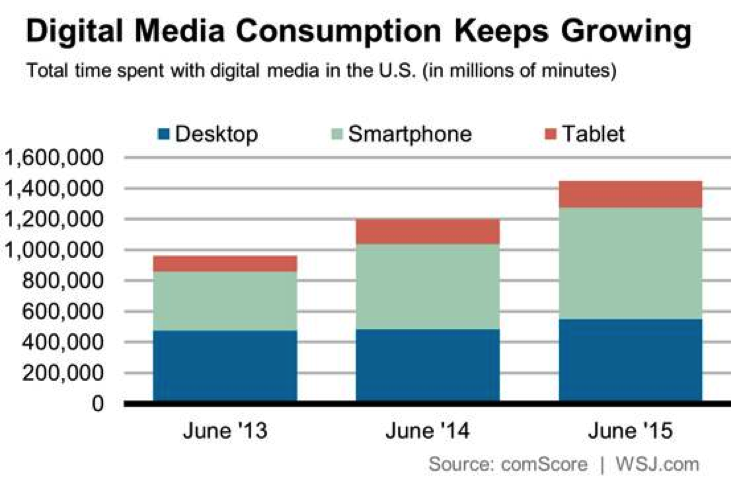
Today, Digital Means: Mobile
Mobile content consumption has increased by a jaw-dropping 90 percent over the last two years, according to a recent report in the Content Strategist. Heck, even desktops are enjoying more screen time: the report reveals that from 2013 to 2015, digital media consumption on desktop computers grew by 16 percent. That's how comprehensive this movement is. [8]
Millennials are leading with mobile too. According to one 2014 ComScore report, millennials aren't only more receptive to mobile devices; they're also relying on them more and more. The report found that, as of November 2013, 18 percent of 18-to-34 year olds were "mobile-only users."[9]
Numbers like these suggest that it's absolutely critical that marketers have a solid digital plan in place in order to reach this key generation. "It's definitely a concern because play that out five years from now, ten years from now," McQuivey says of the watershed moment. "Chances are good younger viewers will never acquire those TV habits, and you'll end up in a world where advertisers are now stuck saying, 'How do I reach these people who are the future of my brand?'"
So...What's The Silver Lining??
The potential BIG upside for agile marketers is that today's shifting digital landscape also represents an opportunity to shape the new media environment—instead of simply reacting to it. Here’s how:
7 Key Steps For Marketers to Shape Your “Post-TV” world:
1. Think Bigger: Let Go of TV as The "Mental-Map" for Your Media
Shrinking TV audiences suggest that shifting advertising dollars out of television might be a good idea. But you have to stop thinking with a TV mindset as well. You're no longer looking for a smash hit to run for 6-9 months to the audience that TV programmers have brought together for you. Now YOU'RE the one creating the audience — so you're not just making the ads anymore — you're making the series.
2. Lead with Social Media
Eyeballs are also migrating to Social media (picture the skies darkened with migrating eyeballs if you dare). Platforms like YouTube, Facebook, Twitter, Instagram, and Periscope can, if properly utilized, double as a bullhorn for brand messaging.
Millennials in particular use social media to devour and share video content. According to eMarketer, social networks are a major source of millennial video discovery, and the main venue for this discovery is (of course) a mobile device.[10] As Marketing Land spotlights, experts predict that by 2018, two-thirds of social media advertising spending will go toward mobile ads.[11]
3. GO Mobile...NOW!
“When Facebook first went public,” says Paul Sweeney of Bloomberg Intelligence, “about half of their users were mobile — yet Facebook had 0 percent of their revenue coming from those advertisers.” Translation: they weren't monetizing the fast-growing mobile explosion.
"Fast forward to now: 75 percent of the revenue from Facebook comes from their mobile users," adds Sweeney. "If you don't have a viable mobile strategy, you are nowhere. The two biggest trends in digital advertising are number one: social, and number two: mobile."
“But brands do need to keep in mind that social media users are incredibly resistant to in-your-face advertising. " adds Sweeney. Therefore, something new and different is needed…
4. Invite Your Audience to Co-Create
Instead of uploading videos that simply tell your brand's story, extend a hand to your audience so that they can co-create with you. According to experts at Google BrandLab, this helps the brand broaden its relevance while cultivating an engaged fan base at the same time.[12] To better tap into just who your target consumer is, social listening services like Topsy, Hootsuite, and Networked Insights can help clarify what your customers are saying about your brand, and what your brand means to them.
5. Become Your Own Media Company
The Content Strategist gives us a great example with the mattress company Casper, which recently launched its own digital magazine covering all things related to...we’re not kidding now: "sleep culture."[13] In an effort to better connect with their customer-base, Casper is now churning out entertaining, informative, funny articles that are also all on-message for the brand. Of course most brands that are becoming media companies are leading with video: GoPro, LEGO, Pepsi…and a DIY favorite of ours: Chubbies Shorts. Video is the new language of marketing – just ask Facebook…or Instagram.
6. Augment Your Creative Team
Even if launching your own media empire isn't your thing, for a marketing world dominated by social and mobile, regular content creation is vital. You wouldn’t make one Facebook Status update every quarter…would you? So you have to figure out how to organize your budget and work-flow to accommodate these demands. Will you outsource to freelancers? Or hire new in-house employees to carry out these tasks? These are important questions to ask before committing to a plan of action.
Freelance / crowdsourcing platforms can help. Getting more of exactly what you need is what creative platforms like Contently (for written work) and Tongal (for video) can do for you— which is why they're both growing so fast and working with so many successful and iconic brands.
7. Look to Millennials — Because They're Shaping the Landscape
With 80 million millennials living (and spending) in the U.S., they're rapidly becoming the most important customer base around. And as Micah Solomon adds in a 2014 Forbes article, they'll soon be commanding tremendous spending power. How much? By 2017, they're predicted to drop a whopping $200 billion annually.[14]
The Time Is….Soon (& The Sooner The Better)
While engaging millennials used to just provide a leg-up over the competition, we’re quickly reaching a point where businesses will need to reach this massively influential demo simply to survive.
One thing is perfectly clear – we won’t be reaching them as they sit around the big old TV screen munching popcorn and waiting for the next big network hit.
The game has changed, and the game’s afoot…
[2] http://blogs.wsj.com/cmo/2015/08/19/digital-media-consumption-is-booming-as-investment-floods-in/
[5] http://www.experian.com/marketing-services/cross-device-video-analysis.html?WT.srch=PR_EMS_CrossDevi
[8] http://contently.com/strategist/2015/08/20/its-not-just-mobile-time-spent-across-digital-media-is-booming/
[12] https://www.thinkwithgoogle.com/articles/building-youtube-content-strategy-lessons-from-google-brandlab.html


