
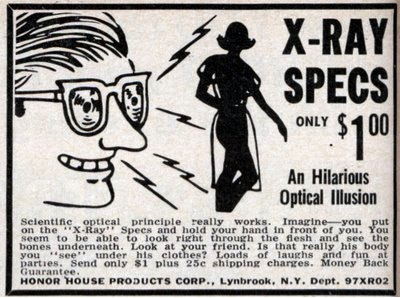
Classic back of the comic-book ad for X-Ray Specs. …No, probably not in keeping with today's guidelines for kid’s advertising.
Chances are, you haven’t thought about Robert Fulghum’s 2004 best-seller "All I Really Needed To Know I Learned In Kindergarten" since you read half of it in the Barnes & Noble checkout line.
Yeah -- us neither.
But Fulghum’s book came to mind recently as we were reviewing the Children’s Advertising Review Unit (CARU) guidelines for advertising to children. The CARU is a self-regulatory program established by the National Advertising Review Council. In essence, it’s an outline for fair conduct from a group of experienced and morally engaged folks regarding kids & advertising. It contains a series of sober advisories about the following:
· Deception
· Product Presentation and Claims
· Endorsements
· Blurring of Advertising and Editorial/Program Content
· Premiums, Kid’s Clubs, Sweepstakes and Contests
· Online Sales
· Sales Pressure
· Unsafe and Inappropriate Advertising to Children
We’ll talk about a few of the individual guidelines in this article, but you can read all of them here if you like (the good stuff starts on page 6).
For the purposes of this article, we want to consdier how they might become, with just a few minor changes, “A Brief Guide To Better Advertising.” Just as Fulghum felt that the moral guidance he received in kindergarten provided a compass for later success in life, we’re pretty sure that advertisers talking to adult audiences could benefit from some of the boundaries CARU proposes for addressing children.
Limits Lead to Breakthroughs
What’s perhaps most interesting about these guidelines is the breakthroughs that can result from throwing out old approaches at the very start.
For example, we’ve seen the toy companies we work with reinvest their rhetorical capital into story, and in so doing, invite their customers to become active participants in the stories they generate.
LEGO probably has done this better than anybody (toy-brand or otherwise). Their groundbreaking LEGO Ideas platform, their amazing user conventions, and the great video work they’ve done with fans (a good bit of it with us) to create a category-dominating YouTube channel – all resulted from their dispensing with the usual hyperbole at the outset. Not merely in order to “follow the rules” – but to look at advertising in a completely different way. By inviting customers to be part of their brand’s story, they’ve embraced and celebrated the notion that they’re the very essence of it.
But what can this mean for non-toy brands? We thought it might be fun to look at a few specific examples of the CARU guidelines and see what impact, if any, they might have on...ahem…“adult content”:
Let’s Look At A Few Examples…
The general thrust of the guidelines can be summed with one admonition: “don’t lie.” That very idea is expressed a bit more politely in the very first CARU guideline listed, under the general heading “Deception”:
The “net impression” of the entire advertisement, considering, among other things, the express and implied claims, any material omissions, and the overall format, must not be misleading to the children to whom it is directed.
Call us starry-eyed optimists, but we think this one works great for everyone. Just swap out the word “children” for the more inclusive “people.” Surely we all agree that the days of multi-paragraph, speedy-playback caveats stealing back all that has been promised are long gone… don’t we?
Well, we hope so anyway -- and we’ll grant you that this first guideline is pretty broad…so let’s go a bit deeper – this one comes under the heading “Product Presentation and Claims”:
The presentation should not mislead children about benefits from use of the product. Such benefits may include, but are not limited to, the acquisition of strength, status, popularity, growth, proficiency and intelligence.
Now there’s a standard that would require a do-over on a goodly number of modern-day beer and car ads…and that’s just for starters. We also can’t help but think that the throwback classic Mr. Microphone might have turned out a little different had this standard been applied back in 1978: “Hey good looking…of course you won’t be here -- but we’ll be back later anyway -- and who knows? This thing might even still be working!”
Here’s another guideline with a fairly broad scope. We find this one filed under General Guidelines: d. Endorsements – and it has big implications for our friends making gym shoes (among others):
Advertisers should recognize that the mere appearance of a celebrity or authority figure with a product can significantly alter a child's perception of the product. Advertisers may use such personalities as product endorsers, presenters, or testifiers, but they must take great care to avoid creating any false impression that the use of the product enhanced the celebrity’s or authority figure’s performance.
Of course Spike Lee’s famous spots for Nike had a lot of fun blurring that line. But children or adults….boy oh boy did Michael Jordan sell a lot of shoes! So, of course it’s important to be thoughtful about these guidelines – after all, celebrity endorsements aren’t going away any time soon. What we’re encouraging here is not a blind adherence to any individual guideline – but rather, a thoughtful review and consideration of all of them.
Big Picture?
While looking at these guidelines entry by entry is fun – we really do think there’s a lot to be learned by taking a giant step back and looking at all of them. Maybe even think about gathering your creative team together and having a discussion about what following them might mean for your brand.
Limitations are often a tremendously productive spur for productivity – but these guidelines, taken as a whole, also trim out a lot of what makes advertising feel like an exercise in form, rather than content. Drafted by advertisers working together explicitly to look out for the interests audience they were addressing – the inventory is honest, smart, and searching. It carves out a whole host of all-too-familiar moves that have become clichés through over-use.
And like the proverbial method for sculpting a statue of a bear: start with a glob of clay, then carve away everything that doesn’t look like a bear – these guidelines may lead your creative team to something truly beautiful.


