
It’s that time of year when we brush up on the lyrics to Auld Lang Syne and reflect on all the things we’ve accomplished in the past 12 months, all while drawing up plans for what we hope to get off the ground in 2020.
As the year draws to a close, we wanted to take a moment to celebrate not only the successes that took place on Tongal, but the big achievements and creative milestones for our community members that took place outside the Tongal platform: The personal passion projects that were either put on the fast-track towards development or, after many, many years of crazed persistence, completed. After all, there are many winding roads through this industry and so many different versions of what “success” looks like.
We spoke to Tongal filmmakers and writers who made new opportunities for themselves in 2019, in both passion projects and client work, to find out how they did what they did and what they learned along the way. We hope this provides some creative fuel in the tank for ALL our creators as they reach for their goals in 2020.
All in all, we love hearing about our community’s successes and are especially heartened to hear when an opportunity on Tongal lead to something unexpectedly career-changing, but we know that Tongal is just one piece of the puzzle. There’s no single path or straight-line trajectory to success; it’s all about being persistent and making the most of the opportunities that come your way.
For Your Viewing Pleasure
Is there anything more satisfying than wrapping a project and putting it out into the world for other people to enjoy and react to? Nay, we say! Here are the projects that got a release in 2019 (and you can watch RIGHT NOW).
Onomatopede and Worm
By David Kilgo and Richard Mather
After meeting through the Tongal community back in 2017, Dave and Richard’s writer-animator partnership has evolved beyond working together on Tongal projects for clients like SYFY and National Geographic to pitching on creative endeavors of their own making.
Produced for Sesame Studios, Onomatopede and Worm is about “a superhero with the power to solve problems using words that represent sounds. However, he often needs the help of his sidekick, Worm.” Surprisingly, the concept originally saw Onomatopede as the bad guy, but he got such a strong response that Richard and Dave reworked the concept to make it a show all about him as the main hero. Just goes to show you, that you’ve gotta stay flexible and “never be afraid to let a concept evolve.”
Will Onomatopede and Worm continue to go on more sonic adventures? According to Dave, they “certainly hope to do more episodes in the future.”
Richard in the sound booth.
Boy Band
Written, produced, and directed by Joel and Stephen Levinson
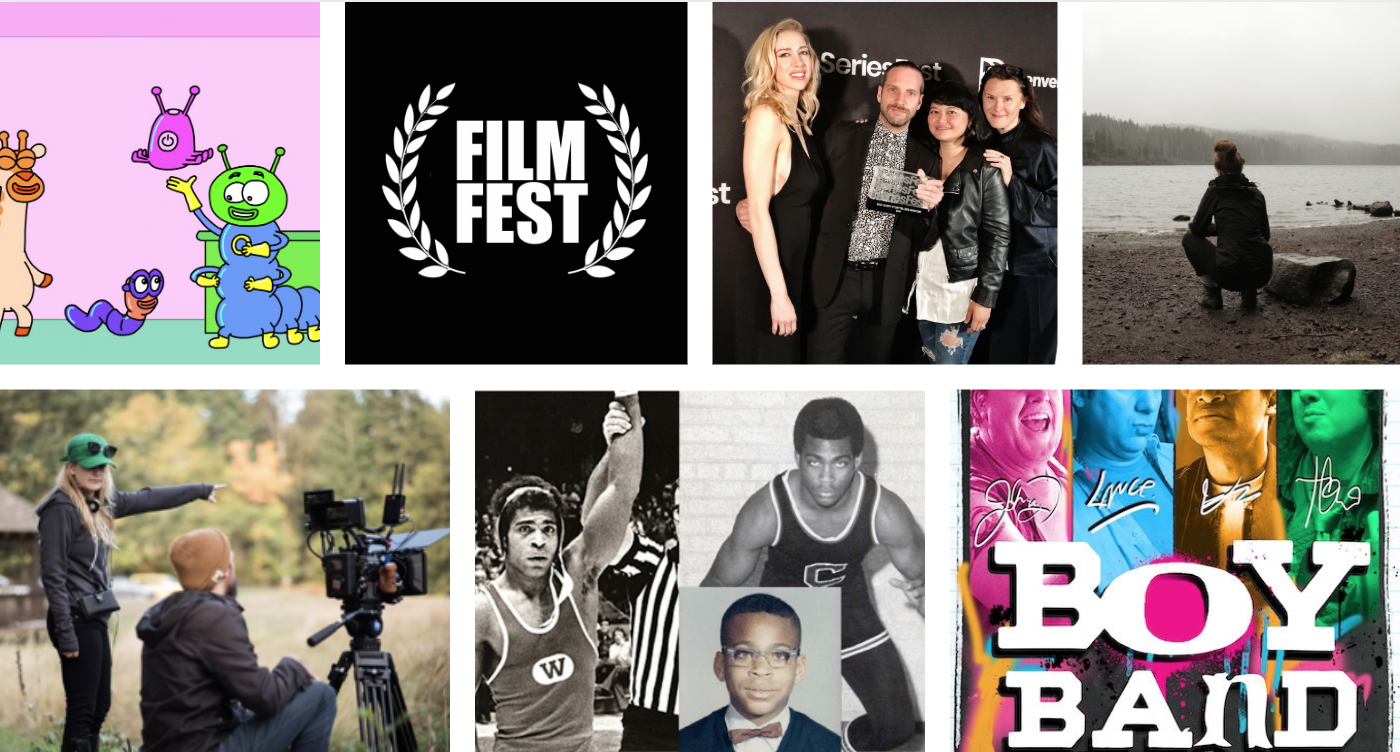
Brothers Joel and Stephen Levinson made a name for themselves as comedy writers and creators of viral videos. In 2018, through a highly successful Kickstarter campaign, they reached their funding goal to direct their first feature Boy Band, a comedy about a superstar boy band called Heartthrob Boyz, who went into the studio in the late nineties to record their sophomore album and two decades later – older, balder and fatter – are still chipping away at it. Running out of money, they have one night left to finish the album they hope will return them to glory. The Levinsons filmed Boy Band in their hometown of Dayton, Ohio, garnering a ton of local support. You can currently watch Boy Band on VUDU and on Fandango Now.
The Levinson brothers revealed their secrets for their Kickstarter campaign success a few years ago on our blog. And just in time for this blog post, they shared the top five tips they learned while making their first feature, including:
Audition your production designer. Make them pitch you ideas, see their vision in full, vet them, and spend more time with them more than anyone else besides your DP. Those are the two most direct places for you to see your dollars at work on screen, and the more clear they are, the better the work will be and the more you’ll save.
Have enough money to live on while making your film. Either because you’ve baked enough into the salary, or because (like David Lynch and Eraserhead) you do it at night while you maintain a day job. Trying to maintain a freelancer’s workload is untenable.
Tell the truth in your art. Even if it’s an action scene, or a comedy, or a movie about a talking Christmas dog, try to make it the most truthful version of that you can. It may be good or bad, but at least it gives it a chance for people to connect.
Don’t shoot the first scene in a location first, because if you haven’t spotted the best angles in it, it will show. If you’ve got eight scenes in a bedroom, shoot scene 5 first. Then 6, 7, 8 then back to 1 and through 4. It ensures the first and last times you see the room you’ve hit your stride visually.
If you’re making a comedy, stop listening to “filmmakers” and start studying “comedic films.” They are two entirely different forms of storytelling and the lessons of one rarely apply to the other. Particularly with framing, shot selection, blocking, and coverage.
Hatched
Produced and directed by Rachel Annette Helson
We first met Rachel in 2018 when she was greenlit to edit social videos for #MacysStyleCrew, yet even then, she had her sights set on bigger aspirations. Determined to direct a piece of her own, Rachel leaned on her network of writers, crew members, and friends and family to produce a project from the ground up. The outcome was Hatched, a short film that wrestles with themes of loss and the resulting grief.
Her directorial debut went on to premiere at Hollyshorts, played at the DGA Theatre in NYC as part of the SHOOT Online New Director Showcase, and was selected as a Film Shortage Daily Short Pick.
While it can be easy to point to our successes along the way, the difficult moments are what really guide our paths forward. For Rachel, that meant learning that “you can't do too much pre-production!” Being in the director’s seat taught her the importance of knowing “how each scene drives the story forward” and communicating “what you want to see in each shot and mak[ing] sure everyone on your team is on the same page!”
With two features in pre-production next, Rachel says that she’s “focused on stories that I feel like I need to tell.”

Left, Rachel dressing the Hatched set. Right, Rachel does the patented 'Director Point.'
Wrestled Away
By Riley Hanlon
Denver-based director, Riley Hanlon, first crossed our radar while running with the all-star team at Cardinal Collective. We were excited to hear that he had completed his first feature doc, Wrestled Away. The documentary is about Lee Kemp, arguably the world’s greatest wrestler, whose dreams of breaking the color barrier for winning an Olympic Gold medal were abruptly dashed when the U.S. boycotted the Olympics in 1980.
Released in October of this year, Wrestled Away was on the top 25 list on the iTunes doc page for the first few days, and it can now also be viewed on Amazon.
Riley came across the opportunity to make this film through Tongal Producer, Tommy Reid, who put him in touch with a friend looking for someone to direct and edit an unfinished film. A crew had started the project nearly 10 years ago, shot for 46 days, but due to budget limitations and changes in Lee’s life, never completed the project.
For the first three months, Riley had the daunting task of sorting through over 150 hours of interviews (shot on DSLRs with 8-minute clip limits and separate audio) to see what there was to work with: “I had talked with a few other documentary editors about organization and approaches to tackling the content, and set out with a game plan for how to review, categorize, and sort the interview. I had a Word document with a rough keyword transcript for each interview that ended up being 300 pages long. After a very long time of slowly narrowing down interviews more and more, I got to a point where we determined what story we already had, and what needed to be captured.”
With a limited budget, he planned to shoot even more footage, as well as interviews with MMA fighters, who continue to find inspiration in Lee Kemp’s groundbreaking career.
Looking back on the project, Riley says, “I found it massively rewarding to be able to be a part of a project that is able to impact people in a positive way and shed light on a person whose story deserves to be told. Lee has the ability to empower and inspire athletes of color, wrestlers, and anyone who has had to fight through adversity for an ultimate goal. I was inspired and honored to get to work with him to bring this thing to the finish line.”
Film Fest
Tongal Hall-of-Famer, Marshall Cook, started making videos with us back in 2012 with his creative partner Tyler Hawes under the production name Convoy Entertainment. Now, he’s on the verge of completing his second feature Film Fest, a comedy about a group of struggling indie filmmakers who go to an obscure festival to sell their movie. Now, he and his team are about to hit the festival circuit to see where this feature takes them.
For Marshall, making Film Fest was “a classic case of ‘write what you know'." Based on his experience, he had always found the festival world to be a perfect backdrop for writing a comedy, so he kept this idea in his back pocket until he found the right collaborators. He met his Executive Producer Edwin Stevens acting in the indie drama Hunting Lands and soon started working with his co-writer Paul Alan Cope to write Film Fest on spec. For Marshall, it was a confluence of strong collaborators and good timing that helped bring this film to life, “We moved quickly, keeping a realistic budget in mind and knocked out a solid draft in a couple of months. Then we recorded a table read with talented comedic actors (many of which are in the film), so we (and potential investors) could hear the script. I shared it with Edwin at a time when he was ready to make another film and wanted to make a comedy. So, it was a combination of hard work, building relationships, and timing.”
Acknowledging that every project comes with its own quirks and uphill battles, Marshall says of his learnings, “Every production (including my shorts, first feature, Tongal, broadcast commercials, etc.) comes with their own unique lessons... Trying to wear too many hats, moving too fast, assuming others care about your movie as much as you do, or not smiling enough on set even though you’re not upset, it’s just what your face looks like when you’re thinking... But, no, with this one I did everything right. :D”
In Development
Between developing a script, raising funding, hiring cast and crew, shooting, editing, securing distribution (need we go on?)... there is a LOT of work - and often years and years - that go into producing a dream project. Here are just a few of the irons that Tongal filmmakers have in the works for 2020 and beyond.
Forgive Us, Father
Written by Quick Brown Fox Productions
On Tongal, Quick Brown Fox Productions has tackled original short films for National Geographic (Take Me Back) and social videos for RX Nut Butter, but we don’t know if anything prepared us for their next trick...
Logline: Forgive Us, Father is a sci-fi drama series about two sisters and their father who live in an isolated desert cult where they worship a supernatural black hole in their backyard.
Current status: QBF’s Michael and Amanda are currently fine-tuning the pilot and meeting with producers. While production and distribution are a way off, they count themselves lucky to be working with Elysium Bandini Studios and Series Fest who've been fostering the project alongside them.
How did this come about?
Michael says, “the project started as a short film we were going to produce ourselves, but we got some interest in the concept and we turned it into a short-form series for a digital network. That deal ended up falling through which turned out to be a blessing in disguise because we submitted the pilot script to the Series Fest Storytellers Initiative competition and we won! Now we’re pitching it as an hour-long drama which suits the content of the show much better.”
Amanda (left) and Michael (center-left) enjoy their spoils at SeriesFest
What they’ve learned (so far):
You can’t go it alone! Per Quick Brown Fox, “The biggest thing we’ve learned is how to collaborate on a deeper level. Everybody we’re in contact with, from other writers to potential producers has a different take on the idea and brings something unique to the process. Sometimes you agree and sometimes you don’t, it's knowing what notes to take and what to fight against. When you don’t agree with a note you have to defend it and if you can’t defend then you’re probably wrong. Something that was once our sole vision has now become so much larger and has only gotten better because of it. Learning to really listen to collaborators to make the idea the best possible version of itself has been a remarkable learning experience.”
To Kill A Wolf
Her first project on Tongal was a simple hand-cream product video. Little did we know that Kelsey would blow us all away just a few months later with her short film Alien: Specimen, after becoming one of six filmmakers to get the greenlight from 20th Century Fox to make a short based within the original Alien universe. Something we’ve noticed about Kelsey is that no matter how big or small the project, she approaches everything with the same level of verve and detail. Currently, Kelsey is in development on her first feature film To Kill a Wolf.
Logline: A modern twist on the classic fairytale, LITTLE RED RIDING HOOD... When a teenage girl flees into the forest to escape an abusive uncle, she is rescued by an enigmatic hunter who becomes both her teacher and captor. Through him, she learns the hard truth – that she is the only one who can save herself from the wolves.
Current Status: Aiming to shoot in Spring 2020.
How did this come about?
Frustration really fueled this project -- when I'm feeling down I try to harness that anger and turn it into productivity. When I committed to writing this script I was working really hard in a number of roles helping other people make films and it finally hit me in the face that if I really wanted to direct, I needed to have a script of my own! So I set out to write the script -- the idea was an old one inspired by the grim Pacific Northwest weather where I'm from. I naively thought that writing a good script meant the movie would get made (my hopes skyrocketed when an early draft was a quarterfinalist in the Academy Nicholl Fellowship). Not true. People wanted to see my specific vision and so after making a lookbook, I shot a teaser with friends to show the tone. It was really the teaser in conjunction with the Alien: Specimen short film I did with Tongal that convinced two incredible producers to helm the project.
What she’s learned (so far):
Getting a feature made is really hard -- duh! Until recently, I've been a "just do it" filmmaker, often out of necessity. It's been hard for me to take my foot off the gas and ask for help from people who have skills I don't and can elevate my own work. I'm asking so many favors of these people who have busy lives and many other projects, so I'm learning to be patient and not obsess too much. Don't get me wrong, you have to be obsessive, but there's a fine line between doing everything you can do and realizing when you need other people to move the project forward. All I can do is prepare, prepare, prepare and be 100% ready when the greenlight comes.

The Future is 20/20
As we close out 2019 and look toward another year of livin' the dream, we want to thank all of the creators who allowed us to be part of their journey. We are just as ecstatic to see you have success in your personal projects as when you're reaching new heights and pushing your craft here on the Tongal platform. Please don't ever hesitate to reach out, tag us, email us, or DM us if you've got something you'd like to share. We'd love to celebrate with you.


